Stateful firewall
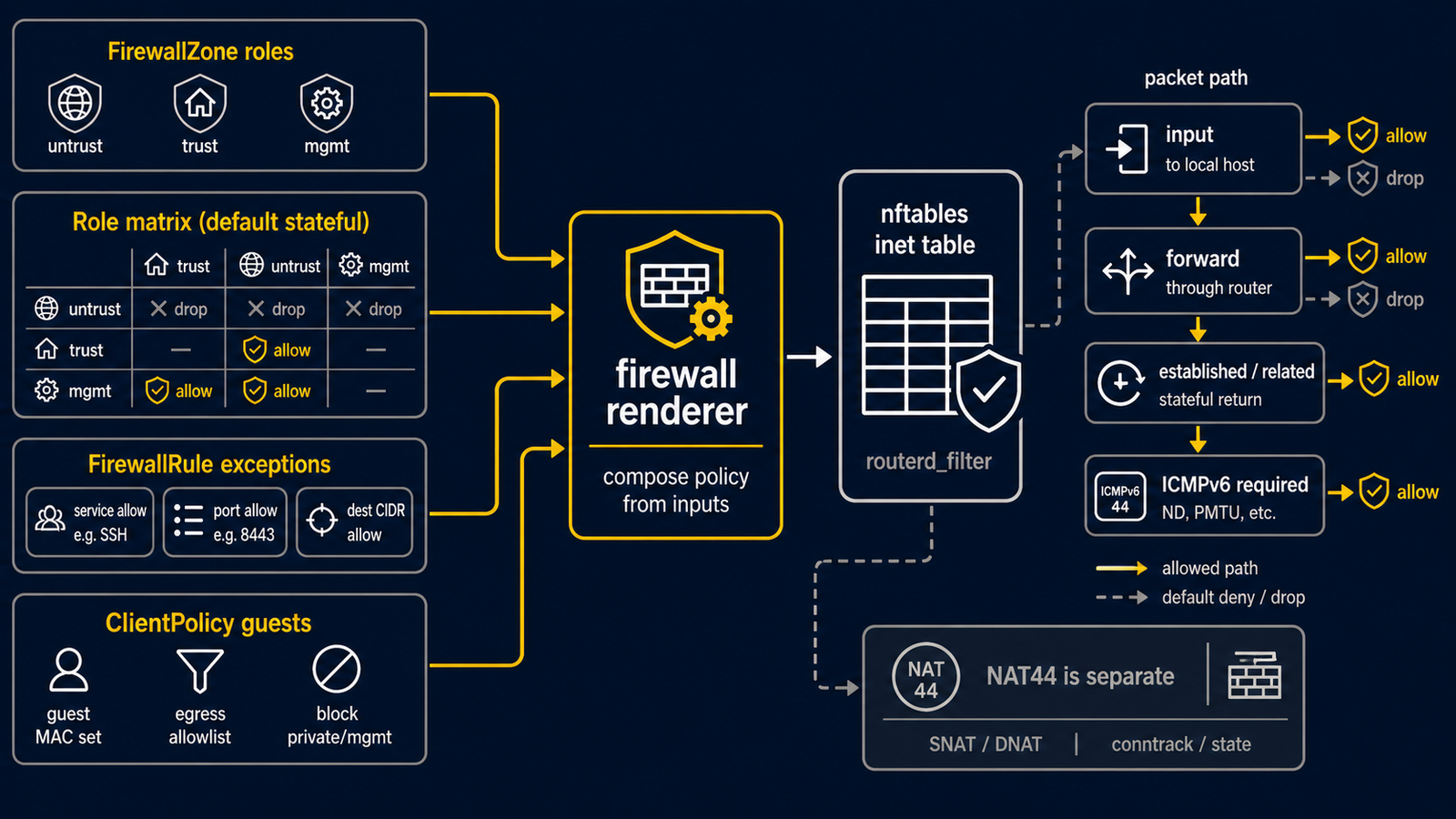
routerd manages a stateful nftables filter table named inet routerd_filter.
The firewall model has four resource kinds:
FirewallZoneassigns interfaces to a named zone and gives that zone a role.FirewallPolicysets global behavior such as deny logging.FirewallRuleadds explicit exceptions to the role matrix.ClientPolicyclassifies LAN clients by MAC address for guest isolation.
The supported roles are untrust, trust, and mgmt. Zone names describe
topology, such as wan, lan, or management. Roles describe policy.
The implicit matrix is:
| From | To self | To mgmt | To trust | To untrust |
|---|---|---|---|---|
mgmt | accept | accept | accept | accept |
trust | accept | drop | accept | accept |
untrust | drop | drop | drop | drop |
The generated rules always accept established and related connections, loopback
traffic, and required ICMPv6 traffic. Controllers also derive internal openings
for routerd-managed services such as DHCPv6 prefix delegation, DS-Lite,
dnsmasq DHCP service, and routerd-dns-resolver.
The firewall table is separate from NAT. NAT44 continues to use ip routerd_nat.
Rule expressions
FirewallRule supports CIDR source/destination matches, reusable
IPAddressSet destination references, TCP/UDP sourcePorts and
destinationPorts, ICMP / ICMPv6 type names, nftables rateLimit, and
per-source connLimit. rateLimit and connLimit match over-limit traffic,
so they are usually paired with drop or reject rules for dampening scans or
brute-force attempts.
Guest client isolation
ClientPolicy is a MAC-based guest mode for shared LAN segments. It is meant
for the case where trusted and guest devices receive addresses from the same
DHCP server, but guest devices must not reach private networks.
The policy has two modes:
| Mode | Behavior |
|---|---|
include | Listed MAC addresses are guests. All other clients remain trusted. |
exclude | Listed MAC addresses are trusted. All other clients on the target interfaces are guests. |
ClientPolicy.spec.macs is the short form for the common case. interfaces
can be omitted when the policy should target every interface in a trust
FirewallZone. spec.isolation provides readable intent for guest mode:
internet, LAN, management, and local discovery can be allowed or denied without
hand-writing CIDR lists.
Guest clients can use the router's local DNS, DHCP, and NTP services. By
default they cannot forward traffic to 10.0.0.0/8, 172.16.0.0/12,
192.168.0.0/16, or fc00::/7. Global internet egress still follows the
normal zone matrix and route policy.
ClientPolicy is implemented by the Linux nftables renderer with Ethernet
source address sets. FreeBSD pf cannot provide that MAC/L2 matching model in
the routed filter path. On FreeBSD, routerd instead renders IPv4 rules from a
DHCPv4Reservation and IPv6 rules only from explicit
classification[].ipv6Addresses. It never derives IPv6 identity from a MAC or
IPv4 reservation. This preserves a safe, address-based guest-deny model but
does not cover privacy or otherwise unlisted IPv6 addresses; use separate
network segmentation when that is required.
Logging
When FirewallPolicy.spec.logDeny is true and a FirewallEventLog resource is
enabled, generated nftables rules log denied packets to the configured NFLOG
group. On Linux, routerd-firewall-logger reads that group directly through
nfnetlink and stores rows in firewall-logs.db. This keeps NFLOG prefixes,
interfaces, packet family, protocol, addresses, and ports without running a
separate packet capture process.
The Web Console Firewall tab and routerctl get firewall-logs read from that
database. When FirewallEventLog.spec.enabled is true, routerd derives the
routerd-firewall-logger service artifact and passes the configured database
path and NFLOG group to it.
For accepted-flow DPI observation, set FirewallEventLog.spec.log.copyRange to cap
the NFLOG payload copied from each packet. Values such as 1536 or 2048
bytes keep the first payload visible for TLS/HTTP/DNS classification without
copying full packets into user space.