Log Storage
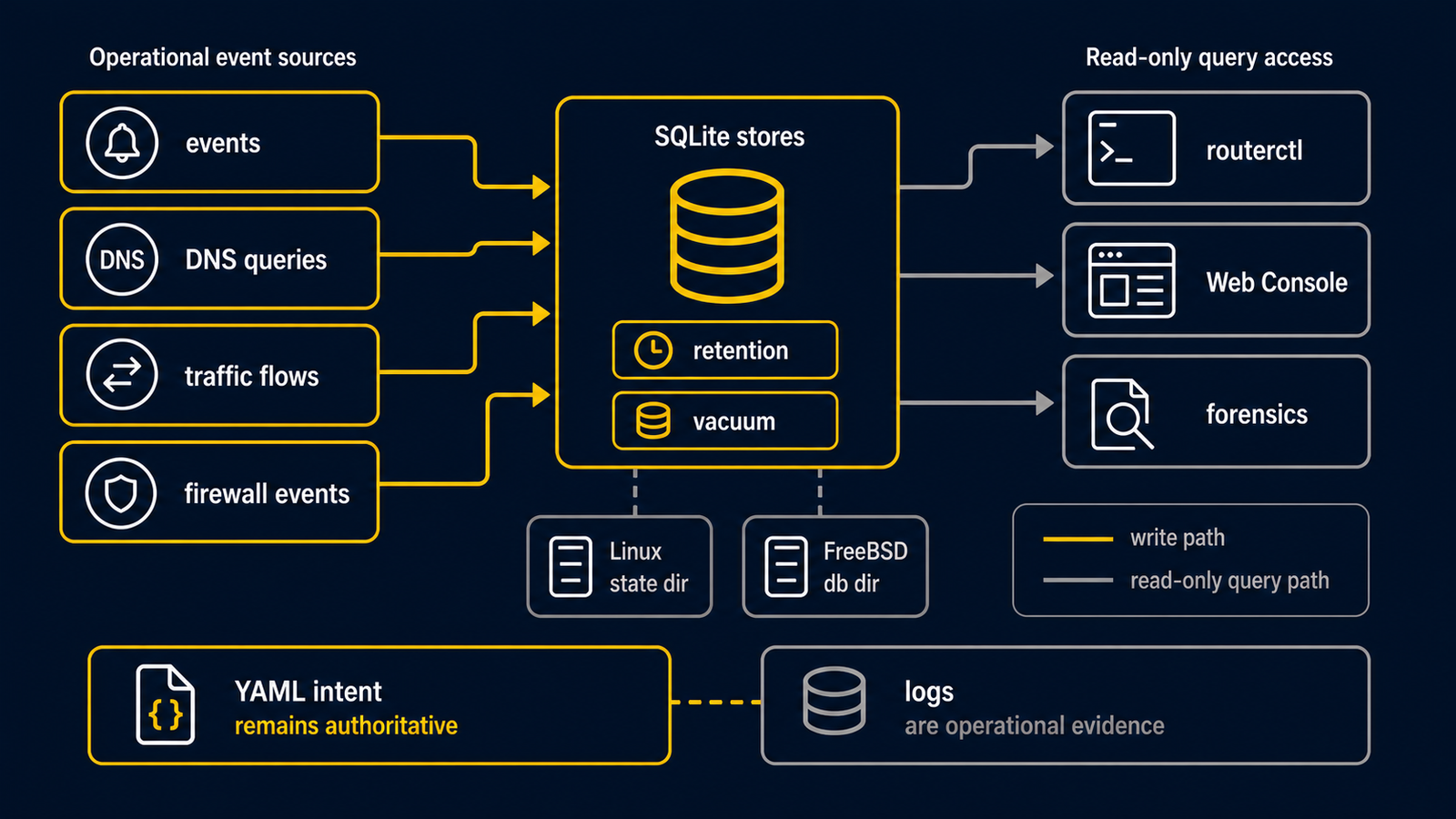
routerd keeps long-lived state separate from operational logs.
The Linux default layout is:
| File | Purpose | Typical retention |
|---|---|---|
/var/lib/routerd/routerd.db | resource state plus event, access-log, and plugin-run log tables | events: 24 hours by default; explicit policy for other log tables |
/var/lib/routerd/dns-queries.db | DNS query rows from routerd-dns-resolver | 30 days |
/var/lib/routerd/traffic-flows.db | conntrack-derived traffic flows | 30 days |
/var/lib/routerd/firewall-logs.db | firewall accept/drop/reject rows | 90 days |
/var/lib/routerd/dhcp-fingerprints.db | DHCP client fingerprint observations | 30 days |
FreeBSD keeps the same database names under /var/db/routerd.
The log tables use column names that can be mapped to OpenTelemetry log
attributes. nDPI and TLS SNI columns are reserved in traffic-flows.db, even
when no writer fills them yet.
The event journal has an always-on safety bound even when no LogRetention
resource is configured. routerd keeps at most 24 hours, 100,000 rows, and 64
MiB of logical event payload; the first limit reached wins. Old events are
removed in batches and state tables are never included. This bound protects
small Live ISO COW filesystems and is not a substitute for archival retention.
LogRetention is the configurable local SQLite retention policy. It removes old rows
by signal and can run SQLite incremental vacuum. It no longer exposes database
paths or per-writer retention in user config; routerd derives the event, DNS
query, traffic flow, firewall event, DHCP fingerprint, access-log, and
plugin-run stores from the
registered log-table catalogue. New operational log tables must register their
signal and timestamp column in that catalogue before they can be retained.
dhcp-sticky.db, lease replication data, configuration generations, and
federation state are operational state, not logs. They are intentionally not
eligible for LogRetention, because deleting them can change router behaviour.
Specify LogRetention.spec.sinks to archive rows to named LogSink resources
before local deletion. A failed archive prevents deletion, so the local copy is
not removed before the external destination acknowledges it.
apiVersion: system.routerd.net/v1alpha1
kind: LogRetention
metadata:
  name: default
spec:
  retention: 30d
  schedule: daily
  vacuum: true
  signals:
    - events
    - accessLogs
    - pluginRuns
    - dnsQueries
    - trafficFlows
    - dhcpFingerprints
  sinks:
    - LogSink/local-syslog
---
apiVersion: system.routerd.net/v1alpha1
kind: LogRetention
metadata:
  name: firewall-events
spec:
  retention: 90d
  schedule: daily
  vacuum: true
  signals:
    - firewallEvents
Inspection commands:
routerctl get dns-queries --limit 100
routerctl get traffic-flows --limit 100
routerctl get firewall-logs --limit 100
routerctl doctor disk
If SQLite reports a full filesystem, routerd keeps locally-derived runtime
events flowing without requiring their forensic journal write to succeed. It
marks the overall status Degraded, exposes EventJournalReadOnly in runtime
statistics and routerctl doctor, writes
/run/routerd/storage-critical.json, and updates systemctl status routerd.
For a volatile Live ISO overlay, reboot the router OS to clear the COW layer,
then verify the configured retention. On persistent storage, rebooting alone
does not free space: prune or compact the journal, or expand/move the state
filesystem.