Sysctl profile
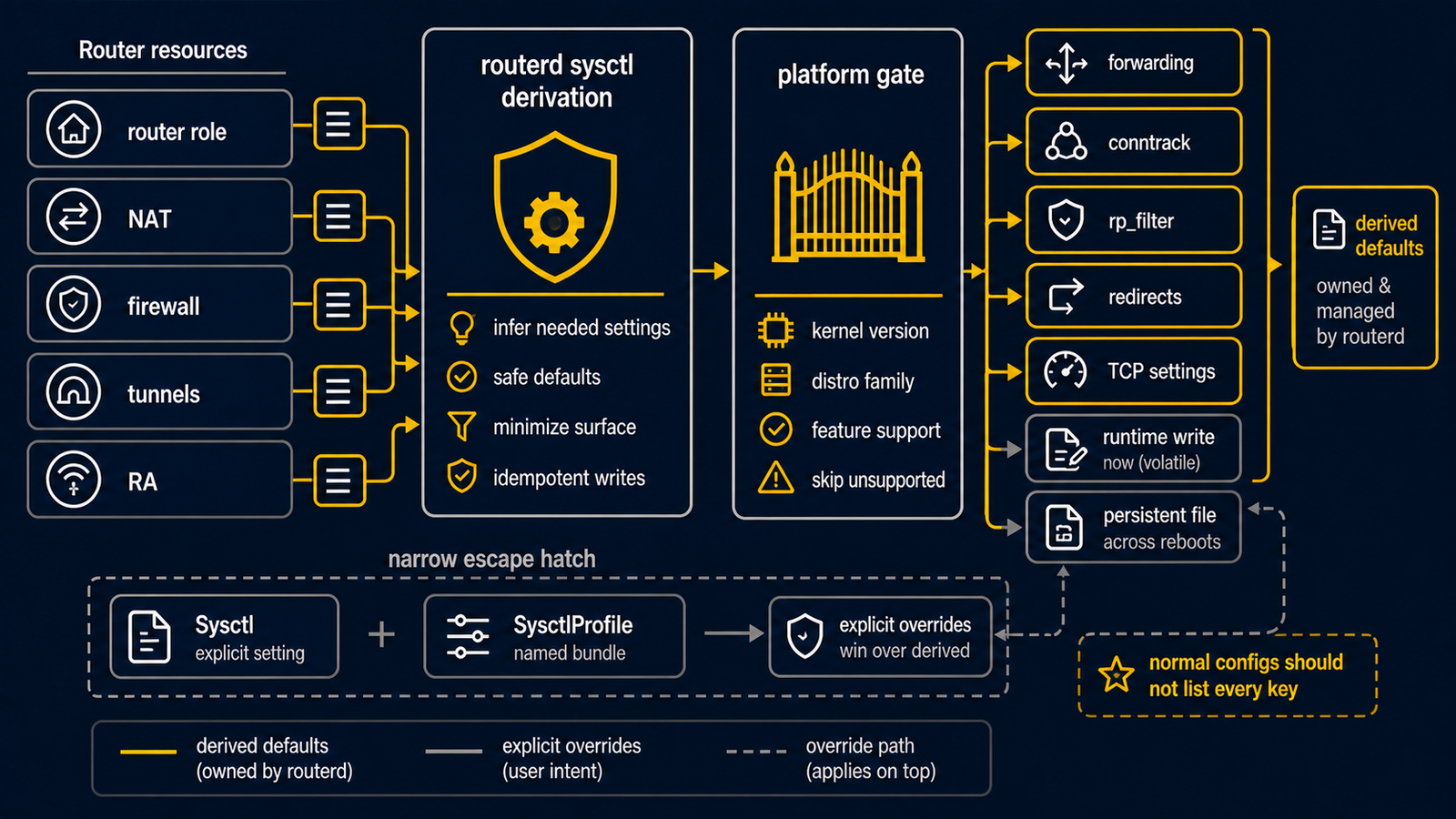
routerd derives the Linux router sysctl set from router resources.
Normal home-router configs should not list SysctlProfile or many individual
Sysctl entries. NAT, DS-Lite, BGP, IPv6 prefix delegation, RA, and LAN service
resources imply the forwarding, redirect, reverse-path-filter, conntrack, TCP,
and per-interface RA settings they need.
Sysctl and SysctlProfile remain as narrow escape hatches for hardware,
kernel, or distribution-specific settings that routerd cannot yet derive. Treat
such entries as implementation overrides, not as the main way to describe router
intent.
runtime: true writes immediately to the running kernel when the controller
chain is serving. persistent: true writes a persistent file under
/etc/sysctl.d/. routerctl apply mutates only explicit Sysctl and
SysctlProfile resources; derived sysctls are rendered and planned there, then
applied by routerd serve.
Use overrides only when you intentionally keep an explicit profile escape
hatch.
spec:
  profile: router-linux
  overrides:
    net.netfilter.nf_conntrack_max: "524288"
routerd reads the current value before writing. If the current value already satisfies the expectation, routerd does not write — and does not emit an apply event for that key.
Some sysctl values are rounded up by the kernel.
For those, use compare: atLeast.
value is what routerd writes; expectedValue is what routerd accepts on read-back.
If expectedValue is omitted, value is used.
Each explicit sysctl key may be declared by only one Sysctl resource.
Validation rejects duplicate keys even when their values match, avoiding
order-dependent runtime and persistent writes.
apiVersion: system.routerd.net/v1alpha1
kind: Sysctl
metadata:
  name: socket-buffer
spec:
  key: net.core.rmem_max
  value: "16777216"
  expectedValue: "16777216"
  compare: atLeast
  runtime: true
Values in the router-linux profile
| Key | Value | Reason |
|---|---|---|
net.ipv4.ip_forward | 1 | Enable IPv4 forwarding. |
net.ipv4.conf.all.forwarding | 1 | Enable per-interface IPv4 forwarding. |
net.ipv4.conf.all.rp_filter | 0 | Prevent reverse-path filtering from dropping return traffic for policy routing or DS-Lite tunnels. |
net.ipv4.conf.default.rp_filter | 0 | Same, applied to interfaces created later (e.g. tunnels). |
net.ipv4.conf.all.send_redirects | 0 | Do not emit ICMP redirects from the router. |
net.ipv4.conf.default.send_redirects | 0 | Same, applied to interfaces created later. |
net.ipv4.conf.all.src_valid_mark | 1 | Allow fwmark-based routing decisions to participate in reverse-path validation. |
net.ipv6.conf.all.forwarding | 1 | Enable IPv6 forwarding. |
net.ipv6.conf.default.forwarding | 1 | Same, applied to interfaces created later. |
net.netfilter.nf_conntrack_acct | 1 | Enable per-flow packet/byte accounting; used by the Web Console client traffic view. Optional when conntrack is not loaded. |
net.netfilter.nf_conntrack_max | 262144 | Avoid table exhaustion under many devices and apps. Optional when conntrack is not loaded. |
net.netfilter.nf_conntrack_buckets | 65536 | Roughly nf_conntrack_max / 4. Optional — not all environments allow writing this. |
net.netfilter.nf_conntrack_tcp_timeout_established | 86400 | Reduce the default 5-day timeout to 24 hours (more appropriate for home routers). Optional when conntrack is not loaded. |
net.netfilter.nf_conntrack_udp_timeout | 30 | Shorten one-shot UDP retention. Optional when conntrack is not loaded. |
net.netfilter.nf_conntrack_udp_timeout_stream | 180 | Set sustained UDP retention to 3 minutes. Optional when conntrack is not loaded. |
net.core.rmem_max | 16777216 | Cap socket receive buffers at 16 MiB. |
net.core.wmem_max | 16777216 | Cap socket send buffers at 16 MiB. |
net.ipv4.tcp_rmem | 4096 87380 16777216 | Widen the TCP receive autotuning range. |
net.ipv4.tcp_wmem | 4096 65536 16777216 | Widen the TCP send autotuning range. |
net.core.netdev_max_backlog | 5000 | Reduce drops on short receive bursts. |
net.core.somaxconn | 4096 | Set an explicit listen backlog ceiling. |
net.ipv4.ip_local_port_range | 1024 65535 | Widen the ephemeral port range used by the router itself. |
net.ipv4.tcp_fin_timeout | 30 | Shorten FIN-WAIT-2 retention. |
net.ipv4.tcp_mtu_probing | 1 | Let TCP fall back to smaller segments when path-MTU notifications are blackholed. |
net.ipv4.tcp_tw_reuse | 1 | Allow reuse of TIME-WAIT sockets. |
net.ipv6.route.max_size | 16384 | Raise the IPv6 route cache ceiling. |
net.ipv4.route.max_size is no longer effective on some recent Linux kernels and is not set by the default profile.
If you need it, add it as a discrete Sysctl (not via overrides) and verify on the target host first.
30 seconds is the Linux conntrack default for unreplied UDP flows and is also
routerd's profile default. On busy home routers, 60 seconds can be a better
operational override when short UDP flows are being correlated with firewall
denies or DPI observations:
spec:
  profile: router-linux
  overrides:
    net.netfilter.nf_conntrack_udp_timeout: "60"
Kernel Modules
SysctlProfile expects the relevant kernel subsystems to exist. routerd derives
kernel module loading from resources such as NAT, firewall logging, traffic flow
logging, and WireGuard. KernelModule is no longer a user-facing config kind;
if a module is missing from the derived set, fix the derivation instead of
adding implementation-specific YAML.
When to use a discrete Sysctl
Use a discrete Sysctl only for a setting that is truly outside routerd's
derived model. Per-interface router needs such as DS-Lite tunnel
rp_filter=0, WAN/LAN accept_ra=2, and LAN send_redirects=0 are derived
from resources and should not appear in normal configs.
Example escape hatch for a lab kernel that needs a temporary socket-buffer override:
apiVersion: system.routerd.net/v1alpha1
kind: Sysctl
metadata:
  name: lab-rmem-max
spec:
  key: net.core.rmem_max
  value: "33554432"
  compare: atLeast
  runtime: true
  persistent: true