Plugin protocol
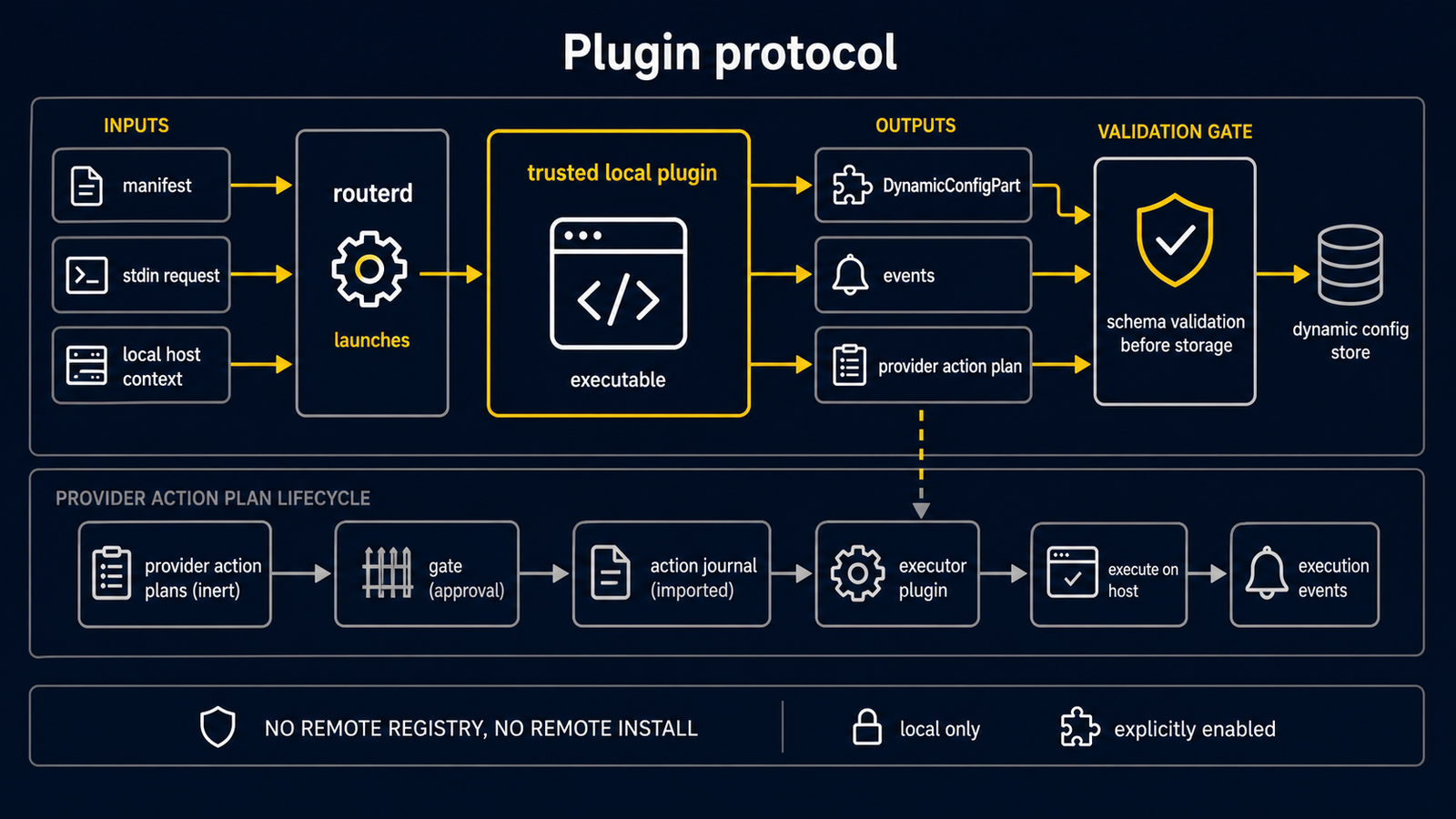
routerd plugins are trusted local executables. The plugin mechanism lets you add resource-specific behaviour as a small program on the same host, without modifying the routerd binary.
Remote plugin registration, remote installation, and a public plugin registry are intentionally out of scope.
Layout
The default install path is:
/usr/local/libexec/routerd/plugins/<name>/
Each plugin has a manifest and an executable:
plugin.yaml
bin/<plugin>
Responsibilities
A plugin can take part in:
- Resource validation
- Plan generation
- Host state observation
- Host state application
Operations that mutate network state should be split into testable units. As with the main code base, tests that touch real host networking should run inside isolated network namespaces (see tests/netns).
MVP policy
For the CloudEdge MVP, plugins are trusted local executables only. routerd does not fetch plugins from a remote registry or install plugins remotely.
Plugin output is always validated before it is stored as dynamic-config or used
to derive effective-config. A plugin can propose resources, directives,
provider action plans, and events. actionPlans are inert inside dynamic-config
and are never executed by the plugin runner or merge path. They can be imported
into the provider-action journal and handed to an executor plugin only after
ProviderActionPolicy, approval, allowlist, and dry-run/live mode gates pass.
Resource shapes
A plugin is declared as a local executable and optional trigger set:
apiVersion: plugin.routerd.net/v1alpha1
kind: Plugin
metadata:
  name: oci-inventory
spec:
  executable: /usr/local/libexec/routerd/plugins/oci-inventory/bin/oci-inventory
  timeout: 10s
  capabilities: [observe.cloud, propose.dynamicConfig]
  triggers:
    - type: interval
      every: 300s
    - type: event
      topic: routerd.cloud.oci.refresh
A dynamic config source binds a plugin to dynamic-config production policy:
apiVersion: plugin.routerd.net/v1alpha1
kind: DynamicConfigSource
metadata:
  name: oci-inventory
spec:
  pluginRef: oci-inventory
  ttl: 300s
  mergePolicy:
    conflict: reject
The runner requires spec.executable to be an absolute executable file. Plugin
capabilities are currently observe.cloud, observe.providerPrivateIPs,
propose.dynamicConfig, propose.providerAction, and
execute.providerAction. Interval triggers use every; event triggers use
topic.
Triggers
Plugins run from explicit triggers:
| Trigger | Meaning |
|---|---|
interval | Periodic refresh, usually for inventory or lease-like observations. |
event | Event-bus driven refresh for a named topic. |
The PluginRequest.spec.trigger field records the actual trigger for one
invocation. trigger.type is interval or event; trigger.topic is set for
event-triggered invocations.
I/O contract
routerd starts the plugin executable, writes one PluginRequest JSON object to
stdin, and expects one PluginResult JSON object on stdout. Timestamps use
RFC3339. Duration strings use Go-style duration syntax such as 300s.
The child process receives a minimal environment: PATH from routerd's
environment, or a fixed system fallback if PATH is unset, plus explicit
Plugin.spec.env entries. routerd does not pass through the full parent
environment.
PluginRequest
{
  "apiVersion": "plugin.routerd.net/v1alpha1",
  "kind": "PluginRequest",
  "metadata": {
    "name": "oci-inventory"
  },
  "spec": {
    "trigger": {
      "type": "interval",
      "topic": ""
    },
    "startupConfigHash": "sha256:...",
    "effectiveGeneration": 44,
    "previousDynamicGeneration": 12,
    "now": "2026-05-29T12:00:00Z"
  }
}
| Field | Meaning |
|---|---|
spec.trigger | Why this plugin invocation happened. |
spec.startupConfigHash | Digest of the current startup-config. |
spec.effectiveGeneration | Current effective-config generation before this result. |
spec.previousDynamicGeneration | Last accepted generation for this source. |
spec.now | routerd's invocation timestamp. |
PluginResult
{
  "apiVersion": "plugin.routerd.net/v1alpha1",
  "kind": "PluginResult",
  "metadata": {
    "name": "oci-inventory"
  },
  "status": {
    "observedAt": "2026-05-29T12:00:00Z",
    "ttl": "300s",
    "resources": [
      {
        "apiVersion": "net.routerd.net/v1alpha1",
        "kind": "IPv4Route",
        "metadata": { "name": "cloud-app-static-fallback" },
        "spec": { "destination": "10.0.1.123/32", "gateway": "192.0.2.1" }
      }
    ],
    "directives": [
      {
        "op": "mask",
        "target": {
          "apiVersion": "net.routerd.net/v1alpha1",
          "kind": "IPv4Route",
          "name": "cloud-app-static-fallback"
        },
        "reason": "provider inventory confirms the dynamic route"
      }
    ],
    "actionPlans": [
      {
        "name": "assign-cloud-secondary-ip",
        "provider": "oci",
        "action": "assign-secondary-ip",
        "target": {
          "nicRef": "ocid1.vnic.oc1..example",
          "address": "10.0.1.123"
        },
        "undo": {
          "action": "unassign-secondary-ip"
        }
      }
    ],
    "events": [
      {
        "type": "InventoryObserved",
        "message": "observed app private address",
        "attributes": {
          "provider": "oci",
          "address": "10.0.1.123"
        }
      }
    ]
  }
}
routerd decodes plugin stdout with YAML decoding, even when the plugin emits
JSON, so resource specs are restored to typed routerd structs. It validates the
plugin result shape, stores accepted output as a DynamicConfigPart, and derives
expiresAt from observedAt + ttl. Full effective-config validation, including
dynamic override policy evaluation, happens when dynamic parts are merged with
startup config.
actionPlans describe provider operations an operator may choose to import into
the provider-action journal. The plugin result itself must stay a dry-run plan;
mode: execute is rejected. Live provider mutation, when used, happens only via
routerctl action execute --approved or the daemon auto-execution gate, and the
executor plugin receives no routerd-held secrets.
ObservePrivateIPsResult
Plugins with observe.providerPrivateIPs return
providerinventory.routerd.net/v1alpha1 ObservePrivateIPsResult objects. The
legacy status.ips field remains wire-compatible and is treated as observed
candidate addresses for ownership-discovery events. New plugins should also set
status.localIPs to the authoritative local provider inventory for the scanned
VPC/VNet/VCN or subnet, including VM NIC and private-endpoint addresses before
routerd applies trap exclusions or ownership selectors. If localIPs is absent,
routerd falls back to observedCandidates and then ips.
status.observedCandidates can be used when a plugin wants to return a narrower
event-emission candidate set while still exposing the full local inventory in
localIPs. SAM uses that local inventory only to establish the router's own
NIC, private-IP, and trusted-subnet scope. Durable ownership facts are emitted
from the filtered observedCandidates set, or legacy ips when candidates are
not supplied.
Each private-IP record should set resourceRef to the owning compute instance
ID when the provider can report it, and resourceType to distinguish router
NICs from ordinary instance NICs or private endpoints. status.self may also
set resourceRef/resourceType for the local router instance. SAM uses this
identity to distinguish a secondary IP captured onto the router instance from a
real home client address on the same provider subnet.
CLI
The MVP operator commands are:
routerctl plugin list [--config <startup>] [-o table|json|yaml]
routerctl plugin run <name> [--dry-run] [--config <startup>] [--state-file <db>] [-o table|json|yaml]
routerctl action import|list|show|approve|execute|journal|rollback ...
plugin run --dry-run executes the plugin and prints the candidate
DynamicConfigPart without writing state. Without --dry-run, routerctl records
the plugin run and stores the validated dynamic part in the local state
database.
Current status
The main router features are advanced inside the routerd binary and its managed daemons. The plugin protocol is the safe foundation for site-local extensions; the manifest format and the I/O contract may still change before the protocol is frozen as a stable public surface.
See also Hybrid cloud edge design and Dynamic config reference.