Dynamic config
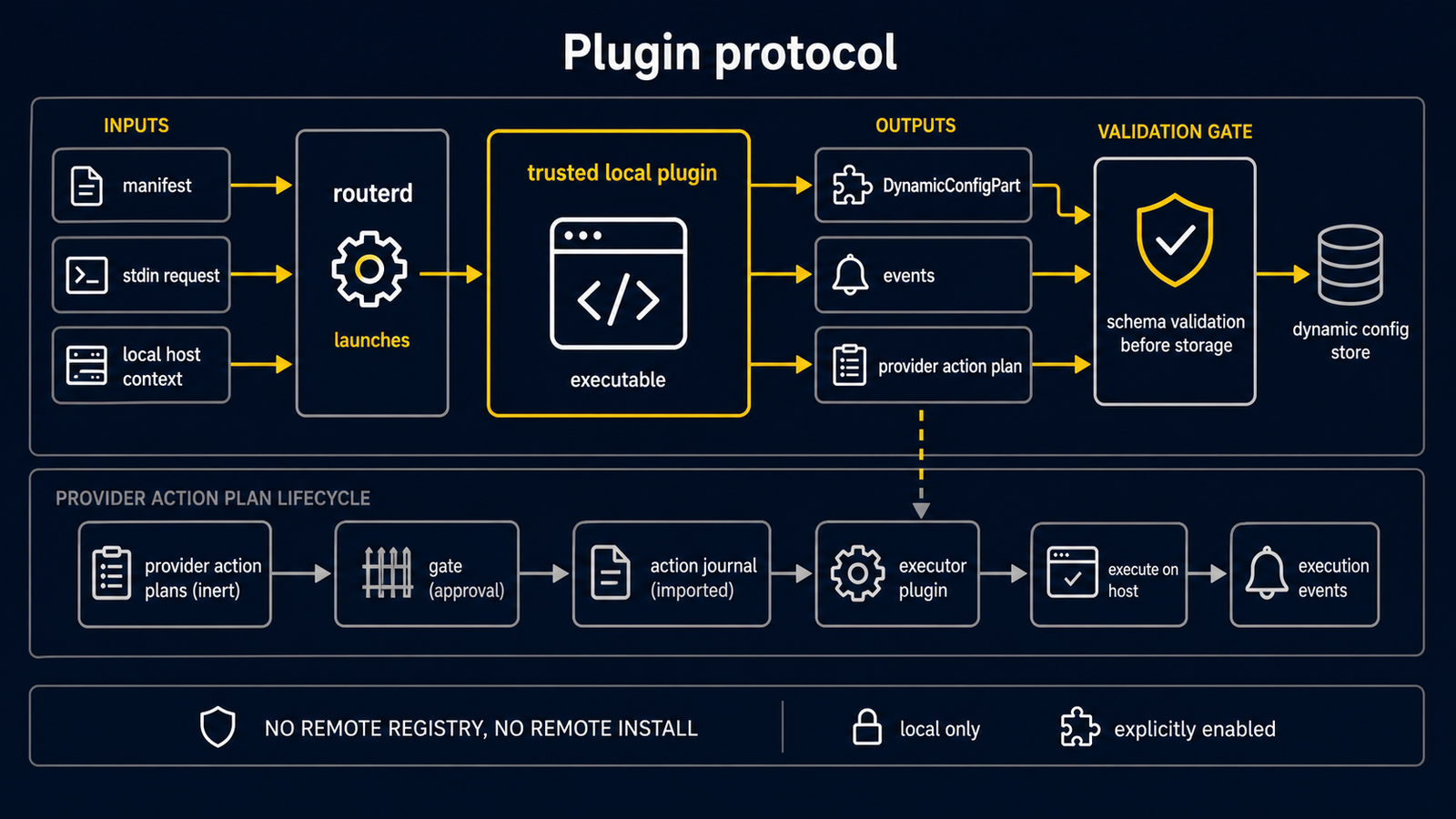
Dynamic config lets trusted local sources contribute runtime intent without editing startup-config. routerd derives one effective-config from startup YAML, active dynamic parts, and active masks. Effective-config is the only reconcile target.
This page documents the dynamic-config API shape for the CloudEdge MVP. The
plugin runner can store validated plugin output as DynamicConfigPart records;
provider actions from actionPlans remain inert inside dynamic config and are
not merged into effective config. The separate provider-action engine can import
them into its journal and execute them only through ProviderActionPolicy,
approval, and executor-plugin gates.
DynamicConfigPart
DynamicConfigPart is one validated runtime fragment from a dynamic source.
The source can contribute normal api.Resource objects and directives. Mobility
controllers additionally persist the typed mobilityDataplane plan,
fibVerdicts, and fact-side arpObserverIntents; those are controller-owned
outputs, not plugin-authored resources.
apiVersion: config.routerd.net/v1alpha1
kind: DynamicConfigPart
metadata:
  name: oci-inventory
spec:
  source: Plugin/oci-inventory
  generation: 12
  observedAt: "2026-05-29T12:00:00Z"
  expiresAt: "2026-05-29T12:05:00Z"
  digest: sha256:...
  resources:
    - apiVersion: net.routerd.net/v1alpha1
      kind: IPv4Route
      metadata: { name: cloud-app-static-fallback }
      spec: { destination: 10.0.1.123/32, gateway: 192.0.2.1 }
  directives:
    - op: mask
      target: { apiVersion: net.routerd.net/v1alpha1, kind: IPv4Route, name: cloud-app-static-fallback }
      reason: "provider inventory confirms the dynamic route"
| Field | Meaning |
|---|---|
spec.source | Stable source identity, for example Plugin/oci-inventory. |
spec.generation | Monotonic source generation for explanation and ordering. |
spec.observedAt | RFC3339 time when the source observed the input. |
spec.expiresAt | RFC3339 time after which the part is inactive. |
spec.digest | Digest of the validated part payload. |
spec.resources | Resources contributed to effective-config while active. |
spec.directives | Merge directives, currently only op: mask. |
spec.actionPlans | Provider action proposals. They are not resources; the provider-action engine imports only active parts and applies its own gates before execution. |
Plugins return a TTL duration in PluginResult.status.ttl; routerd resolves it
against observedAt into the stored expiresAt.
DynamicConfigSource
DynamicConfigSource is startup-config policy that binds one plugin to dynamic
config production.
apiVersion: plugin.routerd.net/v1alpha1
kind: DynamicConfigSource
metadata: { name: oci-inventory }
spec:
  pluginRef: oci-inventory
  ttl: 300s
  mergePolicy:
    conflict: reject
The MVP merge policy supports only conflict: reject.
DynamicConfigDirective
The MVP supports one directive operation:
| Operation | Meaning |
|---|---|
mask | Suppress one matching startup-config resource while the directive is active. |
A directive target is identified by apiVersion, kind, and name. The
target is intentionally exact; wildcard masks are out of scope for the MVP.
DynamicOverridePolicy
DynamicOverridePolicy grants a source permission to use dynamic directives
against selected resources. A plugin can propose a mask, but the mask is active
only if policy allows that source, operation, and target.
apiVersion: config.routerd.net/v1alpha1
kind: DynamicOverridePolicy
metadata: { name: allow-cloud-plugin-mask }
spec:
  allow:
    - source: Plugin/oci-inventory
      operations: [mask]
      targets:
        - { apiVersion: net.routerd.net/v1alpha1, kind: IPv4Route, name: cloud-app-static-fallback }
Policy is startup-config intent. Dynamic sources do not grant themselves override permissions.
Merge Algorithm
The effective-config merge is deterministic:
- Load and validate startup-config.
- Load validated dynamic parts from the state database.
- Drop dynamic parts whose
expiresAtis at or before the merge time. - Sort active dynamic parts by
source, thengeneration, thenmetadata.namefor stable rendering and diagnostics. - Evaluate active directives against
DynamicOverridePolicy. - Mark startup resources targeted by allowed active masks as suppressed.
- Build effective-config from unsuppressed startup resources plus active dynamic resources.
- Validate the resulting effective-config before reconcile or dry-run output.
Conflict rules:
- A dynamic resource must not replace a startup resource with the same
apiVersion,kind, andmetadata.name. - Two active dynamic resources with the same identity conflict unless a later design defines source-specific ownership rules.
- A disallowed directive is ignored for merge and reported as a validation or diagnostic finding.
- Expired dynamic parts do not contribute resources or masks.
Mask Semantics
A mask suppresses; it does not delete. The startup YAML remains unchanged, git history remains operator-owned, and the static resource becomes active again when every matching active mask expires or is removed.
Suppressed resources should surface status similar to:
status:
  phase: Suppressed
  maskedBy:
    - Plugin/oci-inventory#12
  maskedUntil: "2026-05-29T12:05:00Z"
When multiple masks target the same resource, the resource remains suppressed
until the last active mask expires. maskedBy lists every active source and
generation. maskedUntil is the latest expiresAt among active masks.
The MVP expiry behavior is onExpire=restoreStatic: when a mask expires,
routerd restores the startup-config resource to effective-config during the
next merge. There is no destructive cleanup step because no startup resource was
modified.
CLI
The current operator surface is:
routerctl dynamic list
routerctl dynamic describe <source-or-part>
routerctl dynamic render
routerctl dynamic diff
routerctl plugin list
routerctl plugin run <name> [--dry-run]
dynamic list shows active and expired parts. dynamic describe explains
source, generation, digest, resources, directives, and expiry. dynamic render
prints effective-config. dynamic diff compares startup-config to
effective-config. plugin run --dry-run prints a candidate dynamic part without
writing the state database.
See Hybrid cloud edge design and Plugin protocol.