DHCPv6-PD client implementations and how to choose

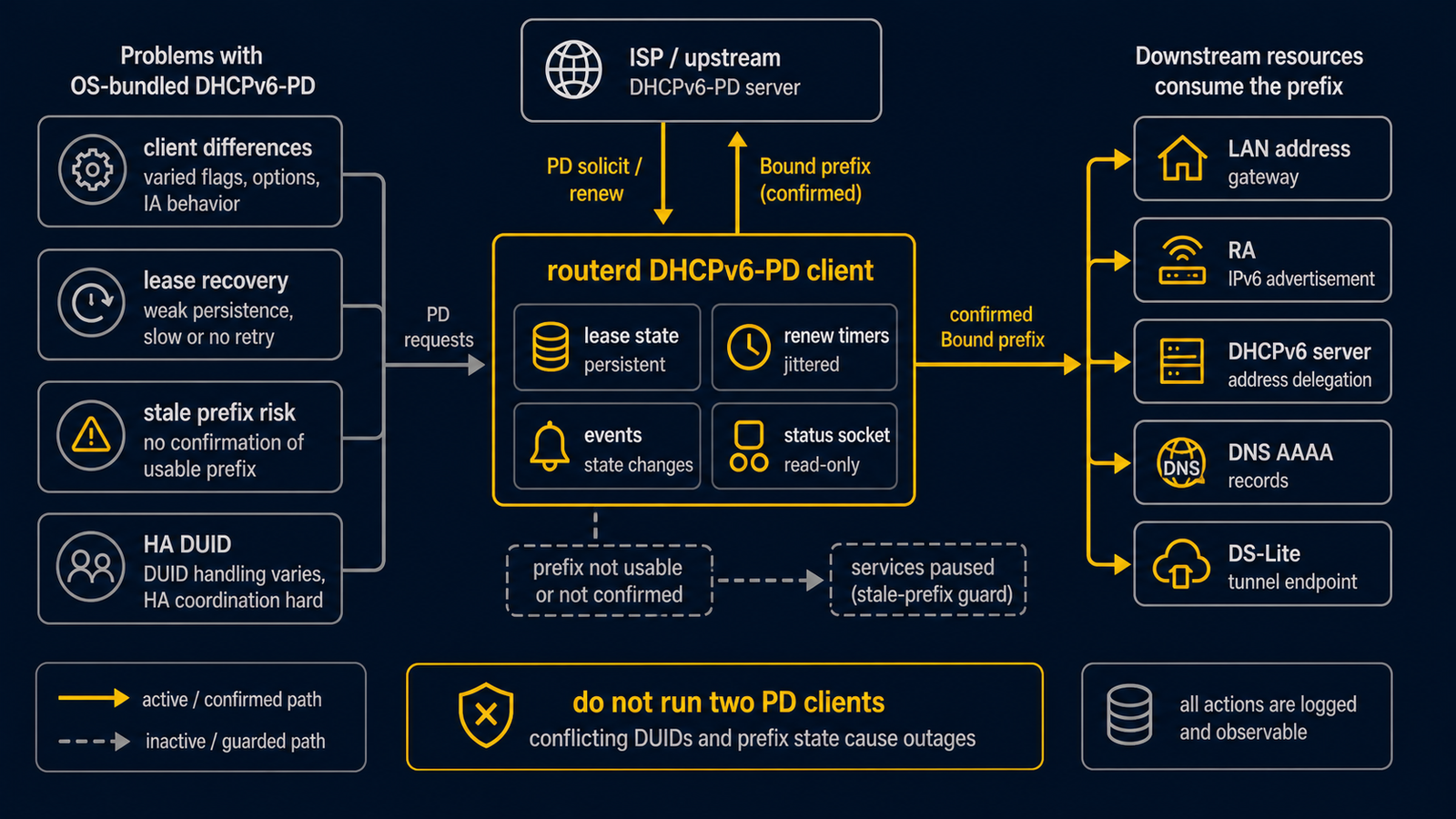
routerd delegates WAN-side DHCPv6 Prefix Delegation to the operating system's DHCPv6 client. This page summarises lab observations from a NTT FLET'S Hikari Next + PR-400NE home gateway deployment, the differences between client implementations seen there, and why routerd's NTT profiles recommend KAME/WIDE dhcp6c.

Comparison

ImplementationLicenceUpstream statusBehaviour under NTT NGN
KAME/WIDE dhcp6c (wide-dhcpv6-client / net/dhcp6)BSD-styleUpstream wide-dhcpv6 stopped at 2008-06-15. Distros patch-maintain. The opnsense/dhcp6c fork is BSD-3 and activeCarries IA Prefix lifetimes from the previous Reply into Renew/Rebind. Sends packet shapes similar to NEC IX commercial routers
systemd-networkdLGPL-2.1+ActiveHas been observed to send Renew/Rebind with IA Prefix pltime=0 vltime=0 (systemd issue #16356). NTT HGW silently drops these as a "release-like" signal
dhcpcdBSD 2-clauseActiveHandles IPv4/RA/DHCPv6/PD in one daemon. Lab tests show its Solicit includes Vendor-Class and ORO codes (e.g. opt_82, opt_83), so it is not the minimal shape that proves to work
odhcp6cGPL-2.0Active under the OpenWrt project, rarely packaged outside OpenWrtWidely used in OpenWrt. NTT FLET'S Cross (10G Hikari) deployments report eight-hour disconnections (OpenWrt issue #13454). Needs more validation under PR-400NE

Behaviour of NTT home gateways (PR-400NE family)

From lab observations and public documentation, the working model is:

  1. Acquisition window after reboot. After a HGW reboot the LAN-side DHCPv6 server takes a few minutes to begin answering fresh Solicits. Once ready, even the minimal Solicit form gets Advertise/Reply quickly.
  2. Renew/Request always honoured during normal uptime. Renew packets that include the Server Identifier and the existing IA_PD Prefix are answered by the HGW regardless of time. This was confirmed by observing a NEC IX router refresh its lease at the T1 boundary.
  3. pltime=0 vltime=0 IA Prefix is silently dropped. The HGW treats this as the client indicating it no longer wants the prefix. systemd-networkd has been observed sending Renew with pltime=0 vltime=0 and getting no Reply.
  4. Reply source UDP port is ephemeral. Advertise/Reply arrives at UDP destination 546 but the source port is not 547 (observed example: 49153). Captures filtered on udp port 547 alone miss the responses; use udp port 546 or udp port 547.

Failure modes

SymptomWhere to lookLikely cause
Solicit gets no reply right after HGW rebootAcquisition window not yet openHGW still preparing. Wait a few minutes and re-evaluate
Solicit gets no reply during normal uptimeSolicit has no Server IdentifierClient lost its lease state. Recovery typically requires a HGW reboot to reopen the acquisition window
Renew gets no reply during normal uptimeRenew with Server Identifier present, but no ReplyInspect IA_PD Prefix lifetimes. If pltime:0 vltime:0 then the client is silently dropped
HGW lease table has the MAC but the LAN side has no prefixOS-side lease pickup is brokenExample: networkd + netplan logging Could not set DHCP-PD address: Invalid argument

How routerd handles this

  • The default Linux client is systemd-networkd. NTT profiles (ntt-ngn-direct-hikari-denwa, ntt-hgw-lan-pd) recommend IPv6PrefixDelegation.spec.client: dhcp6c so that KAME/WIDE dhcp6c is used instead.
  • FreeBSD always uses dhcp6c from net/dhcp6. Base dhclient does not handle DHCPv6-PD.
  • routerd apply preserves the OS DHCPv6 client's in-memory lease. Services are not restarted unless rc.conf or drop-in files actually change.
  • Observability does not treat a derived LAN address as proof of a healthy PD lease. Last Reply timestamp, OS client lease state, and routerctl describe ipv6pd/<name> output are the planned sources of truth.

2026-04-30 lab findings (PR-400NE, sustained uptime)

A multi-VM lab session against a continuously running PR-400NE produced the following evidence-graded notes. They expand on the points above and motivate a separate page on the bootstrap path: see NTT NGN HGW PD acquisition under sustained uptime.

  • observe: 34 distinct Solicit variants (OUI sweep, Vendor-Class, User-Class, hop-limit and flow-label permutations, prefix hint with and without IA address, RS→RA→Solicit ordering, retransmit cadence variants) all failed against a HGW that had not been rebooted recently. None received Advertise or Reply.
  • observe: At the same instant, a NEC IX2215 on the same LAN refreshed its existing lease on every T1 boundary (11/11 successes during the test window). The HGW's DHCPv6 server is therefore healthy; only the new-binding path is blocked.
  • believe: The HGW separates an "acquisition window" (open for a few minutes after a HGW reboot, during which fresh Solicits are answered) from a "steady state" (during which only Renew/Request/Confirm/Information-Request with a known Server Identifier are answered). New Solicits in steady state are silently dropped.
  • measure: Sending a synthesised Request (msg-type 3) carrying the HGW's Server Identifier plus an IA_PD claim from a routerd lab VM produced an immediate Reply with a fresh /60 binding — confirming that the HGW does honour the RFC 8415 §18.2.10.1 INIT-REBOOT-style Request even when its Solicit path is blocked. See the dedicated page for transcripts.
  • assert: routerd's WAN profile must be able to drive Solicit, Request, Renew, Rebind, Release, Confirm and Information-Request directly. Stock OS clients limit themselves to the canonical Solicit→Advertise→Request bootstrap and cannot recover from this state without a HGW reboot. This is a primary motivation for the routerd active controller path described in docs/design-notes.md Section 5.2.

Renew acceptance hypothesis (2026-04-30)

Byte-level captures of three Renew implementations side by side support the following hypothesis. routerd should treat it as the working contract until contradicted.

  • observe: A unicast Renew (UDP 547 to the HGW global address) is always answered, but the answer is a status-code 5 (UseMulticast) Reply within ~4 ms. WIDE dhcp6c re-sends the same xid over multicast to ff02::1:2 and the HGW silently drops the retry — believed to be xid-replay suppression.
  • measure: A multicast Renew that succeeded (IX2215, 11/11) had: T1=7200, T2=12600, IA_PD carrying the bound prefix with non-zero pltime/vltime, the reconfigure-accept option (20), and a fresh xid.
  • measure: A multicast Renew that failed (WIDE dhcp6c after the UseMulticast bounce) had matching T1/T2 and IA_PD lifetimes but no reconfigure-accept option and the same xid as the failed unicast attempt.
  • measure: A multicast Renew that failed (routerd active controller during the same session) had T1=0, T2=0, no reconfigure-accept and a fresh xid.
  • believe: The HGW's multicast Renew acceptance test is approximately "fresh xid AND non-zero T1/T2 AND reconfigure-accept option present". Any one of these missing causes silent drop. This must be re-validated by an ablation pass; until then, routerd sends Renew with all three.

DHCPv6 client implementation gotchas (2026-04-30)

  • WIDE dhcp6c sends Renew as unicast first when it has cached the server link-local address. Result: the UseMulticast bounce path above. routerd's profile sets dhcp6c to multicast Renew where possible, and treats unicast Renew as a deprecated path.
  • WIDE dhcp6c does not include reconfigure-accept in Solicit or Renew it emits. Its receive path for option 20 is implemented but the send path is not. Patching the send path or running routerd's active controller is required.
  • WIDE dhcp6c stores its DUID at /var/db/dhcp6c_duid (FreeBSD) or /var/lib/dhcp6/dhcp6c_duid (Ubuntu). When forcing a DUID-LL (type 0x0003), hardware-type must be 0x0001 (Ethernet) — anything else violates the expectations the HGW enforces on NTT NGN.
  • systemd-networkd can emit Renew/Rebind with IA Prefix pltime=0 vltime=0 (systemd issue #16356). The HGW treats that as a release-like signal and silently drops the request, breaking the binding without informing the client. routerd's NTT profiles route around networkd by selecting dhcp6c.

Server Identifier derivation from RA

  • observe: The HGW's DHCPv6 Server Identifier is a DUID-LL constructed as 0003 0001 (DUID type 3, hardware type Ethernet) followed by the HGW's LAN-side MAC address (lab example 1c:b1:7f:73:76:d8).
  • observe: The same MAC address is exposed in the source link-local address of every Router Advertisement the HGW emits, encoded as modified EUI-64.
  • assert: routerd derives the expected Server Identifier by listening for a single Router Advertisement, recovering the MAC by inverting the modified-EUI-64 transform on the source link-local, and prepending 0003 0001. Operators may override this in the resource spec when needed.
  • assert: This means routerd can recover from a fully cold start with no prior DHCPv6 transaction history: receive RA, compute Server-ID, send Request, receive Reply — provided the HGW honours Request without prior Solicit (see ntt-ngn-pd-acquisition.md).

Reconfigure key handling

  • observe: The HGW's first PD Reply after a fresh acquisition includes an Authentication option with proto=reconfigure, algorithm=HMAC-MD5, RDM=mono and a 16-byte reconfig-key value. This is the key the HGW will use to authenticate any future Reconfigure (RFC 8415 §18.2.10) it sends.
  • observe: Subsequent Renew Replies on the same binding may omit the Authentication option entirely.
  • assert: routerd must persist the Reconfigure key from the first Reply and treat it as authoritative until a new Reply explicitly rotates it. The key is held in objects.status._variables next to the rest of the lease state, not exposed in the public resource view.

References

  • systemd issue #16356 — DHCPv6 Renew not resetting valid/preferred lifetimes
  • OpenWrt issue #13454 — odhcp6c eight-hour disconnections under NTT 10G Hikari (FLET'S Cross)
  • OpenWrt forum: "Server Unicast DHCPv6 option causes my ISP to ignore Renew packages"
  • opnsense/dhcp6c — actively maintained BSD-3 fork of the KAME WIDE-DHCPv6 client
  • NEC UNIVERGE IX FLET'S IPv6 IPoE configuration guide — example of a working commercial router on the same network
  • RFC 8415 §18.2.1 (Solicit), §18.2.4 (Request), §18.2.5 (Confirm), §18.2.6 (Renew), §18.2.10 (Reconfigure), §18.2.10.1 (INIT-REBOOT considerations)
  • rixwwd public lab notes — observation that PR-400NE Reply uses ephemeral source UDP port (e.g. 49153)
  • sorah public lab notes — DUID-LL composition observed under PR-400NE