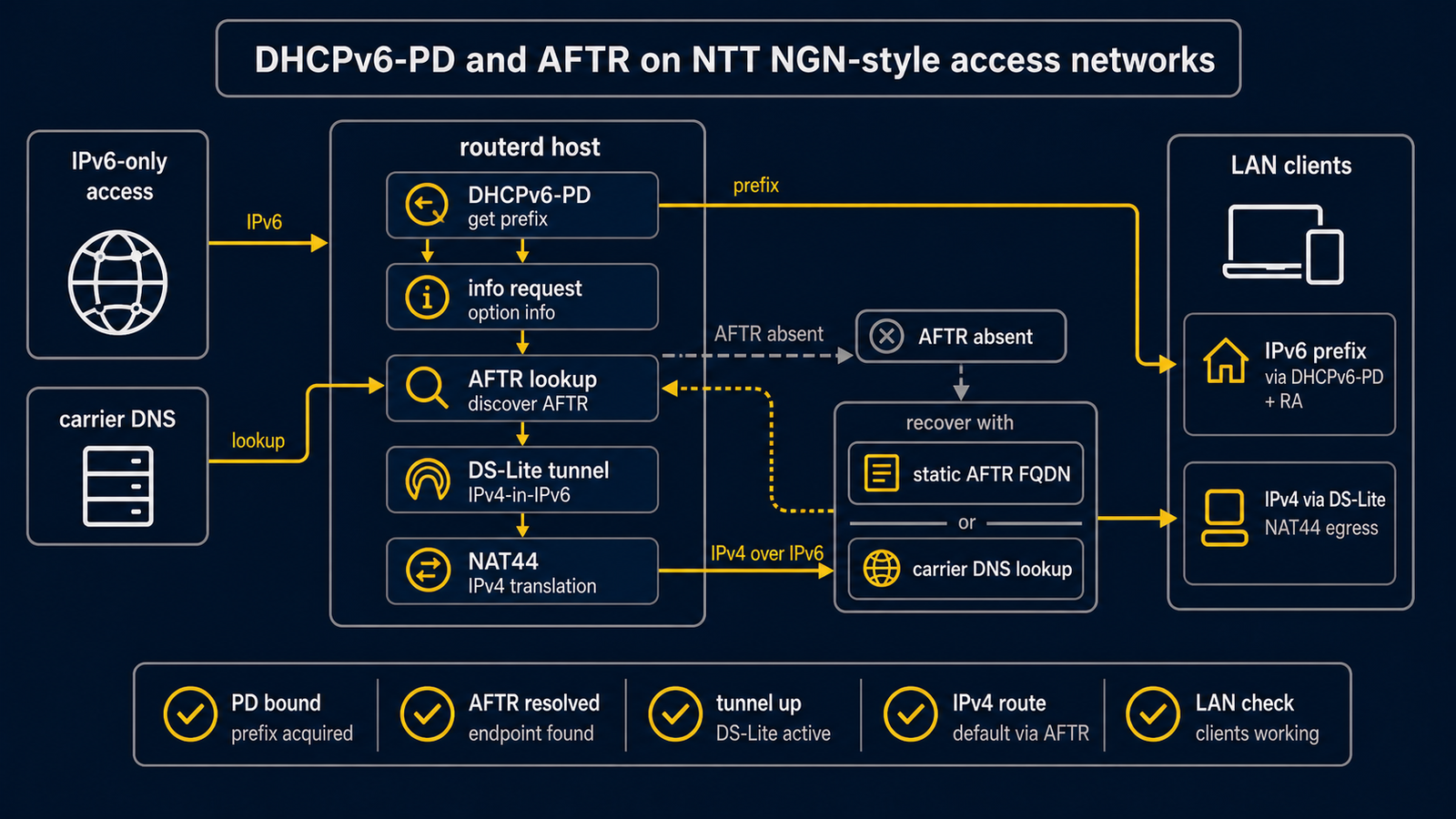
NTT NGN HGW PD acquisition under sustained uptime

This page records the 2026-04-30 lab investigation into how a NTT NGN PR-400NE home gateway behaves when a new DHCPv6-PD client tries to acquire a prefix while the HGW has been running uninterrupted for an extended period. It is companion material to DHCPv6-PD client implementations and how to choose; that page covers client-side implementation choices, this page covers the server-side state machine implied by lab evidence.

The intent is that anyone reproducing the same setup should not have to rediscover these traps. Evidence is graded with the labels documented in docs/design-notes.md (assert / believe / observe / measure / cite).

Background and lab topology

  • HGW: NTT PR-400NE, NTT NGN ("FLET'S Hikari Next") native IPv6 IPoE.
  • Reference appliance: NEC IX2215 with an existing /60 PD lease.
  • Devices under test: three routerd lab VMs (router01, router02, router03) on the same LAN segment as the HGW and IX2215.
  • HGW LAN-side MAC (lab value): 1c:b1:7f:73:76:d8.
  • HGW LAN-side RA flags: M=0, O=1 (Flags [other stateful]); prefix info for SLAAC is a /64 derived from the HGW's own /60.
  • HGW LAN PD assignment table caps at 15 slots (1/15, 2/15, ..., 15/15).
  • HGW had been running continuously for several days before the test session. No reboot occurred during the session.

A. The Solicit path is not reliable on a long-running HGW

  • observe: 34 Solicit variants were sent from the routerd lab VMs across the session. None received Advertise or Reply. Variants exercised:
    • DUID-LLT vs DUID-LL vs DUID-EN (with NTT NGN-relevant enterprise numbers).
    • MAC OUI sweep across Yamaha, NEC, IX-series, Cisco, Allied Telesis, Apple, Intel, Realtek, locally-administered random.
    • With and without Vendor-Class option (option 16) carrying NEC IX strings.
    • With and without User-Class option (option 15).
    • hop-limit values 1, 64, 128, 255.
    • flow-label 0 vs randomised.
    • With and without IA Prefix hint option in IA_PD.
    • With and without IA_NA alongside IA_PD.
    • RS→RA→Solicit ordering with timing variants 0.5s, 1s, 2s, 5s gap.
    • Single Solicit vs RFC 8415 §15 retransmit cadence (IRT/MRT/MRC).
  • measure: At the same instant, IX2215 was observed refreshing its existing lease at every T1 (11/11 successes during the test window). HGW DHCPv6 service is therefore healthy.
  • believe: The HGW operates two distinct admission paths, gated separately:
    • Acquisition path: open for several minutes after a HGW reboot. Accepts new Solicits and produces Advertise/Reply. The 15-slot table is filled here.
    • Maintenance path: open continuously. Accepts Renew/Rebind/Confirm/ Information-Request/Request from clients that present a valid Server Identifier and IA_PD claim. Does not accept fresh Solicits.
  • assert: routerd cannot rely on Solicit succeeding when the HGW has been up for hours. The bootstrap must use Section B's Request path or assume an out-of-band trigger to reopen the acquisition window (HGW reboot).

B. Request-direct bootstrap (RFC 8415 §18.2.10.1 INIT-REBOOT plus extension)

The lab confirmed that Request (msg-type 3) is honoured by the HGW even when fresh Solicit is silently dropped. This is the bootstrap path routerd will use when it cannot reboot the HGW.

B.1 Reproduction with IX2215

  • measure: Issuing clear ipv6 dhcp client GigaEthernet0.0 on IX2215 caused the IX to skip Solicit entirely (its INIT-REBOOT path) and emit a Request carrying the cached Server Identifier plus its existing IA_PD prefix. HGW responded with a Reply that restored the same /60 binding.
  • observe: IX2215 logs the transition as a normal "lease confirmed" event with no Advertise step.

B.2 Reproduction with routerd lab VMs

  • measure: routerd lab VMs (router01, router02, router03) used a scapy-based raw-socket Request to UDP 547 multicast ff02::1:2, carrying:
    • xid (random 24 bits).
    • Client DUID-LL (0003 0001 + VM MAC).
    • Server Identifier DUID-LL (0003 0001 + HGW MAC 1c:b1:7f:73:76:d8).
    • IA_PD with non-zero T1/T2 and an IA Prefix hint of /60.
    • Elapsed Time = 0.
    • Option Request Option (ORO) with the standard NTT-friendly set.
    • reconfigure-accept option (option 20).
  • measure: HGW Replied for each VM with a fresh /60 binding from its available pool:
    • router012400:xxxx:xxxx:1220::/60 (slot N/15).
    • router032400:xxxx:xxxx:1240::/60 (slot N+2/15).
    • router022400:xxxx:xxxx:1260::/60 (slot N+4/15). (The leading 32 bits are the operator-assigned site prefix and are redacted in this public document; the trailing /60 boundaries are reproduced as seen.)
  • observe: The HGW chose the next available slot in its 15-slot table for each Request; it did not honour the IA Prefix hint when the hinted prefix was already bound to another client.
  • observe: When router03 issued the same Request three times in a row re-using the same IAID and the same 1230::/60 claim, the HGW issued three separate bindings (1230, 1240, 1250). Each Request created an independent slot — there is no "merge by IAID" behaviour from the HGW.
  • measure: A multicast Release carrying the appropriate Server Identifier, IA_PD and prefix removed the unwanted bindings cleanly. No HGW reboot was needed to free the slots.

B.3 routerd implication

  • assert: routerd's NTT WAN profile has a bootstrap_via_request option that synthesises a Request directly when:
    • No prior lease state is on disk, or
    • The cached lease has aged out and Solicit retries have failed past their MRC budget.
  • assert: routerd must guard against accidentally consuming multiple slots by retrying Request without first sending Release for the previous binding. The IAID alone is not enough; the HGW issues a new slot per Request.

C. Server Identifier derivation from RA (no prior DHCPv6 history)

  • observe: The HGW's Server Identifier is a DUID-LL made of 0003 0001 followed by the HGW LAN-side MAC. In the lab, 0003 0001 1c b1 7f 73 76 d8.
  • observe: The HGW's RA source link-local address is the EUI-64-derived link-local for the same MAC: fe80::1eb1:7fff:fe73:76d8.
  • measure: Inverting the modified-EUI-64 transform on the RA source LL recovered the MAC byte-for-byte. The recovered MAC, prepended with 0003 0001, matched the Server Identifier actually emitted by the HGW in DHCPv6 Replies.
  • assert: routerd's controller can therefore acquire the HGW's expected Server Identifier from a single RA observation, without needing a prior DHCPv6 round trip. This makes Section B's Request bootstrap usable from cold start.
  • assert: The resource spec exposes a serverID override. Operators with non-default HGW behaviour can pin the Server Identifier explicitly.

D. Renew acceptance under the maintenance path

The HGW's Renew handling is the single biggest source of confusion in this network. The session produced byte-level captures of three Renew variants and the following hypothesis.

D.1 Unicast Renew always elicits a UseMulticast bounce

  • measure: Sending Renew unicast to UDP 547 at the HGW global address produced a Reply within ~4 ms carrying status-code 5 (UseMulticast) and echoing the same xid.
  • measure: WIDE dhcp6c re-emitted the same xid on multicast ff02::1:2. The HGW did not respond. Believed cause: xid-replay suppression on the multicast path.
  • assert: routerd's controller does not Renew over unicast on this HGW. It always Renews over multicast with a fresh xid.

D.2 Successful multicast Renew

The IX2215 lease-refresh transcripts show the working Renew shape:

FieldValue
xidfresh per Renew
T17200
T212600
IA_PDbound prefix with non-zero pltime and vltime
reconfigure-acceptpresent
IAID1568088 (IX2215 lab value)

D.3 Multicast Renew that the HGW silently dropped

ImplementationxidT1/T2reconfigure-acceptResult
WIDE dhcp6c after UseMulticast bouncereused7200 / 12600absentsilent drop
routerd active controller (early build)fresh0 / 0absentsilent drop

D.4 Hypothesis

  • believe: The HGW accepts a multicast Renew when all of the following hold simultaneously:
    1. The xid is fresh (not seen before from this client).
    2. T1 and T2 are non-zero. The IX2215 captures show T1=7200 and T2=12600.
    3. The reconfigure-accept option (20) is present in the Renew.
  • assert: routerd sends Renew satisfying all three until an ablation pass contradicts the hypothesis. Ablations should be done one option at a time and recorded back into this page.

E. WIDE dhcp6c quirks worth noting on this HGW

  • observe: dhcp6c defaults to unicast Renew once it has cached the server link-local address. This puts every Renew on the UseMulticast bounce path described in D.1.
  • observe: dhcp6c does not include reconfigure-accept in its outgoing Solicit or Renew packets. The receive path for option 20 is implemented but the send path is not.
  • observe: dhcp6c stores its DUID at:
    • /var/db/dhcp6c_duid on FreeBSD.
    • /var/lib/dhcp6/dhcp6c_duid on Ubuntu.
  • assert: When forcing DUID-LL in dhcp6c configuration, hardware-type must be 0x0001 (Ethernet). Other values violate the implicit contract the HGW enforces.

F. PR-400NE-specific operational notes

  • measure: HGW Reply packets arrive at UDP destination port 546 but their source UDP port is ephemeral (lab observation: 49153). pcap filters that say only udp port 547 will miss the Reply leg. Use udp port 546 or udp port 547 for any DHCPv6 troubleshooting on this HGW. This is consistent with rixwwd's public notes.
  • measure: HGW LAN /60 PD assignment table caps at 15 slots. Status pages display them as 1/15, 2/15, ... 15/15. Once full, new acquisitions need a Release of an existing slot or a HGW reboot. Multicast Release works.
  • observe: HGW LAN-side RA carries Flags [other stateful] (M=0, O=1) with the prefix-info option set to a /64 SLAAC range. Hosts that want a stateful configuration (DNS, NTP) must run an Information-Request DHCPv6 query alongside SLAAC.
  • observe: HGW does not echo the client's IA Prefix hint when that hint is already in use — it returns the next free slot.

G. Reconfigure key handling

  • observe: The first Reply after a fresh acquisition contains an Authentication option:
    • protocol = reconfigure
    • algorithm = HMAC-MD5
    • RDM = mono
    • RD field: 8 bytes
    • reconfig-key value: 16 bytes
  • observe: Subsequent Renew Replies on the same binding may omit the Authentication option entirely. The key remains valid until the HGW issues a new one.
  • assert: routerd persists the Reconfigure key from the first Reply and uses it to validate any future HGW-initiated Reconfigure (RFC 8415 §18.2.10) for that binding.

Note: the actual reconfig-key value is not reproduced in this document. It differs per HGW deployment and is not useful as a constant; recording it here would also be a needless secret leak. Treat it as per-binding state.

H. routerd active controller justification (session takeaway)

  • assert: Stock OS DHCPv6 clients adhere to the canonical Solicit-first RFC path and therefore cannot recover from the steady-state-only HGW state documented above. Any production routerd deployment on NTT NGN must drive the protocol directly.
  • assert: routerd's controller emits Solicit, Request, Renew, Rebind, Release, Confirm and Information-Request as needed. The state held in objects.status._variables for a IPv6PrefixDelegation resource includes:
    • lease.serverID
    • lease.prefix
    • lease.iaid
    • lease.t1, lease.t2
    • lease.pltime, lease.vltime
    • lease.sourceMAC
    • lease.sourceLL
    • lease.lastReplyAt
    • lease.reconfigureKey
    • wanObserved.* (last seen RA fields, Server-ID derivation snapshot)
  • assert: Renew is sent over multicast, with a fresh xid, non-zero T1/T2, and the reconfigure-accept option, in line with Section D's hypothesis.
  • assert: Server-ID is by default derived from the most recent RA observed on the WAN interface, by inverting modified-EUI-64 to recover the MAC and prepending 0003 0001. The resource spec exposes an override.
  • assert: routerd dhcp6 renew and routerd dhcp6 release CLI subcommands are diagnostic and recovery tools, not operational refresh tools. The HGW only honours Renew sent at the natural T1 boundary; an ad-hoc active Renew issued before T1 is silently dropped (see Section D). Steady-state lease refresh stays with the OS DHCPv6 client (dhcp6c) running on its own T1 timer. routerd records the Reply and surfaces the lease state, but does not try to accelerate the refresh cadence beyond what the HGW will accept.

H.1 T1 cycle and grace window

  • measure: Reply values observed from this HGW are T1=7200 (2 h), T2=12600 (3.5 h), pltime=vltime=14400 (4 h).
  • With these values, a successful Renew at the T1 boundary resets the timers from the moment the Reply is received. The next Renew opportunity is therefore another 2 hours later (T0+4h relative to the original allocation, but T0'+2h relative to the latest Reply).
  • assert: Renew opportunities are spaced exactly 2 hours apart and routerd cannot legitimately accelerate that cadence. dhcp6 renew issued before the natural T1 boundary is silently dropped by the HGW.
  • measure: From the moment the HGW first ignores a T1-boundary Renew, the operator has approximately 2 hours of grace before vltime expires (Renew at T1 → silent drop → Rebind retries at T2=3.5 h → vltime expires at T0+4 h). This 2-hour grace window is the time budget routerd must size detection and operator notification against.
  • observe: This 2-hour grace window is also why a single missed Renew is recoverable: a HGW reboot any time before vltime expiry restores the maintenance path and the next T1-boundary Renew succeeds.

I. Operator runbook (compressed)

When a routerd VM has lost its lease and the HGW has been up for hours:

  1. Confirm RA is being seen on the WAN interface (tcpdump -i <wan> 'icmp6 and ip6[40] == 134').
  2. Confirm the HGW MAC matches expectations (ip -6 neigh show fe80::1eb1:7fff:fe73:76d8 dev <wan> — replace LL with what you actually observe).
  3. Compute the expected Server Identifier: 0003 0001 + HGW MAC.
  4. Decide whether to bootstrap-via-Request or wait for a HGW reboot.
    • bootstrap-via-Request is the default routerd action.
    • HGW reboot is the safer fallback if you see HGW-side state corruption.
  5. If multiple stale bindings exist on the HGW, send a multicast Release for each. Do not assume IAID-based deduplication.
  6. After Reply, validate that Renew at T1 succeeds in steady state. If it does not, capture the bytes and compare to Section D's hypothesis.

J. Investigation journey: pitfalls, dead ends, and RFC deviations

This section preserves the misunderstandings, dead ends, and the points where HGW behaviour diverges from RFC 8415 strict reading. It is intentionally verbose so that the next operator on a NTT FLET'S deployment does not fall into the same thinking traps. Each subsection separates three layers explicitly: (a) what we believed at the time, (b) what RFC 8415 says, and (c) what the HGW actually does. A short Lesson line closes each subsection.

J.1 The "Solicit canonical path" tunnel vision

  • what we believed: RFC 8415 §18.2.1 frames a "fresh" client as starting from Solicit, receiving Advertise, then sending Request. We assumed that any client without prior lease state had no other entry point, and that the only way to make the HGW reply was to find the right Solicit shape.
  • what we tried (all failed): 34 Solicit variants on the content axis only. DUID-LL / DUID-LLT / DUID-EN; IAIDs of 0, 1, MAC-tail, and IX-derived; hop limits of 1, 8, 64, 128, 255; flow label 0, random, and max; Vendor-Class option 16 with NEC / Buffalo / Yamaha enterprise numbers; User-Class option 15; IA Prefix hints aimed at empty slots; RS→RA→Solicit ordering experiments; full MAC OUI sweep. Every single Solicit was silently dropped by the HGW while the IX2215 next to us refreshed its existing lease without issue (Section A).
  • the blind spot: we never moved on the message-type axis. RFC §18.2.4 INIT-REBOOT is described as a path "for a client that has prior valid lease state", and we read that strictly: "we have no prior lease, therefore this path is not available to us". So we never tried Request directly without Advertise.
  • what RFC 8415 says: §18.2.4 expects a Request used as INIT-REBOOT to carry the prior Server Identifier and the prior IA_PD content. The server is expected to verify that the claimed binding still exists and reply accordingly (or reject with NoBinding).
  • what the HGW actually does: PR-400NE accepts a Request from a client that has no prior valid lease as long as it carries (i) a Server Identifier matching the HGW's DUID-LL and (ii) an IA_PD claim of any prefix. The HGW does not strictly validate that the claim corresponds to a binding the client previously held; it allocates a free slot and returns it in the Reply. This is the lenient deviation that makes Section B work.
  • Lesson: when a server silently drops protocol traffic, exhaust the message-type axis before brute-forcing the content axis. Server state machines often gate each transition with separate logic, and the gate you are bouncing off may not be the one the message you are sending tries to open.

J.2 The unicast-vs-multicast Renew confusion

  • what we believed: when WIDE dhcp6c Renew failed against the HGW, we initially concluded that "the HGW does not accept Renew over multicast at all". This was wrong, and it cost a session of investigation.
  • what we observed: dhcp6c first sends Renew unicast to the HGW global address (it caches the server link-local). The HGW returns within ~4 ms a Reply with status-code 5 (UseMulticast), echoing the same xid. dhcp6c then re-emits to multicast ff02::1:2 with the same xid. The HGW does not respond. The IX2215 in parallel had been Renewing on multicast with a fresh xid the whole time, and that succeeded 11/11 in the same window.
  • what RFC 8415 says: §18.2.10.1 states that on receipt of UseMulticast, subsequent messages should be sent multicast. RFC does not explicitly forbid reusing the same xid when retrying on the new transport — it is a gray area.
  • what the HGW actually does: PR-400NE seems to deduplicate by xid across transports, treating the multicast retransmit with the same xid as a duplicate of an already-replied transaction, and silently drops it. This is defensible from a state-machine viewpoint but is not what the RFC literally requires.
  • the misreading: by treating both packets as a single client-side "Renew attempt" we lost track of which xid was on the wire. Once we split the captures by xid, the unicast-then-multicast double-shot became obvious.
  • Lesson: trace the client and the server separately, and key on xid rather than on time order. "Retransmit" is a compressed label that hides exactly the bug class that DHCPv6 implementations create on themselves.

J.3 The "passive T1/T2 wait" anti-pattern

This was called out by the user during the session itself, not derived in hindsight.

  • what we did: after acquiring a binding, we let the natural T1=7200 s timer expire to observe the Renew. When that Renew failed, we re-acquired and waited another T1 cycle to retry. Several full cycles were spent like this before any active triggering capability existed.
  • the user's correction (paraphrased): "you keep waiting for T1/T2 and failing. You need an active firing path so you can send Solicit or Renew at any moment, not just when the OS client decides to."
  • what RFC 8415 says: §18.2.6 specifies that Renew is sent "after T1". This is a client-timer rule, not a prohibition on operator-driven Renew. Nothing in 8415 stops a debug controller from emitting Renew earlier.
  • what we should have done: built scapy-driven raw-socket emission of every relevant message type early, and reserved the OS client cycle for validating "real operational behaviour" once we already understood the state machine.
  • Lesson: in protocol debugging, never let the slowest natural timer in the system gate your iteration speed. Build active control first, observe passive cycles second.

J.4 The "fresh client must use Solicit" RFC strict reading

This is the conceptual flip side of J.1, framed from the RFC angle.

  • strict RFC reading: 8415 §18.2.1 describes Solicit→Advertise→Request as the path for a client without prior state. §18.2.4 INIT-REBOOT is described as the path for a client that has a prior valid Server Identifier and wants to confirm or refresh a binding it already holds.
  • what routerd lab VMs faced: no prior lease state on disk, the HGW silently dropping every Solicit shape we tried (Section A).
  • what we ended up doing: synthesised a Request with a Server Identifier derived from the RA observation (Section C) and an IA_PD claim of an arbitrary /60. The HGW allocated a free slot.
  • why this is an RFC deviation: in RFC terms an INIT-REBOOT Request from a client that does not actually hold the claimed binding should result in NoBinding status. The HGW instead treats such a Request as a new acquisition request, allocating a free slot from its 15-slot table. This is what makes the bootstrap-via-Request path of Section B viable when the HGW's Solicit gate is closed.
  • why this matters for routerd: Section H's active controller intentionally exploits this lenient deviation. It is the only way to acquire a fresh /60 from a long-running HGW without an out-of-band reboot. Section 5.2 of docs/design-notes.md codifies this as a hybrid recovery path — it is not a mistake, it is the design.
  • Lesson: do not memorise RFC paths as "this path is for clients in state X". Memorise them as "this message type with this content elicits this server reaction", and treat the strict client-state preconditions as RFC's expectation, not necessarily the implementation's gate.

J.5 RFC compliance vs HGW behaviour, side-by-side

BehaviourRFC 8415 expectationHGW (PR-400NE) actual behaviourrouterd response
Solicit during normal operationServer should reply (Advertise/Reply)Frequently silently dropped on long-running HGWTry Solicit first, fall back to Request after N failures
INIT-REBOOT Request with prior valid leaseServer confirms / re-issues binding (§18.2.4)Reply immediatelyStandard path
INIT-REBOOT-style Request without prior leaseServer should return NoBinding (§18.2.4)Allocates a free slot and replies with a new bindingIntentionally exploited as recovery path
Unicast RenewPermitted only if server granted unicast (§18.2.10)Always replies with UseMulticast or with full ReplyNot used; we always Renew multicast
Multicast Renew with T1/T2=0 and no reconfigure-acceptServer should reply (§18.2.6)Silently dropped (observed)Avoided
Multicast Renew with non-zero T1/T2 + reconfigure-acceptServer should replyRepliesStandard send shape
Reply source UDP port547 (RFC 8415 §7)49153 (ephemeral, observed)Client side accepts any source port
Same-xid retransmit across transport (unicast → multicast)Not explicitly forbiddenTreated as duplicate, droppedAlways use a fresh xid on multicast retry

J.6 Points not documented anywhere we found

These are the items that are easy to miss because they appear neither in NTT public documentation nor in the RFC:

  • HGW acquisition window is bursty: the Solicit-accepting window seems to open mainly in the minutes after a HGW reboot. A long-running HGW will silently drop fresh Solicits for hours. Not a published spec point; inferred from this session.
  • Reply source UDP port is ephemeral, not 547: lab observation 49153. pcap filters that say only udp port 547 will lose the Reply leg (see Section F).
  • WIDE dhcp6c unicast-then-same-xid-multicast loop: an OSS implementation artifact, not a RFC mandate. Anyone debugging Renew on this HGW with dhcp6c will see Renew "fail" without seeing what went wrong unless they capture both transports (J.2).
  • Renew without reconfigure-accept and with T1/T2=0 is dropped even on multicast — hypothesis from D.4, not yet ablated. Anyone reproducing this should ablate the three preconditions one at a time and append the result to Section D.
  • Server-ID is computable from one RA: invert modified-EUI-64 on the RA source link-local to recover the MAC, prepend 0003 0001. This makes cold-start Request bootstrap viable without any prior DHCPv6 history (Section C).

K. HGW DHCPv6 server hung-up condition

This section records a separate failure mode observed on 2026-04-30 that is distinct from the Section A "long-running HGW silently drops fresh Solicit" condition. In this mode the HGW DHCPv6 server stops servicing all DHCPv6 client messages, not only Solicit. The IX2215 next to the routerd lab VMs also failed Renew during the affected window, which is the discriminator between "Section A" and "Section K".

K.1 Symptoms

  • observe: The HGW silently drops every DHCPv6 client message it receives: Solicit, Request, Renew, Rebind, Release, Confirm, and Information-Request. Both fresh-acquisition clients and clients with valid existing bindings (IX2215, routerd lab VMs) are equally unable to elicit a Reply.
  • observe: The L2 / NDP plane keeps working. NS/NA exchanges with the HGW link-local complete normally, and the HGW continues to emit RA on the LAN segment with the same flags and prefix as before.
  • observe: Bindings already present in the HGW LAN PD assignment table are retained. The HGW status page still lists the same N/15 slots, but the per-slot lease counter only ticks down — it is never refreshed by a Renew Reply, because the Reply never leaves the HGW.
  • measure: During the affected window the IX2215 lease-refresh stream switched from "Renew at every T1 succeeds" (Section A measurement) to "Renew at every T1 elicits no Reply", confirming that this is a HGW-side server stall and not a routerd-side packet-shape problem.

K.2 Detection by routerd

  • assert: The active controller (Section H) measures the wall-clock gap between a Renew or Rebind being placed on the wire and the corresponding Reply arriving. After the controller has emitted a Renew with the shape documented in Section D and no Reply is observed for more than N seconds (default 30 s), the controller flags the binding as HGW DHCPv6 hung suspected.
  • assert: routerd records the suspicion timestamp under objects.status._variables.hgwHungSuspectedAt for the affected IPv6PrefixDelegation/<name>. routerctl describe ipv6pd/<name> displays a WARNING: HGW DHCPv6 hung suspected since <timestamp> line and prints the remaining lease.vltime so the operator can judge urgency.
  • assert: A successful Renew Reply (or any Reply that updates the cached lease) clears the suspicion flag. Recovery is observable from the same routerctl describe view.

K.3 Public reports

The same symptom shape is reported in public lab notes for several upstream hardware families. routerd treats these as independent corroboration that the condition is a known external failure mode and not a one-off in this lab.

K.4 Recovery

  • measure: A manual HGW reboot recovered the DHCPv6 server immediately in the 2026-04-30 lab session. After reboot, both the acquisition path (Section A "minutes-after-reboot" window) and the maintenance path (Section D Renew acceptance) operated normally.
  • measure (2026-04-30 11:16:50 UTC): Following the reboot, routerd's active Request from router03 succeeded against the recovered HGW and refreshed the existing 1240::/60 binding to a near-full lease lifetime.
  • measure (2026-04-30 11:20:44 UTC): Active CLI Renew, Release, and a follow-up Request from the same router03 against the same HGW, issued only about four minutes after the successful 11:16:50 Request, all received no DHCPv6 Reply. The HGW table did not refresh and the binding was not released. This shows the post-reboot acceptance window can close within minutes even while the HGW remains otherwise healthy (NDP, RA, and existing-binding lease counters were unaffected). The operator playbook in K.5 should not assume the window stays open after the first successful exchange.
  • observe: It is not confirmed whether the HGW recovers on its own without operator intervention. The rabbit51 report cites an auto-reboot recovery, but in this lab the auto-recovery path was not exercised; manual reboot was the only path verified to work.
  • observe: A HGW reboot interrupts the home network for roughly one to two minutes. WAN reconnect, RA re-emission, and DHCPv6 server readiness proceed in their normal post-boot order.

K.5 Operator playbook

When routerctl describe ipv6pd/<name> shows the Section K.2 warning:

  1. Confirm the suspicion is real by checking IX2215 (or any other Renew-only client on the same segment). If IX2215 also fails Renew at its next T1, the HGW is in the Section K state and not in the Section A state.
  2. Read the remaining lease.vltime from routerctl describe.
  3. If vltime is short (lab threshold: under one hour), reboot the HGW immediately. The lease is going to expire and IPv6 connectivity will stop on every routerd-served LAN.
  4. If vltime is comfortable (several hours or more), schedule a HGW reboot at a low-impact time. Continue monitoring routerctl describe for the suspicion clearing on its own (auto-recovery is not guaranteed but has been reported).
  5. After the reboot, confirm that routerd's next Renew elicits a Reply and that hgwHungSuspectedAt clears.
  6. Note: Even when the HGW has just rebooted and is in the post-reboot acceptance window, that window can close within minutes (Section K.4 11:20 UTC measure). After the first successful exchange, treat subsequent active CLI use as best-effort; the canonical path forward is to let the OS DHCPv6 client refresh at its natural T1 boundary.

K.6 Why routerd cannot fix this automatically

  • assert: routerd is a DHCPv6 client and a LAN-side service. It has no control plane into the HGW. It cannot push a reset, restart the HGW DHCPv6 daemon, or trigger an internal recovery routine.
  • observe: In the affected state the HGW ignores routerd's active Request, Renew, Rebind, Release, Confirm, and Information-Request equally. There is no DHCPv6-layer message routerd can send that the HGW will act on.
  • assert: Recovery requires a human action — the HGW web UI reboot button or a physical power cycle. routerd's responsibility in this failure mode is therefore limited to detection, accurate surfacing of the remaining lease budget, and notification (operator, and where available, household members through whatever notification path is configured).

References

  • RFC 8415 — Dynamic Host Configuration Protocol for IPv6 (DHCPv6)
    • §7 Server / Relay / Client message format
    • §15 Reliability of Client-Initiated Message Exchanges (retransmission)
    • §18.2.1 Solicit
    • §18.2.4 Request
    • §18.2.5 Confirm
    • §18.2.6 Renew
    • §18.2.10 Reconfigure
    • §18.2.10.1 INIT-REBOOT considerations
  • systemd issue #16356 — DHCPv6 Renew not resetting IA Prefix lifetimes
  • OpenWrt issue #13454 — odhcp6c eight-hour disconnections under NTT FLET'S Cross
  • rixwwd public lab notes — PR-400NE Reply ephemeral source UDP port observation
  • sorah public lab notes — DUID-LL composition for NTT HGW DHCPv6 server
  • routerd docs/design-notes.md Section 5.2 — Active DHCPv6 controller path
  • routerd docs/knowledge-base/dhcpv6-pd-clients.md — client-side selection