What is routerd?
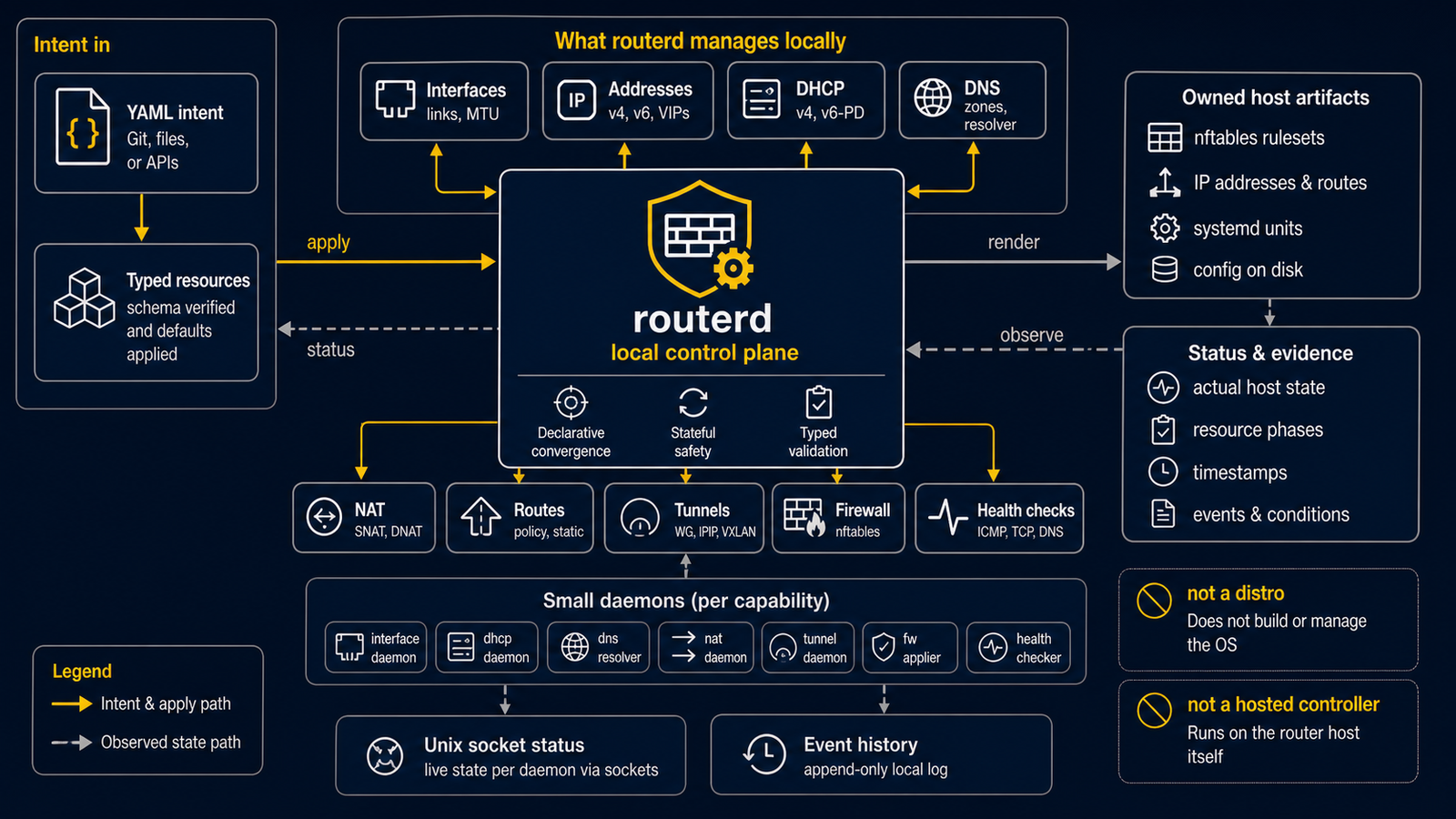
routerd is a declarative router control plane with Ubuntu Server as its primary host target. NixOS and FreeBSD have selected integration paths and groundwork; they are not first-lab equivalents. You write the router intent as YAML resources. routerd turns that intent into interfaces, addresses, DHCP service, DNS service, NAT, routes, tunnels, health checks, system packages, sysctl values, service units, logs, and status.
routerd is not a distribution and it is not a hosted controller. It runs on each router host. It uses local kernel features and host components such as systemd-networkd, dnsmasq, nftables, pppd, WireGuard, and systemd where that is the right boundary.
The Problem
A hand-built router spreads state across many places:
- interface addresses in netplan, systemd-networkd, rc.d, or NixOS settings
- DHCP, DHCPv6, DHCP relay, and RA in dnsmasq configuration
- DNS forwarding and local records in resolver-specific files
- NAT, route policy, conntrack, and firewall state in nftables and iproute2
- DHCPv4, DHCPv6-PD, PPPoE, health checks, and logging in separate daemons
- packages, sysctl values, and service units in host bootstrap scripts
routerd treats these pieces as resources. The YAML shows the router intent.
Git diffs show the operational change. routerctl and the Web Console show
what the host actually observed.
Current Shape
routerd serve loads resources, resolves dependencies, starts child daemons,
subscribes to events, and adjusts the host toward the desired state.
Long-running protocol state lives in small managed daemons:
routerd-dhcpv6-clienthandles DHCPv6 prefix delegation and information request.routerd-dhcpv4-clienthandles DHCPv4 WAN leases.routerd-pppoe-clienthandles PPPoE sessions.routerd-healthcheckruns TCP, DNS, HTTP, and ICMP probes.routerd-dns-resolveranswers DNS zones and forwards DoH, DoT, TCP, and UDP upstreams.routerd-dhcp-event-relayconverts dnsmasq lease changes into routerd events.routerd-firewall-loggerimports firewall logs into routerd log storage.
Each daemon exposes local HTTP+JSON status over a Unix socket and persists its own state where needed. routerd consumes those events and updates LAN service, DNS records, DS-Lite tunnels, NAT, route policy, health-derived choices, and observability stores.
What It Can Manage
The current implementation can manage:
- DHCPv6-PD and delegated IPv6 LAN addresses
- DHCPv6 information request, AFTR DNS resolution, and DS-Lite
- DHCPv4 WAN leases and DHCPv4 LAN scopes with reservations
- DHCPv6 server modes and IPv6 Router Advertisement options
- DNS zones, DHCP-derived records, conditional forwarding, DoH, DoT, TCP DNS, UDP fallback, multiple listen profiles, and cache
- NAT44, private-destination exclusions, IPv4 route policy, reverse-path filter settings, Path MTU policy, and TCP MSS clamping
- PPPoE, WireGuard, VXLAN, VRF, and cloud-oriented IPsec connection
definitions with strongSwan
swanctlrendering - package installation, sysctl profiles, network adoption, systemd units, NTP client configuration, log sinks, log retention, and Web Console
EgressRoutePolicy,HealthCheck,EventRule, andDerivedEventcoordination- status, event, DNS query, connection, traffic-flow, and firewall-log inspection
Deliberate Boundaries
routerd is v1alpha1 pre-release software. Names and fields may change without a compatibility alias when the cleanup makes the router safer or the configuration more understandable.
Stateful firewall filtering is intentionally scoped groundwork. routerd renders NAT44, zone policy inputs, service holes, denial logging, and traffic inspection, but it is not a general-purpose firewall rule language or a security certification. Do not rely on it as the only boundary for an Internet-facing router. NixOS and FreeBSD use the same resource model where their native activation paths are available. Platform-specific host surfaces are tracked in the platform matrix.