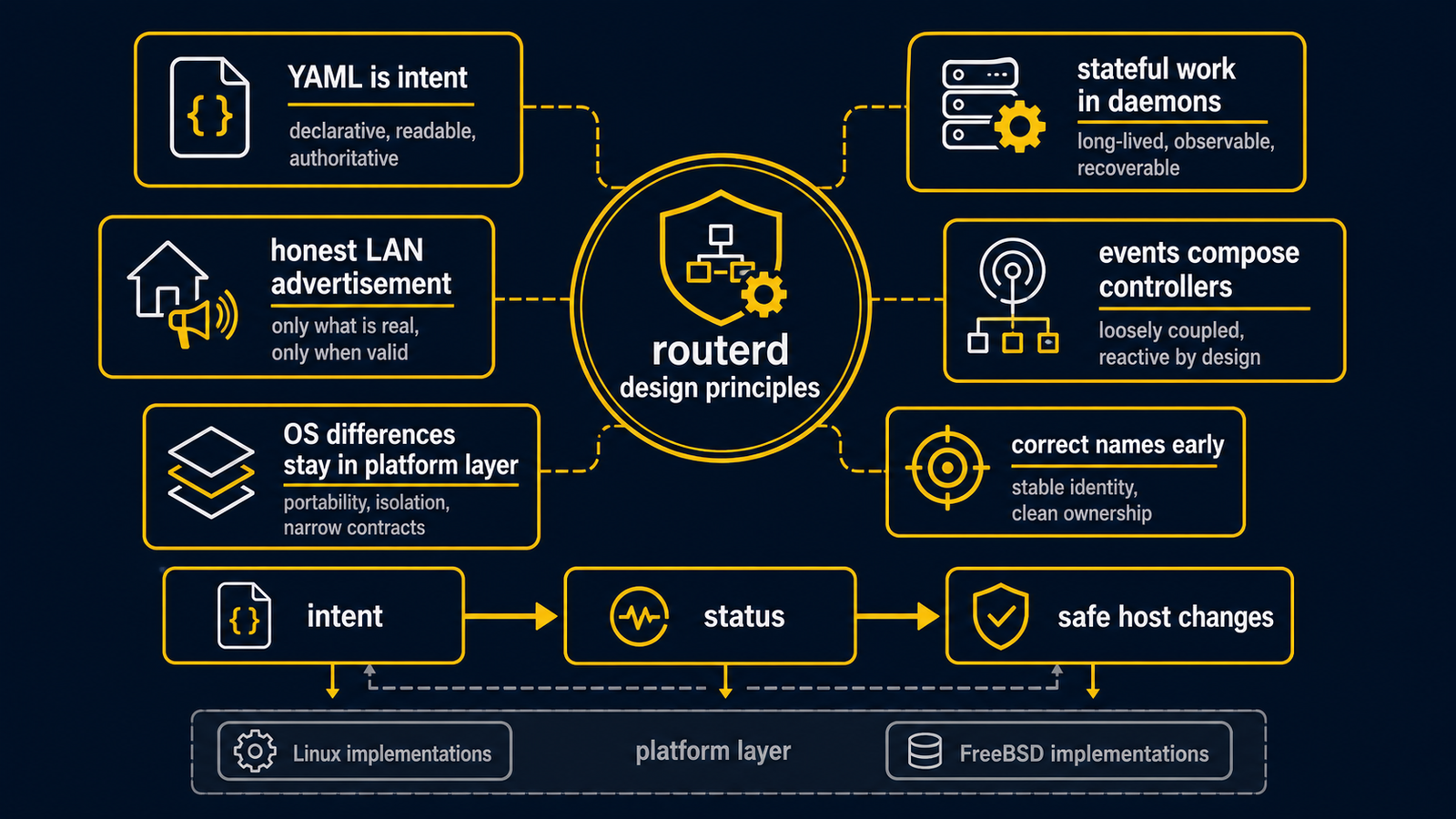
Design philosophy
routerd is opinionated. It works the way it does because of a small set of principles that turned out to matter on real router hosts. Reading these once makes most of the day-to-day decisions in the project obvious.
1. The YAML is the source of truth
A router's behavior should live in a file you can review, diff, and roll back. routerd treats the YAML as the source of truth and the host as a projection of it.
Practical consequences:
- Operators change YAML, not generated files. Editing
/etc/dnsmasq.d/routerd.confby hand means routerd will overwrite it on the next apply, and the change will not survive a host rebuild. - The history of changes lives in git.
routerd applydoes not need to log "what changed" because the diff already exists. - Rollback is
git revertplusrouterd apply.
2. Prefer OS-standard daemons; add ports tools only when the base lacks the feature
routerd is not a network stack. It configures and supervises the OS's own daemons. On each platform we use the most standard daemon that does the job, and we accept a non-base tool only when the base option is missing or known not to work.
Examples:
- Ubuntu: systemd-networkd is the default for interfaces and DHCPv4/DHCPv6. dnsmasq handles LAN DNS/DHCP. nftables for filtering and NAT.
- FreeBSD: base
dhclientfor IPv4 DHCP, basertsoldfor IPv6 SLAAC router solicitation. KAMEdhcp6c(from ports) is used only for IPv6 prefix delegation, because the FreeBSD base does not ship a working PD client. - NixOS: same Linux daemons, but installed and configured through the Nix
module system rather than raw
/etcfiles.
This keeps the host inspectable with the operator's existing knowledge of the OS. It also means we trust each OS to know how to renew leases, restart daemons, and survive crashes; routerd does not reimplement those.
3. kubectl-style verbs
routerd resources look like Kubernetes resources, and the CLI uses the same verbs:
applybrings the host into the shape of the YAML.validatechecks the YAML against the schema.rendershows what files would be written for the current YAML.get,describe,showinspect resources and observed state at three granularities (one-line summary, structured summary, full data).
This is not aesthetics. The verbs match a control loop that already works at scale, and the resource ownership model is built on the same idea (managed objects, owner references, finalizers conceptually).
4. Observation-first
routerd records what it observed on the host alongside what was declared. DHCPv6 prefix delegations, host inventory (kernel, virtualization, service manager, available commands), and the artifacts routerd installed are stored in a local SQLite database in addition to the YAML.
This lets you answer "what is the router actually doing right now?" without grepping through several daemons' logs. It also lets future versions of routerd branch on observed facts (physical vs virtual host, systemd vs rc.d) instead of guessing.
5. Small, inspectable, no remote control plane
routerd is not a platform. It is a small control loop with a typed YAML schema and a SQLite state file. Adding a new resource kind is a deliberate decision, not a feature gap to fill. There is no centralized API server, no agent fleet, no per-tenant abstraction.
You can read the daemon's behavior end-to-end with routerctl and a few
SQL queries. Operators of small networks should be able to fully
understand the tool that is running their router.
6. Idempotent by default
Re-applying the same YAML against an already-converged host should change nothing. The renderer is deterministic. The reconcile loop diffs observed state against desired state and only acts when there is a real difference. This is the property that lets routerd run as a long-lived daemon on the apply loop without thrashing the host.
How these connect
These principles compound:
- "YAML is the source of truth" + "kubectl-style verbs" gives a workflow operators already know.
- "OS-standard daemons" + "observation-first" means the host can be debugged with normal tools, and routerd's state explains what it expected.
- "Small + inspectable" + "idempotent" means you can leave the daemon running and trust it.
When choosing between two implementation paths in routerd, the principle that wins is whichever makes the next operator faster at understanding the running router from the YAML alone.