Resource ownership and the apply model
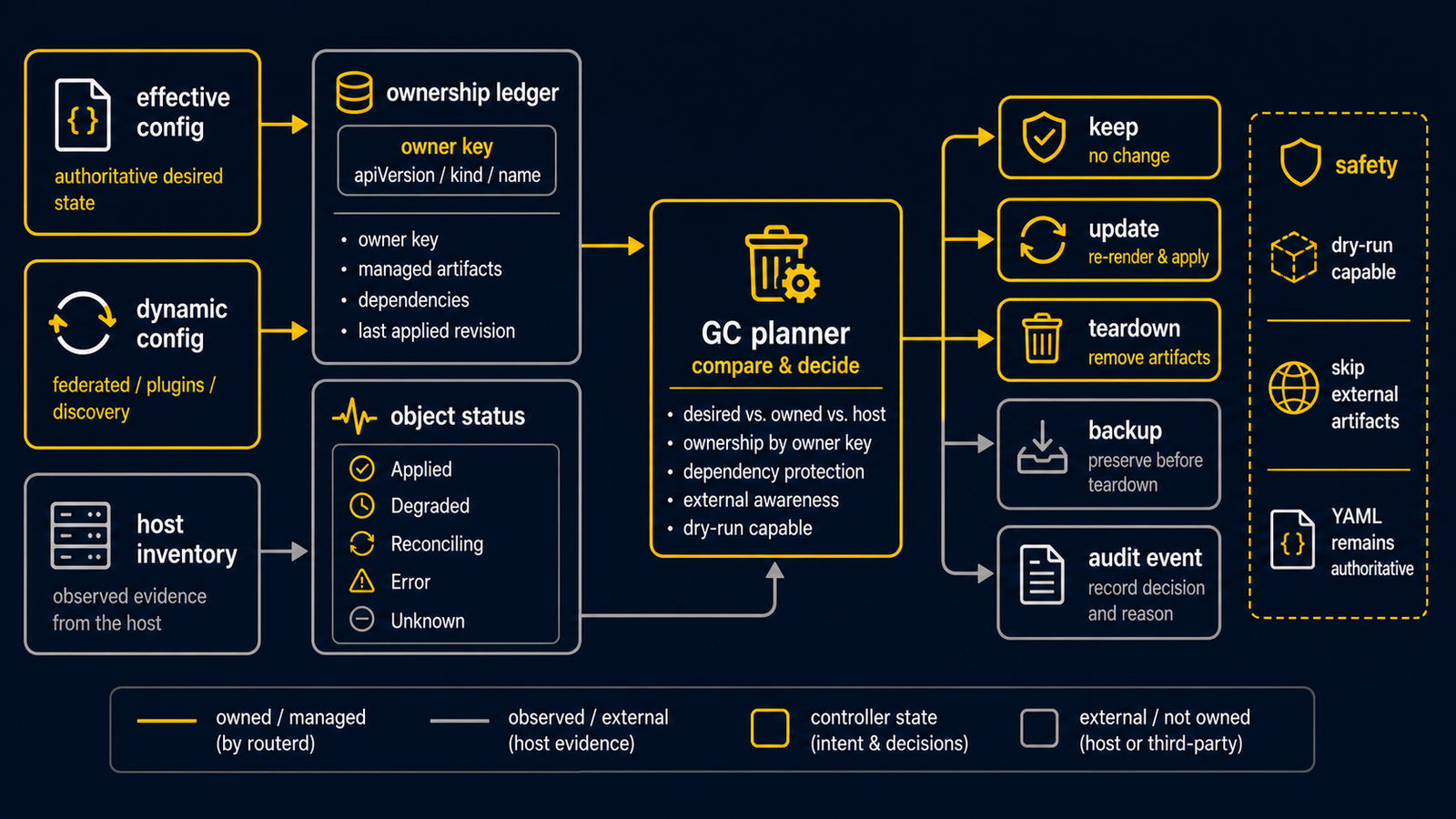
routerd associates host-side artefacts with the resource that produced them. Recording who owns what makes diffs, deletions, and incident debugging tractable.
Ownership categories
| Category | Meaning |
|---|---|
| Created | routerd produced the artefact itself. |
| Adopted | routerd took over an existing artefact and now manages it. |
| Observed | routerd only reads the state; it does not change it. |
The stable owner identity is apiVersion/kind/name. Apply generations are not
part of the owner key: a new generation can replace or remove artifacts owned by
the same resource without changing the ownership identity. Object status records
also carry owner metadata and a lifecycle class so stale-state cleanup can make
the same distinction as the apply path.
Resource → host artefact map
| Resource | Host artefact |
|---|---|
Interface | OS interface name and admin state |
DHCPv6PrefixDelegation | routerd-dhcpv6-client socket, lease, events |
DHCPv4Client | routerd-dhcpv4-client socket, lease, events |
PPPoESession | routerd-pppoe-client socket, state, pppd/ppp config |
HealthCheck | routerd-healthcheck socket, state, events |
DHCPv4Server / DHCPv6Server / IPv6RouterAdvertisement | Managed dnsmasq configuration |
RogueRADetector | Auto-derived routerd-ra-observer socket, passive IPv6 RA observations, rogue RA events |
DNSZone | routerd-dns-resolver local authoritative zone |
DNSResolver | routerd-dns-resolver socket, state, events, listener configuration |
DNSForwarder | routerd-dns-resolver runtime forwarding rule derived into the resolver config |
DNSUpstream | routerd-dns-resolver runtime upstream endpoint derived into forwarder rules |
DSLiteTunnel | Linux ip6tnl interface |
TunnelInterface | Linux ipip/gre tunnel device; FOU/GUE modes also ensure the matching ip fou listener port |
SAMTransportProfile | A DynamicConfigPart containing generated TunnelInterface, endpoint /32 IPv4Route, and BGPPeer resources |
MobilityPool | Dynamic SAM capture/control-plane resources, BGP /32 advertisements, provider action plans, and ownership observations |
IPAddressSet | nftables IPv4/IPv6 named sets when referenced by a Linux renderer |
IPv4Route | Kernel route |
ClusterNetworkRoute | Generated IPv4StaticRoute intents for Pod / Service CIDRs through configured next hops |
NAT44Rule | nftables routerd_nat table |
PortForward / IngressService | Linux nftables routerd_nat / routerd_filter DNAT, optional hairpin SNAT, or FreeBSD pf.conf rdr pass / optional NAT reflection rules |
BGPRouter / BGPPeer | Long-lived routerd-bgp daemon state controlled through local GoBGP gRPC; learned IPv4 best paths installed into the kernel FIB with routerd-owned protocol/metric values |
BFD | Linux or FreeBSD FRR bfdd session configuration and observed status for referenced GoBGP peers |
VirtualAddress | Static VIP through ip addr or ifconfig; VRRP/VRRPv3 VIP ownership through keepalived on Linux or CARP on FreeBSD |
ObservabilityPipeline | In-process routerd event exporter and generated OpenTelemetry environment for managed units |
RouterdCluster | File lease under spec.leasePath; leader-only apply/controller mutation gate |
WireGuardInterface / WireGuardPeer | WireGuard configuration |
TailscaleNode | routerd-tailscale-<name> service unit/script and tailscale up arguments |
VRF | Linux VRF device and routing table |
VXLANTunnel | VXLAN device |
Package | Optional package override; normal host package intents are derived from router resources |
Sysctl | One sysctl value |
SysctlProfile | A set of sysctl values |
| Derived host runtime | Kernel module load state and systemd-networkd / systemd-resolved drop-ins derived from router resources |
NTPClient | NTP client configuration |
Linux nftables tables rendered by routerd carry a table comment marker
(routerd.owner=routerd routerd.generation=1). Doctor uses this marker, not a
name-prefix heuristic alone, when deciding whether a present routerd_* table
is stale relative to the current rendered config.
Lifecycle contracts
Every config resource kind is declared in the lifecycle registry. The declaration records the resource class and one teardown contract:
ArtifactKinds: the resource records concrete host artifacts in the ownership ledger, and the generic artifact teardown registry knows how to remove those artifact kinds.TeardownLifecycle: resource: the resource has resource-specific teardown that runs from object status, for example kernel route removal, WireGuard adopted/external checks, or SAM proxy-ARP cleanup.NoHostTeardownReason: the resource is renderer input, external policy, or a dynamic source that does not own standalone host artifacts.
CI checks that every config kind has exactly one explicit contract and that each declared artifact kind exists in the teardown registry. This is meant to prevent new resources from silently bypassing cleanup.
How removal works
routerd does not silently delete artefacts it does not own. When a resource is removed from YAML, the GC planner compares the current effective resource set with the ownership ledger, object status rows, and host inventory. It then builds a dry-run-capable plan containing artifact removals, resource-specific teardown, ledger forgets, stale status deletion, state backup, and audit events.
Ledger read and write failures stop the operation rather than being treated as
empty ownership. SQLite batches commit atomically. Legacy artifacts.json
imports record completion in that same transaction; a failed rename is retried
without reimporting old ownership, even after the ledger becomes empty.
The desired set is the same effective view used by apply and serve:
FilterRouterByWhen, dynamic SAM resources, and DynamicConfigPart merges are
included. This prevents when: false resources from being treated as active
cleanup targets and prevents generated SAM tunnel/BGP/route resources from being
mistaken for orphans while their profile is still present.
Profile-derived resources clean up by normal ownership flow. For example,
deleting a SAMTransportProfile leaves an empty active dynamic part, generated
TunnelInterface / BGPPeer / endpoint-route resources disappear from the
effective config, and the generated resources' owners drive artifact teardown.
Destructive cleanup requires a state backup and records an event. Unsupported OS integrations are non-destructive. Adopted or externally managed object statuses are not torn down by resource lifecycle GC.
Full configuration rollback is not a current goal. For changes that affect production traffic, follow this order:
- Validate.
- Inspect the plan.
- Run a dry-run apply.
- Confirm the management connection survives the change.
- Apply.
- Verify state and connectivity.
Legacy configurations
Older experimental DHCPv6 packages and renderers have been removed. The current DHCPv6-PD path is routerd-dhcpv6-client. Examples that referenced dhcpcd or dhcp6c directly are no longer part of the supported configuration set; the legacy resources have been retired without aliases.
Pending DHCP callback journal
<platform StateDir>/dhcp-events/ is node-local persistent state owned by
routerd and its privileged dnsmasq callback. pending.db (and its transient
rollback journal) stores bounded pending callbacks; pending.db.consumer is
the cross-process consumer lock. The directory is 0700 and files are 0600.
Retain these files for restart recovery and backups; do not copy them through
HA lease sync or delete them as runtime artifacts. The callback creates them
on first use; idle serve startup does not create them. See
callback recovery
for limits and failure handling.