DNS resolver
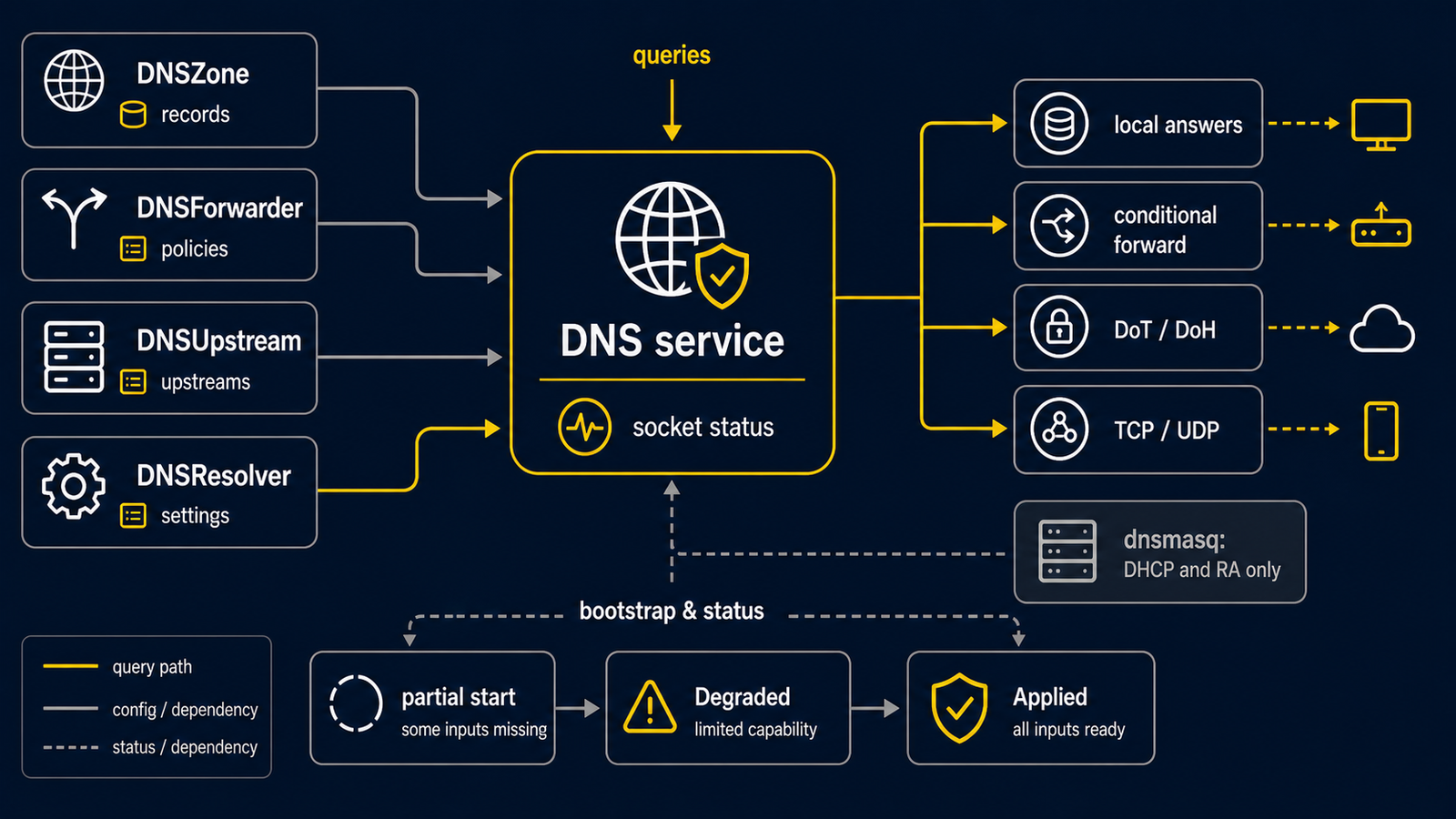
routerd splits DNS into small resources with a clear boundary between authoritative data, the resolver process, forwarding rules, and upstream endpoints.
DNSZone owns local authoritative data. It stores manual records and records derived from DHCP leases.
DNSResolver owns the daemon instance. It defines listen addresses, cache policy, metrics, and query logging. Each DNSResolver resource starts one routerd-dns-resolver process.
DNSForwarder owns one match rule for a resolver. It either serves DNSZone resources or forwards matching queries to DNSUpstream resources.
DNSUpstream owns one upstream endpoint. It can be plain UDP/TCP DNS, DoT, or DoH.
Startup and partial bring-up
DNSResolver does not wait for every dependency before it serves. At startup it
brings up the daemon with whatever listen addresses and sources already resolve,
and converges later as the rest become ready:
- A listen entry binds the addresses that resolve now; an address whose
*Fromsource is not ready yet (for example a delegated-prefix address still waiting on DHCPv6 prefix delegation) is added on a later reconcile. - A forward/upstream source whose dynamic upstream is unresolved (for example an
AFTR forwarder whose upstream comes from a
DHCPv6Informationserver) is omitted until that upstream appears. Zone sources, and sources with static or already-resolved upstreams, are served immediately.
While some parts are still waiting, the resource reports phase: Degraded with a
waiting list naming each listen/source and what it is waiting on. This is a
normal bootstrap state, not a failure: general DNS already answers. Once the
dependencies publish their status the controller re-reconciles and converges to
phase: Applied with the full configuration (identical to a fully-resolved
start). The resolver only reports phase: Pending (serving nothing) when no
listen address resolves at all, or no usable source remains.
This removes the boot-time window where DNS was refused while waiting on a
DHCPv6 prefix delegation (measured on a production router: general DNS answered
from the first second while the AFTR forwarder showed Degraded, then converged
to Applied once the delegated prefix arrived). The resolver runs as its own
service unit, so a deliberate routerd restart does not restart DNS; restart
the resolver unit explicitly when a process restart is needed.
Source ordering
DNSForwarder resources that reference a resolver are evaluated in config order.
A forwarder with zoneRefs answers from DNSZone.
A forwarder with upstreams sends matching queries to selected upstreams.
Use match: ["."] for the default recursive path.
The resolver supports DoH, DoT, TCP DNS, and plain UDP DNS. It tries upstreams by priority and falls back when a higher source fails.
Multiple listen profiles
spec.listen is a list.
Each entry can select a subset of source names.
This allows LAN and VPN listeners to behave differently while sharing one resolver resource.
The names in listen[].sources refer to DNSForwarder resources. If omitted,
the listener uses every forwarder attached to the resolver.
Use listen[].addressFrom when a listen address comes from another
resource status. This keeps the dependency explicit and lets the controller
reconfigure the daemon when the source resource changes.
listen:
  - name: lan
    addresses:
      - 192.0.2.1
    addressFrom:
      - resource: IPv6DelegatedAddress/lan-base
        field: address
    port: 53
If a required address source is not available yet, the resolver stays
Pending(AddressUnresolved) instead of starting with a stale address.
Dynamic zone records
DNSZone.spec.records[].ipv4 and ipv6 are literal addresses.
Use ipv4From or ipv6From when a record address comes from another
resource status.
records:
  - hostname: router
    ipv4From:
      resource: IPv4StaticAddress/lan-base
      field: address
    ipv6From:
      resource: IPv6DelegatedAddress/lan-base
      field: address
If a required record source is not available yet, the record field is marked in
DNSZone.status.pendingRecords. The resolver is regenerated when the source
resource changes, and the record is published after the field resolves.
Network-constrained upstreams
DNSUpstream.spec.sourceInterface binds outgoing queries to a specific interface on Linux.
Use a literal OS interface name, for example ens18 or wg0.
When a tunnel or VRF resource creates that interface, make the dependency
explicit with resource ownership or ordering and keep the resolver pending
until the interface exists.
DNSUpstream.spec.bootstrap supplies DNS server addresses for resolving DoH and DoT endpoint names.
DNSUpstream.spec.bootstrapFrom can derive those resolver addresses from another
resource status, such as DHCPv6Information/<name>.dnsServers.
These fields are useful when the endpoint name is only resolvable inside an access network.
Use addressFrom when the upstream server list comes from another resource
status.
apiVersion: net.routerd.net/v1alpha1
kind: DNSForwarder
metadata:
  name: ngn-aftr
spec:
  resolver: DNSResolver/lan-resolver
  match:
    - transix.jp
  upstreams:
    - DNSUpstream/wan-dns
---
apiVersion: net.routerd.net/v1alpha1
kind: DNSUpstream
metadata:
  name: wan-dns
spec:
  protocol: udp
  addressFrom:
    - resource: DHCPv6Information/wan-info
      field: dnsServers
DNSResolver.spec.sources is not accepted in user YAML. Split old inline
source entries into DNSForwarder and DNSUpstream.
apiVersion: net.routerd.net/v1alpha1
kind: DNSForwarder
metadata:
  name: default
spec:
  resolver: DNSResolver/lan-resolver
  match:
    - "."
  upstreams:
    - DNSUpstream/cloudflare
---
apiVersion: net.routerd.net/v1alpha1
kind: DNSUpstream
metadata:
  name: cloudflare
spec:
  protocol: doh
  address: cloudflare-dns.com
  path: /dns-query
dnsmasq boundary
dnsmasq is now limited to DHCPv4, DHCPv6, DHCP relay, and RA.
It does not generate server=, local=, or host-record= lines.
All DNS answering and forwarding goes through routerd-dns-resolver.