routerd architecture overview
Web Console Connections summarizes local IPv4 SNAT entries by translated address before applying entry display limits. DS-Lite rows use the resource's observed innerLocalIPv4; shared addresses represent combined state, not unique tunnel attribution. Missing observations remain unknown, never an assumed zero.
This document is an introduction to routerd for operators and contributors. It covers the design intent and the major moving parts. For day-to-day usage, start with the tutorials and the how-to guides. For resource definitions, see the API reference.
Configuration replacement, runtime activation, generation persistence and response delivery are separate outcomes. Their failure and cancellation contracts are described in Apply and render.
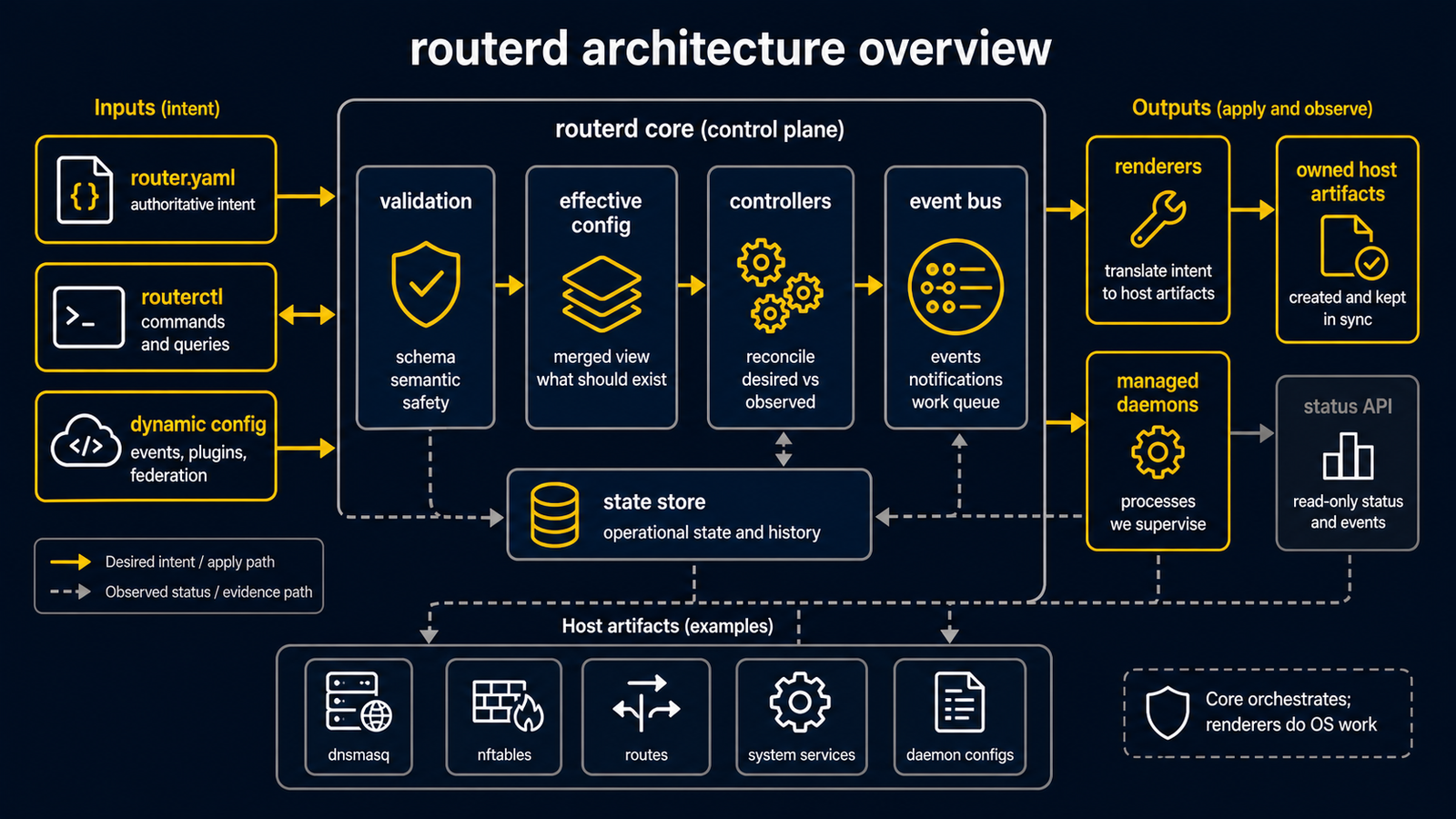
1. Where routerd fits
routerd is a declarative router framework. Its goal is to let you build a home router, a SOHO router, or a small data-center edge router from the same set of primitives.
The three deployment targets we design for:
| Target | Scope | Required tier |
|---|---|---|
| Home-router replacement | One host, one or two uplinks, one to three LAN VLANs | H |
| Hypervisor SDN router | VXLAN / EVPN / underlay routing inside a cluster | C |
| Kubernetes cluster edge | Advertise Pod CIDR / LoadBalancer IP via BGP, terminate ingress | S → C |
All three are expressible with the same declarative primitives. The applicable feature set scales with the deployment.
1.1 Capability tiers
| Tier | Use case | Headline features |
|---|---|---|
| H (Home) | Home or small office | WAN acquire (PD/RA/PPPoE/DHCPv4/DS-Lite), LAN service (RA/DHCPv6/dnsmasq), NAT44, firewall, EgressRoutePolicy |
| S (SOHO/branch) | Several sites with VPN | + WireGuard / IPsec, VRF, dynamic routing across VPN, commit-confirmed |
| C (Campus / small DC) | Tens of nodes | + EVPN-VXLAN, iBGP RR, BFD, RouteMap DSL, richer routing policy |
| E (Enterprise / SP) | Hundreds of nodes | + Full BGP, MP-BGP L3VPN, segment routing, HA leader election |
The primitives are the same from H to E. Higher tiers add more routing and policy controllers on top of the same model.
2. Runtime environment
2.1 Deployment shape
routerd targets virtual machines. Embedded appliances are out of scope for now.
Requirements for the host environment:
- virtio NICs (vmxnet, ne2k, etc. are out of scope)
- No dependency on privileged kernel modules (DPDK / XDP optional, host passthrough not required)
- Console + SSH for operations
- For lab work, snapshots and clones are encouraged
2.2 OS strategy
routerd is designed to be cross-OS. The same binary and the same configuration target multiple operating systems.
| OS | Strengths | Role |
|---|---|---|
| Linux (Ubuntu / Debian) | systemd standard, easy to obtain, recent kernels | Primary platform for development and production |
| FreeBSD | Stable base, small footprint, jail isolation | Long-running and low-resource deployments |
OS-specific differences are absorbed in the pkg/platform layer.
Mappings such as nftables ↔ pf, systemd-networkd ↔ rc.conf, and systemd unit ↔ rc.d script are owned by per-OS renderers.
Versioning policy: routerd uses date-and-time-based release versions in vYYYYMMDD.HHmm format; the previous 0.x.y and yyyymmdd.N pre-release numbering is discontinued.
3. End-to-end picture
┌─────────────────────────────────────────────────────────────────┐
│ User                                                              │
│   /etc/routerd/*.yaml  +  routerctl CLI                          │
└─────────┬─────────────────────────────────────────┬───────────────┘
          │ inotify                          HTTP+JSON
          │ (notify only)                    (explicit apply)
          ▼                                         ▼
┌─────────────────────────────────────────────────────────────────┐
│ routerd (1 binary, multi-OS)                                      │
│                                                                   │
│   ConfigWatcher ──notify only──▶ Bus                              │
│   ConfigLoader ◀──explicit trigger───── routerctl apply           │
│                                                                   │
│   ┌──────────────────────────────────────────────────────────┐   │
│   │ Bus (in-process channel + persistent SQLite event log)    │   │
│   │  topics: routerd.<area>.<subject>.<verb>                  │   │
│   │  cursor: events.id (autoincrement)                        │   │
│   │  fanout: subscribe pattern match → controller channel     │   │
│   └─────┬─────────────────────────────────────────────────────┘   │
│         │                                                         │
│         ▼ Controllers (in-process reactors)                       │
│   PrefixDelegationCtrl / LANAddressCtrl / RAAnnouncerCtrl         │
│   DNSAnswerCtrl / DNSResolverCtrl / FirewallCtrl / RouteCtrl      │
│   EgressRouteCtrl / ServiceLifecycleCtrl / ConfigLoaderCtrl       │
│   EventRuleEngine / DerivedEventEngine                            │
│         │                                                         │
│         ▼ SQLite state DB (objects/events/artifacts/generations)  │
└─────────┬─────────────────────────────────────────────────────────┘
          │ Unix socket HTTP+JSON                fsnotify (lease/snapshot)
          ▼                                            ▲
┌─────────────────────────────────────────────────────────────────┐
│ Layer 1 source daemons (one process each)                         │
│   routerd-dhcpv6-client / routerd-dhcpv4-client                   │
│   routerd-pppoe-client / routerd-dns-resolver                     │
│   routerd-healthcheck@<resource> / routerd-firewall-logger        │
└─────────────────────────────────────────────────────────────────┘
4. Resource model
routerd configuration is a set of resources. The shape is similar to Kubernetes but the apiVersion hierarchy and the controller plumbing are simpler.
- apiVersion: net.routerd.net/v1alpha1
  kind: DSLiteTunnel
  metadata:
    name: ds-lite-primary
  spec:
    aftrFQDN: gw.transix.jp
4.1 Major apiVersions
| apiVersion | Responsibility |
|---|---|
net.routerd.net/v1alpha1 | Networking (Interface, IPv4Static, DSLite, PPPoE, EgressRoute, HealthCheck, etc.) |
dns.routerd.net/v1alpha1 | DNS (DNSZone, DNSResolver, DHCPv4Reservation, etc.) |
firewall.routerd.net/v1alpha1 | Firewall (FirewallZone, FirewallPolicy, FirewallRule, NAT44Rule, etc.) |
system.routerd.net/v1alpha1 | OS bootstrap intent and overrides (Package, SysctlProfile, WebConsole, etc.); host runtime artifacts are derived from resources |
control.routerd.net/v1alpha1 | controller chain and routerctl control surface |
The full list is in the API reference.
4.2 Cross-resource references
When one resource refers to the status of another, use a typed *From field instead of a literal value.
- apiVersion: net.routerd.net/v1alpha1
  kind: WebConsole
  spec:
    listenAddressFrom:
      resource: Interface/mgmt
      field: ipv4Addresses
    port: 8080
addressFrom, ipv4From, ipv6From, prefixFrom, rdnssFrom, gatewayFrom,
and upstreamFrom follow the same shape. Dependencies (dependsOn) use the same
mechanism.
A *From reference whose target has not published a value yet is a normal
bootstrap condition, not an error: the consuming controller reports the resource
as Pending (with a reason naming the unresolved reference) and re-reconciles
when the referenced status changes — no explicit dependsOn is required. For
example a DNSResolver forward source whose upstreamFrom points at a
DHCPv6Information server stays Pending until that server learns its DNS
servers, then becomes Applied on the next reconcile. A source that declares no
upstream at all (neither upstreams nor upstreamFrom) is a real
misconfiguration and is rejected by validation instead.
For details, see resource model and state and ownership.
5. Event bus and controller chain
routerd combines an in-process event bus with a set of controllers to converge to the desired state declared in configuration.
5.1 Event bus
- in-process channels backed by a SQLite event log for persistence
- topics use the pattern
routerd.<area>.<subject>.<verb>(for examplerouterd.dhcpv6.bind.changed) - subscribers receive events via pattern match
- every event has an
events.idcursor so re-evaluation is possible after a restart
5.2 Controller chain
Every controller follows the common framework.FuncController shape:
Subscriptions: topics this controller cares aboutBootstrap: one-shot initialisation at startupPeriodicFunc: idempotent periodic re-evaluationReconcileFunc: state convergence on event arrival
The eventedStore wrapper guarantees that every persisted state change emits routerd.resource.status.changed, which downstream controllers consume to resolve cross-resource dependencies.
Kubernetes edge resources use this status flow directly. IngressService
health checks choose an active backend and the NAT renderer uses that status on
the next reconcile. BGPRouter / BGPPeer status is observed from the
long-lived routerd-bgp daemon with typed ListPeer / ListPath API calls
and can lower VirtualAddress VRRP priority through track. BGP config changes
are applied to that daemon with GoBGP API objects instead of rendering FRR-style
text config or shelling out to reload tools. VirtualAddress and
IngressService hostnames feed
DNSResolver-served zones as derived A/AAAA records, and BGP/VRRP/Ingress status is
also surfaced through routerctl get BGPRouter, routerctl get VirtualAddress,
and routerctl get IngressService views plus low-cardinality OTel metrics for
transitions and backend health.
5.3 Dynamic SAM topology keeps a safe fallback
Dynamic SAM enrollment is a functional-core boundary: an RR admits a
client-authored leaf claim (authenticated by joinTokenFrom when configured),
projects a typed SAMRRSet, and a leaf's existing transport and
BGP controllers apply that snapshot. A policy may bundle an optional direct
leaf SAMPeerGroup in the same dynamic-config part. This does not replace the
RR topology. The leaf retains its RR peers, and direct imported routes have a
higher local preference only while their direct BGP session is established.
Missing, incompatible, or unreachable direct peers therefore fall back to the
RR path without a special recovery controller or a destructive topology update.
For direct topology, the leaf sends a digest of its current claim and requires
every configured RR to echo that same accepted-claim digest and the same peer
group. It also sends an identity digest that covers only client-authored claim
material, not RR-owned expiry or revocation fields. A joinTokenFrom policy
authenticates that material with its join HMAC; a token-less policy is trusted
control-plane input, not cryptographic admission. On a direct-refresh GET, an
RR that lost its volatile admission row can explicitly report that this client
identity is absent. The leaf re-submits only when every other RR either still
attests that identity or gives the same identity-aware absence response. A
revoked identity, a different active identity, an unreachable or ambiguous
legacy RR, or any mismatched topology leaves the RR-only fallback in place.
Revoked client identities are retained in a durable identity ledger, so
replacing an expired dynamic row cannot make an old identity replayable. A
stale or older RR can still refresh the RRSet, but cannot authorize the
higher-preference direct path.
5.4 Daemon contract
Long-running OS processes (DHCPv6 client, DNS resolver, healthcheck, etc.) live as daemons rather than as controllers.
Each daemon talks to the controller chain over a Unix domain socket using JSON, and persists its own state under files such as lease.json.
For details, see reconcile loop behaviour.
6. Operating the configuration file
The routerd configuration file (default /usr/local/etc/routerd/router.yaml) is rolled out as follows.
edit → routerctl validate → routerctl apply
                              │
                              └─ observe host state
                                 → plan
                                 → render host artifacts
                                 → record state and exit

routerd serve
  → consumes state/events
  → starts / enables / reloads managed daemons
  → updates OS state (nftables / netlink / systemd) continuously
We strongly recommend keeping the configuration in git.
Apply changes to production via routerd; do not run ad hoc commands such as nft add rule, ip route add, or sysctl -w directly on the host.
Ad hoc changes are either reverted by the next reconcile or, worse, create drift between the routerd state DB and what the kernel actually has.
The right response to drift is to express the new desired state in configuration and apply it again. apply must return quickly and hand daemon lifecycle to the controller runtime; the long-running serve process keeps the configuration ↔ state DB ↔ OS state triangle aligned.
7. Observability and debugging
routerd exposes its operating state through several surfaces.
routerctl get status— phase per resourcerouterctl describe <kind>/<name>— spec, status, and recent events for one resourcerouterctl get events --topic <pattern> --resource <kind>/<name>— tail the busrouterctl plan --diff— preview the diff a future apply would produce- Web Console (default
http://<mgmt-ip>:8080/) — summary, events, connections, clients, firewall, configuration in a browser journalctl -u routerd.service -f | grep "routerd event"— bus events through the systemd journal
Logs are persisted across four databases by purpose: events.db (controller-driven), dns-queries.db (DNS resolver), traffic-flows.db (conntrack/pf), and firewall-logs.db (NFLOG/pflog).
For details, see log storage.
OpenTelemetry export is configured by the Telemetry resource in
observability.routerd.net/v1alpha1. routerd does not bundle an OTLP
collector. When an endpoint is declared, generated systemd, NixOS, and FreeBSD
rc.d units receive the matching OTEL_* environment variables and the existing
SDK path sends logs, metrics, and traces to that endpoint.
Managed client supervision belongs to the serve lifetime, not to one controller
generation. An unchanged client survives runtime reload; a completed supervisor
must be replaced even when its desired spec is unchanged. VIP readiness gates
initial admission. Retention during degradation requires saved Ready/advertised
MASTER publication for the same address and interface; role demotion withdraws it.
vipPublicationConfirmed retains that history independently of observation
errors. Demotion, observed VIP absence, and failed publication invalidate it.
Installers preserve current generated routerd units and replace obsolete
controller-chain units explicitly.