Path MTU and TCP MSS
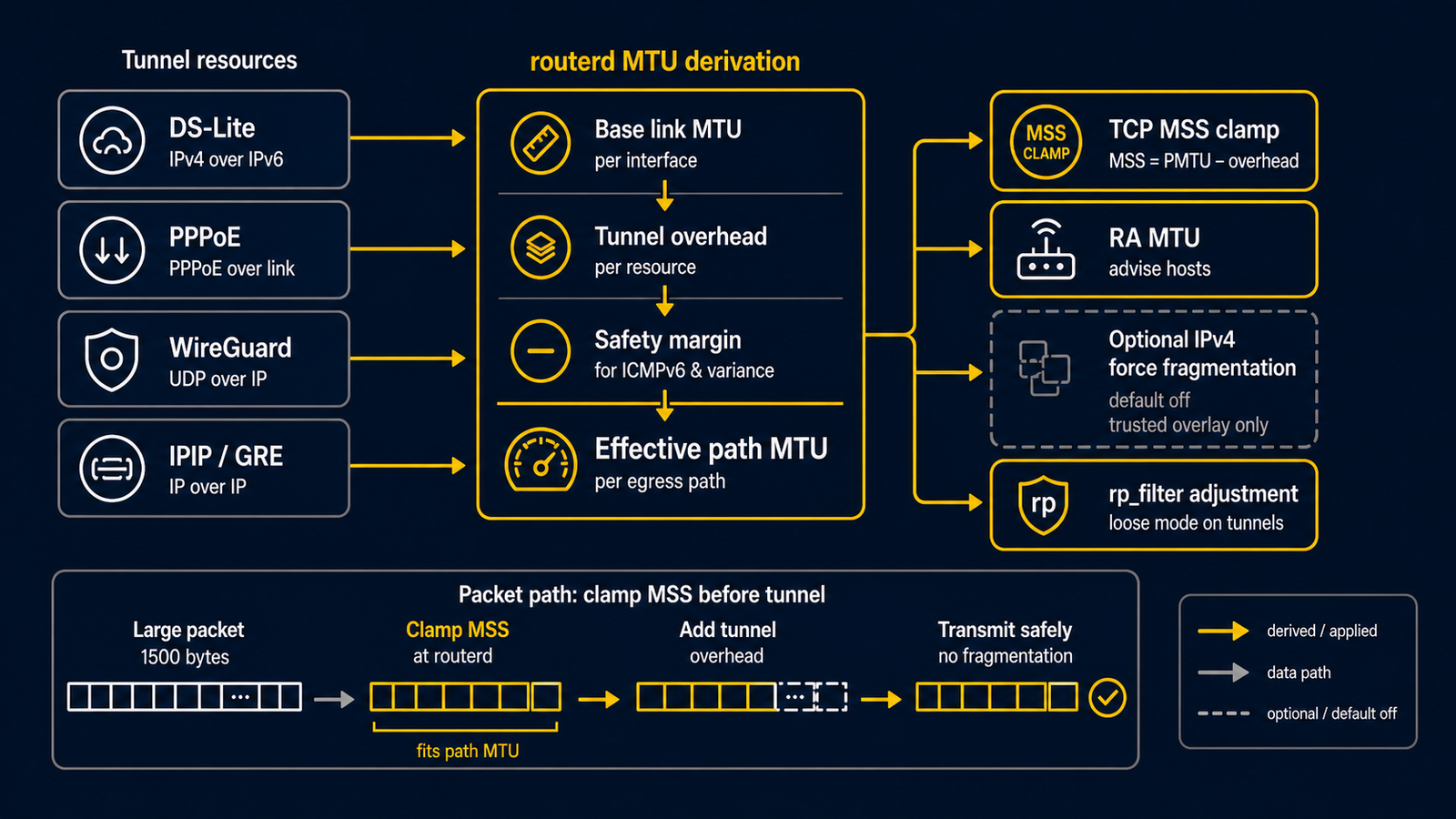
routerd derives path MTU behavior from the resources that create tunnel paths.
DS-Lite, PPPoE, WireGuard, and TunnelInterface underlays (ipip, gre,
fou, gue) provide the effective tunnel MTU, and firewall zones identify the
LAN-to-WAN forwarding direction.
When a trusted interface forwards through an untrusted tunnel, routerd renders
TCP MSS clamping automatically. For IPv4 TCP, MSS is MTU - 40. For IPv6 TCP,
MSS is MTU - 60. The effective value is computed per source and destination
path as the lower of the source interface MTU and destination path MTU. The
Linux nftables renderer only rewrites SYN packets whose advertised MSS is
higher than that derived value, so a lower MSS from another small-MTU interface
is never raised and does not force unrelated LAN paths down.
For trusted overlay paths that still black-hole oversized non-TCP IPv4 traffic
with the DF bit set, OverlayPeer.spec.pathMTU.forceFragmentIPv4 and
TunnelInterface.spec.pathMTU.forceFragmentIPv4 enable an explicit last-resort
fallback. On Linux, routerd renders an ip routerd_forcefrag nftables table
that matches the derived forwarded path, clears DF only when ip length is
larger than the derived path MTU, and then lets the kernel fragment on egress.
This is IPv4-only and default-off. Prefer correct MTU, PMTUD, and TCP MSS clamp
first; use force fragmentation only on a trusted overlay or underlay where
fragmentation is an accepted tradeoff.
Router advertisements also receive a derived MTU when the trusted interface has
a DHCPv6Server or IPv6RouterAdvertisement and the forwarding path uses a
smaller tunnel MTU. The config should declare the LAN, WAN, tunnel, firewall
zones, and RA/DHCPv6 intent; it should not contain a separate MTU policy
resource.
Reverse path filter sysctls follow the same rule: routerd derives conservative
router defaults and tunnel-specific rp_filter=0 settings from router and
tunnel resources.