Event Federation reference
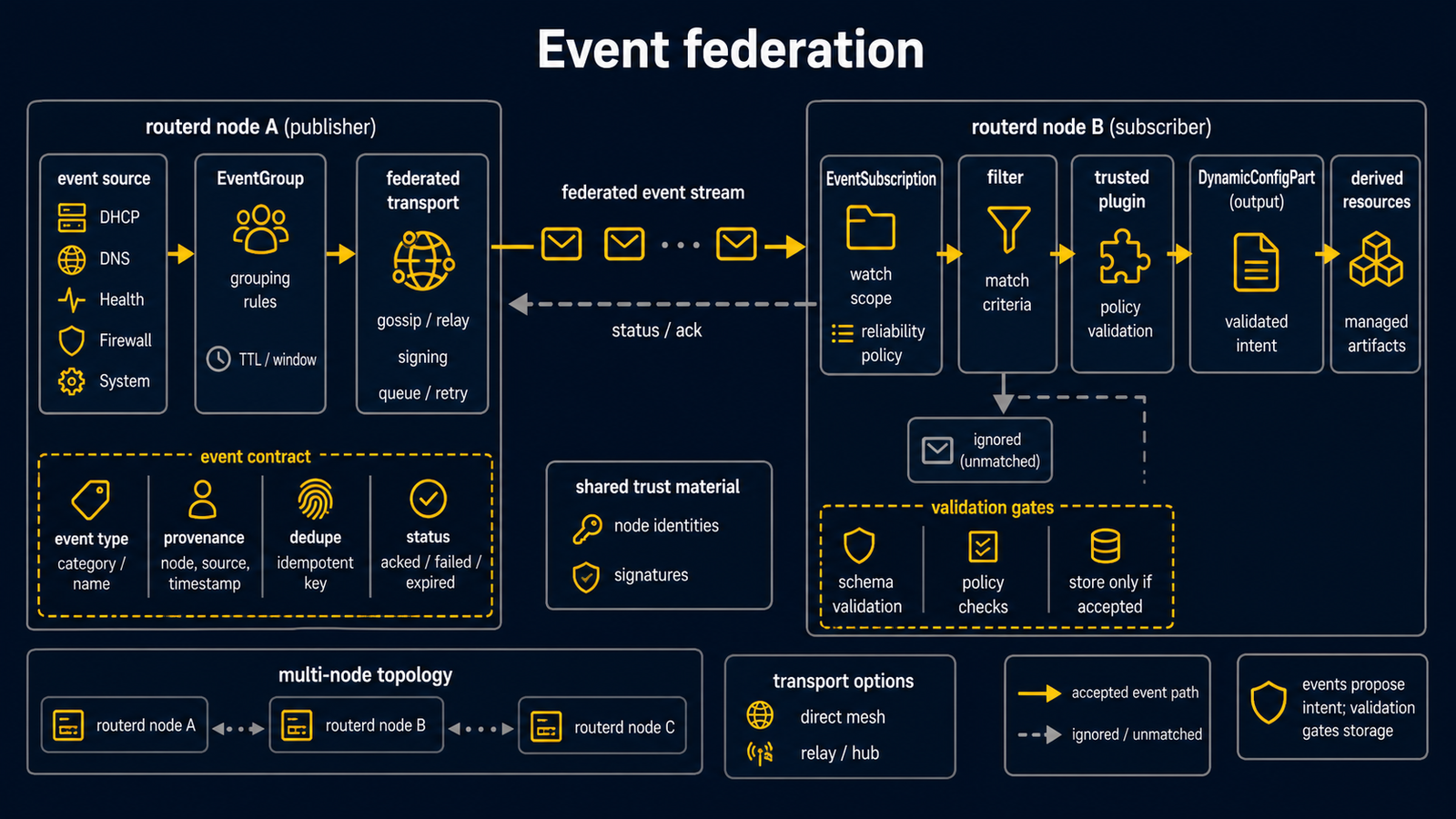
Experimental (CloudEdge). See ADR 0006: CloudEdge Event Federation for the design and invariants, and the how-to CloudEdge mobility demo for a worked example.
Event Federation lets routerd nodes exchange typed, observed facts (e.g. "this
client IPv4 was observed", "this address expired") over the overlay, and lets a
subscriber turn matched events into derived configuration via a plugin. It is the
control-plane substrate beneath
Cloud SAM: an observed address contributes typed
ownership facts used by the receiving MobilityPool plan.
The model is at-least-once delivery with idempotent, observed-fact events.
Events are immutable statements about the world ("observed"), never imperative
commands; a receiver re-deriving the same state from the same events is a no-op.
For example, routerd.mobility.arp.request.observed states that a leaf saw a CE
ask for an unresolved IPv4 target. A receiving leaf may apply its own
MobilityPool scope and rate-limit policy and issue a local probe; the event does
not instruct the receiver to execute one.
Kinds
EventGroup
The bus a node participates in. One node has one identity per group.
| Field | Meaning |
|---|---|
nodeName | This node's identity in the group; stamped as sourceNode on emitted events. |
peersFrom | Optional SAMNodeSet/<name> sources used to derive push peers from each node's eventEndpoint. |
retention | Bounds how many events / how long the local store keeps them. Empty/zero = unlimited. |
auth | HMAC secret material for peer delivery (push). |
listen | Receiver bind (address) for inbound peer pushes. Empty = push-only (no receiver). |
replayWindow | Go duration bounding accepted message timestamp skew for replay protection (default 5m). |
peersFrom lets an EventGroup import peer targets from a shared
SAMNodeSet. The controller reads SAMNodeSet.spec.nodes[].eventEndpoint,
skips the node whose nodeRef matches nodeName, and writes the resolved peers
directly into the generated routerd-eventd config. Hand-authored EventPeer
resources are still accepted and are overlaid after generated peers, so a static
peer with the same nodeName acts as a bootstrap override.
EventPeer
A remote node this node pushes events to.
| Field | Meaning |
|---|---|
groupRef | The EventGroup this peer belongs to (required). |
nodeName | Remote peer node identity (required). |
endpoint | Base URL to push to, e.g. http://10.99.0.7:8787 (required for push). |
direction | Delivery direction; only push is supported. Empty defaults to push. |
types | Optional event-type allowlist; empty delivers all. |
subjectPrefixes | Optional subject-prefix allowlist; empty delivers all. |
EventSubscription
Turns matched events into a plugin invocation that emits a DynamicConfigPart.
| Field | Meaning |
|---|---|
groupRef | The EventGroup to consume from. |
match | Which events to act on (by type / subject). |
trigger.pluginRef | The Plugin invoked for matched events. |
trigger.batchWindow | Coalesce matched events into one invocation (Go duration). |
trigger.debounce | Delay invocation until after the last matched event (Go duration). |
routerctl federation CLI
routerctl federation event emit  --group <g> --type <topic> --subject <entity> [--source-node <n>] [--ttl <dur>] [--payload k=v ...]
routerctl federation event list  --group <g>
routerctl federation event deliveries --group <g>
emit records an observed fact into the local store (e.g.
--type routerd.client.ipv4.observed --subject 10.88.60.9/32). list shows
recorded events; deliveries shows per-peer push delivery state.
Self-capture guard (ADR 0006 no-feedback-loop invariant): a node must not emit
routerd.client.ipv4.observedfor an address already captured by its localMobilityPoolplan, or the delivered capture address would loop back as a fresh observation.
Transport — routerd-eventd
routerd-eventd@<group> is a long-lived per-group daemon (supervised by a
generated systemd unit on Linux, rc.d on FreeBSD) that:
- pushes locally-recorded events to each
EventPeerover HTTP, signed with the group HMAC; the receiver verifies the signature and rejects messages outside thereplayWindow. - records deliveries (per peer, per event) so at-least-once retry is bounded and observable.
- prunes the local event store per the group
retention.
The outbox carries a sourceNode guard so a received event is not re-forwarded back
to its origin (no delivery loop).
When EventGroup.spec.peersFrom is present, routerd-eventd still sees ordinary
peer entries in its config. The dynamic part is resolved by the routerd
controller before writing config.json; no separate DynamicConfigPart is
created for EventPeer derivation.
Subscription → plugin → DynamicConfigPart flow
- A node emits an observed fact (
routerctl federation event emit, or a future observer). routerd-eventddelivers it to peers; each peer records it in its event store.- A peer's
EventSubscriptionmatches the event and invokestrigger.pluginRef, coalescing perbatchWindow/debounce. - The plugin returns observed facts or ordinary dynamic resources. The Mobility controller consumes the facts and persists one typed local capture plan for the dataplane.
This keeps the operator-authored intent declarative: the operator declares the group/peers/subscription; capture and provider action plans are derived.