EgressRoutePolicy
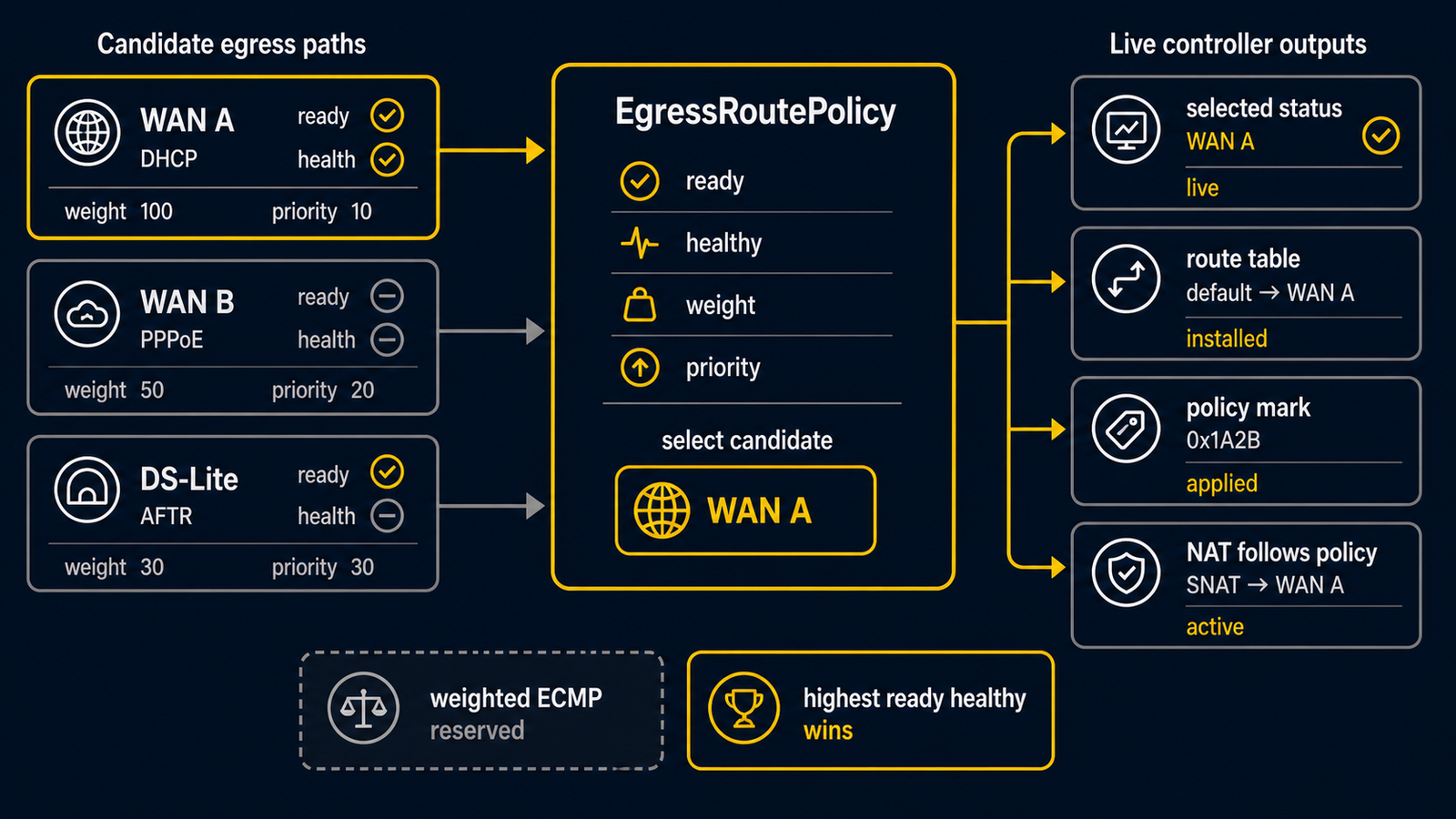
EgressRoutePolicy selects the route used for outbound traffic. It replaces
an earlier WAN route policy Kind. This is a clean break. The old Kind name is
not accepted.
The policy watches candidate resources and health checks. It stores the chosen candidate in status. Other resources can refer to that status.
spec.mode decides which controller owns the status. When mode is omitted,
the egress-route selector publishes selection-only status and
routerd.lan.route.changed events with role: advisory / advisory: true.
That status is live controller output, not an apply dry run. When mode is set
to priority, mark, or hash, the policy-route controller owns the applied
routing/NAT mark state and dependent controllers follow
routerd.resource.status.changed instead of the legacy route-changed event.
mode: priority still uses selection: highest-weight-ready. The highest
weight ready candidate wins; priority is the tie-breaker and the policy-route
rule priority, not a replacement for the selection policy. weighted-ecmp is
reserved until implemented and is reported as UnsupportedSelection rather
than being silently ignored. enabled: false removes the candidate from
selection and from generated policy-route rule/table ownership.
apiVersion: net.routerd.net/v1alpha1
kind: EgressRoutePolicy
metadata:
  name: ipv4-default
spec:
  family: ipv4
  destinationCIDRs:
    - 0.0.0.0/0
  selection: highest-weight-ready
  candidates:
    - name: ds-lite
      source: DSLiteTunnel/ds-lite
      deviceFrom:
        resource: DSLiteTunnel/ds-lite
        field: interface
      gatewaySource: none
      weight: 80
      healthCheck: internet-tcp443
    - name: ix2215
      source: Interface/ix2215
      deviceFrom:
        resource: Interface/ix2215
        field: ifname
      gatewaySource: static
      gateway: 172.17.0.1
      weight: 50
destinationCIDRs limits the destinations managed by the policy. If it is
omitted, routerd uses 0.0.0.0/0 for IPv4 and ::/0 for IPv6.
gatewaySource describes how the gateway is chosen.
none: point-to-point devices such as DS-Lite do not need a gateway.static:gatewaycontains the next-hop address.dhcpv4anddhcpv6: reserved for gateway values learned from client leases.
The selected values are exposed as:
status.selectedCandidatestatus.selectedDevicestatus.selectedGatewaystatus.selectedWeightstatus.selectedTargetsstatus.destinationCIDRs
When a candidate is gated by VirtualAddress/<name>.role: master, applied
mode: priority status also reports HA data-path convergence:
status.datapathState(Standby,Converging, orReady)status.datapathRoleTransitionAtstatus.datapathReadyAtstatus.datapathReadyDurationandstatus.datapathReadyDurationMillisstatus.newFlowBehavior
During Converging, routerd deliberately selects the next ready candidate for
new unmarked flows (datapathFallbackBehavior: select-next-ready-candidate).
It does not silently drop those flows. Existing flows with a replicated,
non-zero conntrack mark keep that mark and do not enter new-flow selection.
The keepalived transition hook wakes routerd immediately; the periodic VRRP
observation remains as a recovery path if the notification cannot be delivered.
At startup, the policy chooses the first ready candidate instead of waiting for
the highest-weight path forever. If a higher-weight candidate becomes ready
later, routerd updates IPv4Route and NAT44Rule through
routerd.lan.route.changed. It does not flush conntrack. Existing flows keep
the kernel state they already have, while new flows use the new route and NAT
direction.
For candidates with multiple targets, routerd hashes new flows into 256 fixed
buckets and assigns those buckets with rendezvous hashing. The seed and target
identity are stable across reconciliation and restart. If a target becomes
unhealthy, only buckets owned by that target move to the next-ready target; a
recovered target takes back the same buckets. Adding or removing a target also
changes only the buckets whose rendezvous winner changes. Existing flows keep
their non-zero conntrack mark and are not rehashed. The fixed bucket table is a
small nftables rule-size cost in exchange for bounded remapping and stable
source-address affinity.
IPv4Route can use those status fields:
apiVersion: net.routerd.net/v1alpha1
kind: IPv4Route
metadata:
  name: default-route
spec:
  destination: 0.0.0.0/0
  deviceFrom:
    resource: EgressRoutePolicy/ipv4-default
    field: selectedDevice
  gatewayFrom:
    resource: EgressRoutePolicy/ipv4-default
    field: selectedGateway
Private destinations that must not leave through a DS-Lite (or any) tunnel can
be modeled as ordinary routes. Use a WAN-side route for the upstream gateway's
private subnet, a dedicated route for any internal 10.0.0.0/8 or
172.16.0.0/12 ranges, and type: blackhole for ranges that should be
discarded:
apiVersion: net.routerd.net/v1alpha1
kind: IPv4Route
metadata:
  name: private-10-blackhole
spec:
  type: blackhole
  destination: 10.0.0.0/8
Health Checks
HealthCheck can pin probes to a path.
apiVersion: net.routerd.net/v1alpha1
kind: HealthCheck
metadata:
  name: internet-tcp443
spec:
  target: 1.1.1.1
  protocol: tcp
  port: 443
When a HealthCheck is referenced by an EgressRoutePolicy candidate or
target, routerd derives the health-check daemon, socket mark, and source binding
from that route target automatically. The config describes the probe intent;
platform-specific socket mechanics stay inside the controller and renderer.