Private DNS upstreams
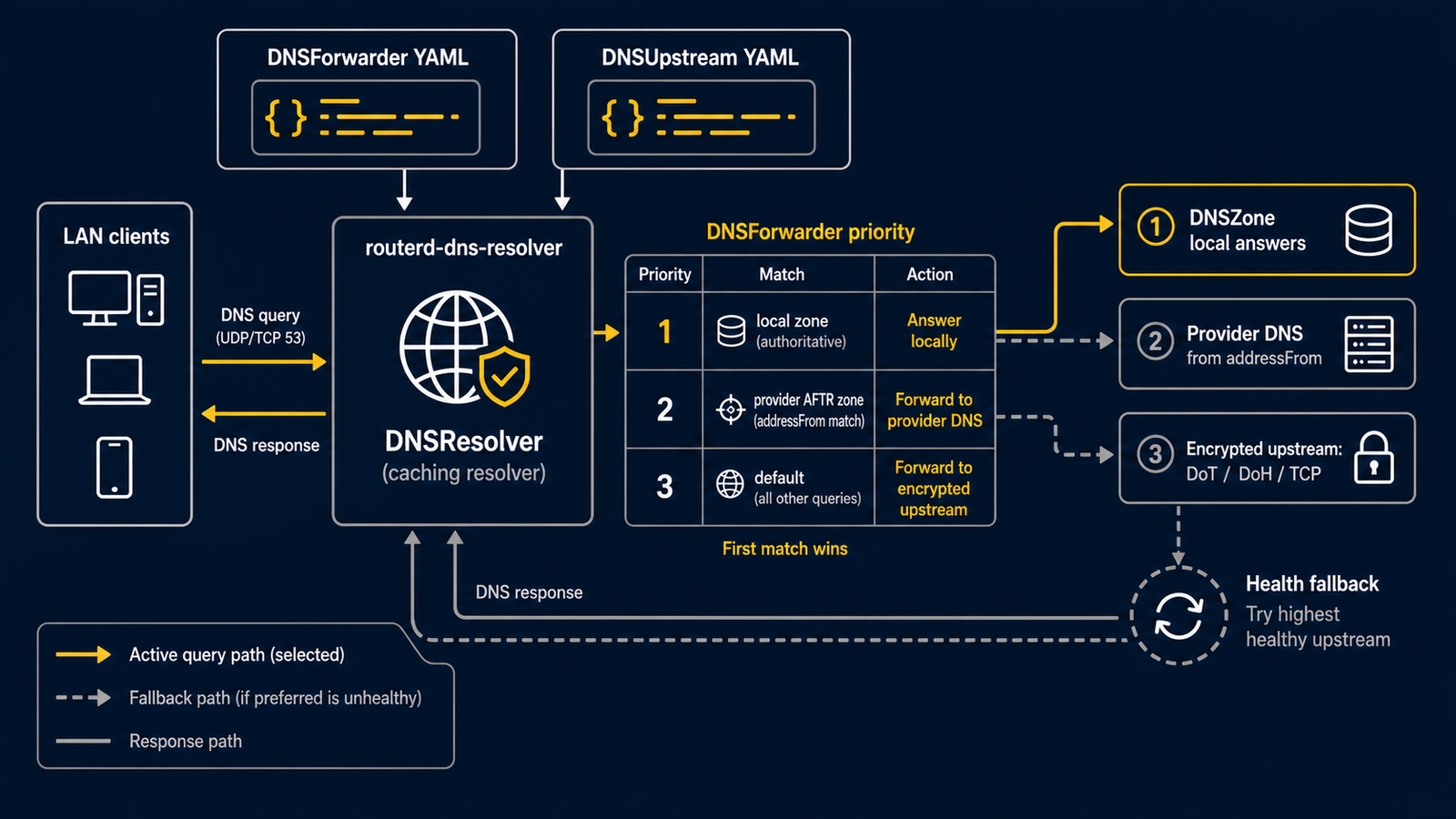
Scenario
You want the resolver on the router to:
- Forward queries for the access network's internal zones (e.g. an ISP's AFTR FQDN, an enterprise intranet domain) to a specific DNS server learned dynamically.
- Use a private encrypted DNS provider (DoH / DoT) as the default upstream.
- Keep a fast plain-DNS fallback if the encrypted upstream becomes unhealthy.
- Avoid exposing provider account IDs or private endpoints in shared examples.
How routerd solves it
DNSResolver runs routerd-dns-resolver. The daemon listens on UDP/TCP. DNSForwarder resources attached to the resolver define the ordered match rules, and DNSUpstream resources define reusable upstream endpoints.
| Scheme | Protocol | Default port |
|---|---|---|
https:// | DNS over HTTPS | URL-dependent |
tls:// | DNS over TLS | 853 |
udp:// | Plain DNS over UDP | 53 |
tcp:// | Plain DNS over TCP | 53 |
The order in DNSForwarder.spec.upstreams is the priority order. routerd tries the highest-priority upstream that is healthy, and falls back through the list when one fails.
DNSUpstream.spec.addressFrom lets the upstream address list come from another resource's status. This is the mechanism for using DNS servers learned through DHCPv6 information request.
Conditional forwarding example
- apiVersion: net.routerd.net/v1alpha1
  kind: DNSResolver
  metadata:
    name: lan-resolver
  spec:
    listen:
      - name: lan
        addresses:
          - 192.0.2.1
        port: 53
        sources:
          - local-zone
          - access-network
          - provider-bootstrap
          - default
    cache:
      enabled: true
      maxEntries: 10000
      minTTL: 60s
      maxTTL: 24h
      negativeTTL: 30s
- apiVersion: net.routerd.net/v1alpha1
  kind: DNSForwarder
  metadata:
    name: local-zone
  spec:
    resolver: DNSResolver/lan-resolver
    match: [lan.example.org]
    zoneRefs: [DNSZone/lan]
- apiVersion: net.routerd.net/v1alpha1
  kind: DNSForwarder
  metadata:
    name: access-network
  spec:
    resolver: DNSResolver/lan-resolver
    match: [transix.jp, corp.example.com]
    upstreams: [DNSUpstream/access-network]
- apiVersion: net.routerd.net/v1alpha1
  kind: DNSUpstream
  metadata:
    name: access-network
  spec:
    protocol: udp
    addressFrom:
      - resource: DHCPv6Information/wan-info
        field: dnsServers
- apiVersion: net.routerd.net/v1alpha1
  kind: DNSForwarder
  metadata:
    name: provider-bootstrap
  spec:
    resolver: DNSResolver/lan-resolver
    match: [dns.example-provider.net]
    upstreams: [DNSUpstream/cloudflare-udp, DNSUpstream/google-udp]
- apiVersion: net.routerd.net/v1alpha1
  kind: DNSForwarder
  metadata:
    name: default
  spec:
    resolver: DNSResolver/lan-resolver
    match: ["."]
    upstreams: [DNSUpstream/provider-doh, DNSUpstream/provider-dot, DNSUpstream/cloudflare-udp]
    healthcheck:
      interval: 15s
      timeout: 3s
      failThreshold: 3
      passThreshold: 2
    dnssecValidate: true
- apiVersion: net.routerd.net/v1alpha1
  kind: DNSUpstream
  metadata:
    name: provider-doh
  spec:
    protocol: doh
    address: dns.example-provider.net
    path: /dns-query
    sourceInterface: ens18
    bootstrap: [1.1.1.1, 2606:4700:4700::1111]
- apiVersion: net.routerd.net/v1alpha1
  kind: DNSUpstream
  metadata:
    name: provider-dot
  spec:
    protocol: dot
    address: dns.example-provider.net
    sourceInterface: ens18
    bootstrap: [1.1.1.1, 2606:4700:4700::1111]
- apiVersion: net.routerd.net/v1alpha1
  kind: DNSUpstream
  metadata:
    name: cloudflare-udp
  spec:
    protocol: udp
    address: 1.1.1.1
- apiVersion: net.routerd.net/v1alpha1
  kind: DNSUpstream
  metadata:
    name: google-udp
  spec:
    protocol: udp
    address: 8.8.8.8
Provider bootstrap
Some private DNS providers serve their resolver endpoint from a domain that the resolver itself is going to use. If a host tries to resolve that provider name through the provider, the query loops or fails before the resolver is healthy.
Add a conditional source for the provider domain that points to a public resolver or to access-network DNS. Keep account IDs (e.g. provider profile IDs) out of shared examples; put them only in your local secrets file or in a per-host YAML overlay.
The DNSUpstream.spec.bootstrap field provides the same protection at a finer granularity: it specifies which resolvers to use for resolving the upstream endpoint name itself, before the encrypted transport is established. Use bootstrapFrom when those resolver addresses come from another resource status, such as DHCPv6-provided DNS servers.
Interface binding
DNSUpstream.spec.sourceInterface binds outgoing DNS queries to a specific Linux interface name. Use a literal OS interface name such as ens18. If the interface is created by another resource (e.g. a tunnel), declare the relationship with ownerRefs or resource ordering and keep the resolver pending until the interface exists.
FreeBSD does not currently provide the same SO_BINDTODEVICE enforcement, so platform-specific docs do not promise identical behaviour there.