NAT44 session sync for HA routers
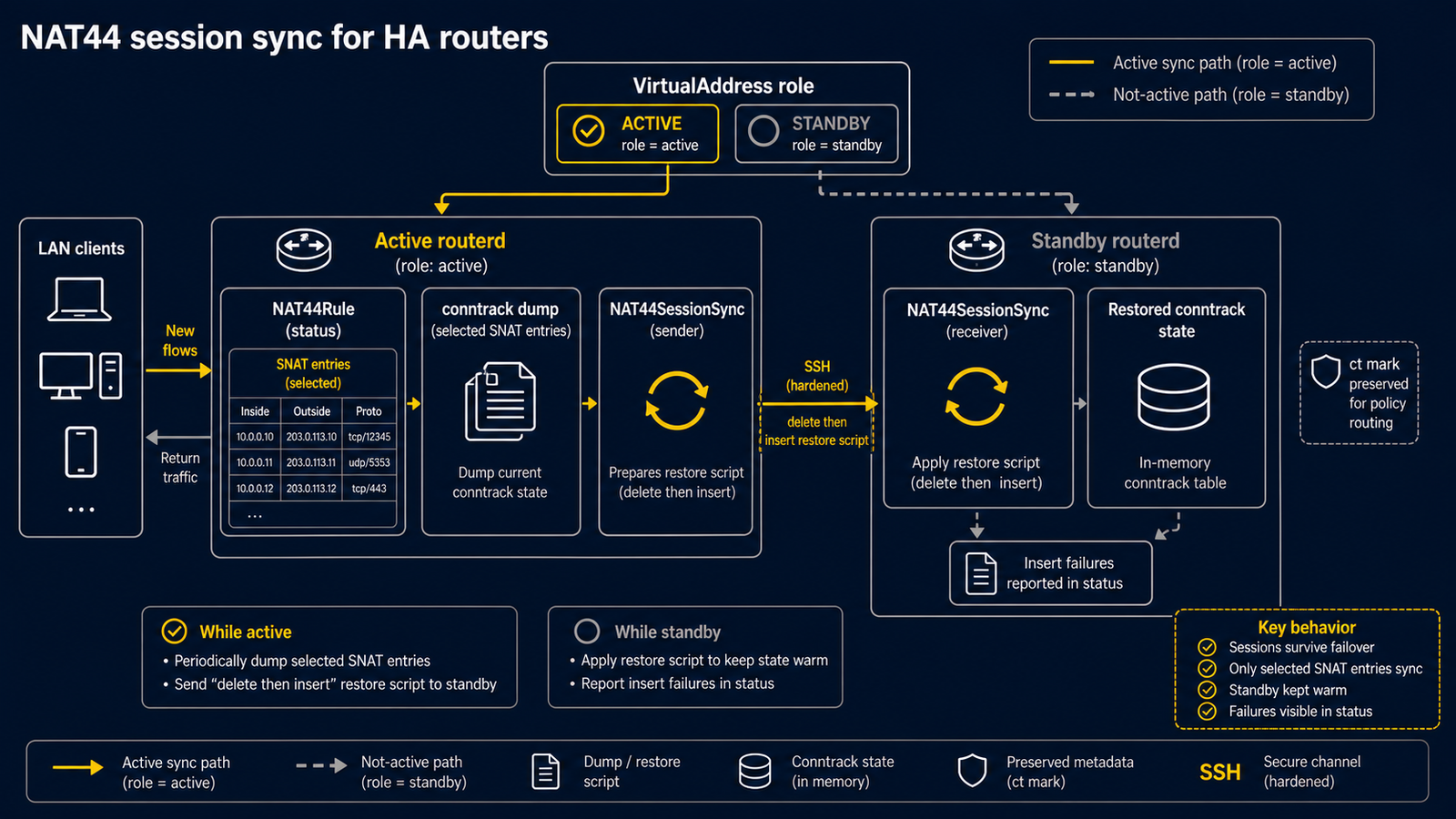
Use NAT44SessionSync when two routerd nodes share a LAN gateway role and the
active node should keep selected NAT44 conntrack sessions warm on a standby
node. It starts with a one-time conntrack snapshot safety net, then keeps a
local conntrack event reader running and sends incremental batches.
Gate the resource with spec.when so only the active node exports sessions.
For VRRP-based failover, the usual gate is the local VirtualAddress role.
Sync selected NAT rules
Reference the NAT rules whose SNAT addresses should be mirrored. Dynamic SNAT
addresses are read from NAT44Rule status, so run the NAT44 controller before
expecting session sync to become active.
- apiVersion: net.routerd.net/v1alpha1
  kind: NAT44SessionSync
  metadata:
    name: dslite-abc-sessions
  spec:
    mode: event-stream
    natRules:
      - NAT44Rule/lan-to-dslite-a
      - NAT44Rule/lan-to-dslite-b
      - NAT44Rule/lan-to-dslite-c
    excludeNatRules:
      - NAT44Rule/lan-to-dslite-ra
    targets:
      - name: standby
        host: routerd-standby.lan.example
        user: routerd
        restoreCommand: [sudo, conntrack]
    when:
      state:
        VirtualAddress/lan-vip.role:
          equals: master
You can also provide snatAddresses directly when the addresses are static:
spec:
  snatAddresses: [192.0.0.2, 192.0.0.3, 192.0.0.4]
Preserve established TCP with conntrackd
Use mode: conntrackd when established TCP flows must survive a VRRP role
change. Both peers run conntrackd continuously, so this mode must not use
spec.when.
Linux conntrack must accept the small TCP window mismatch that can occur when an in-flight segment reaches the new active peer. Declare that host prerequisite explicitly; routerd does not change it from a VRRP hook:
- apiVersion: system.routerd.net/v1alpha1
  kind: Sysctl
  metadata:
    name: conntrack-tcp-ha-liberal
  spec:
    key: net.netfilter.nf_conntrack_tcp_be_liberal
    value: "1"
    runtime: true
    persistent: true

- apiVersion: net.routerd.net/v1alpha1
  kind: NAT44SessionSync
  metadata:
    name: dslite-sessions
  spec:
    mode: conntrackd
    snatAddresses: [192.0.2.2]
    conntrackd:
      interface: ha-sync
      localAddress: 192.0.2.10
      peerAddress: 192.0.2.11
      port: 3780
Validation rejects Linux conntrackd mode unless a runtime, non-optional
Sysctl declares net.netfilter.nf_conntrack_tcp_be_liberal=1.
persistent: true is recommended so the prerequisite is also present before
routerd starts after a reboot.
How restore works
The controller runs:
conntrack --dump -o extended -n <snat-address>
extended output includes the conntrack mark. routerd converts each line into
a delete-then-insert restore script and sends it over SSH. Preserving ct mark
matters when policy routing uses conntrack marks to keep an existing flow on
the same egress path.
restoreCommand defaults to [conntrack]. Use [sudo, conntrack] when the
target user needs privilege elevation.
Event stream operation
NAT44SessionSync always keeps a local conntrack -E -o extended reader
alive and sends incremental create/update/destroy batches.
On startup and after
local stream loss, the target first receives a full snapshot resync. Only after
that resync completes is the resource reported as Synced.
spec:
  mode: event-stream
  natRules:
    - NAT44Rule/lan-to-dslite-a
  targets:
    - name: standby
      host: routerd-standby.lan.example
      user: routerd
      restoreCommand: [sudo, conntrack]
The operational differences are:
- lower steady-state
sshandconntrackprocess churn; - lower failover warm-up delay for active sessions;
- status that reports stream state, queue depth, last event time, last batch time, last resync time, and resync count;
- explicit fallback to snapshot resync when stream integrity is uncertain.
The first event stream implementation still uses the existing SSH restore path for each event batch. Long-lived target restore sessions can be added later if the batch restore path becomes the next bottleneck.
See ADR 0016 for the design and migration plan.
Check it
routerctl describe NAT44SessionSync/dslite-abc-sessions
routerctl doctor nat
routerd serve --controllers nat44-session-sync --config router.yaml
When spec.when is false, status stays Pending with reason WhenFalse. When
a referenced NAT44Rule has not resolved snatAddress yet, status stays
Pending with reason SNATAddressPending.
For conntrackd mode, routerctl doctor nat fails when the runtime
nf_conntrack_tcp_be_liberal value is not 1 or cannot be read. With
--no-host, this check is reported as skip.