How-to: execute the AWS SAM provider action via the gated executor
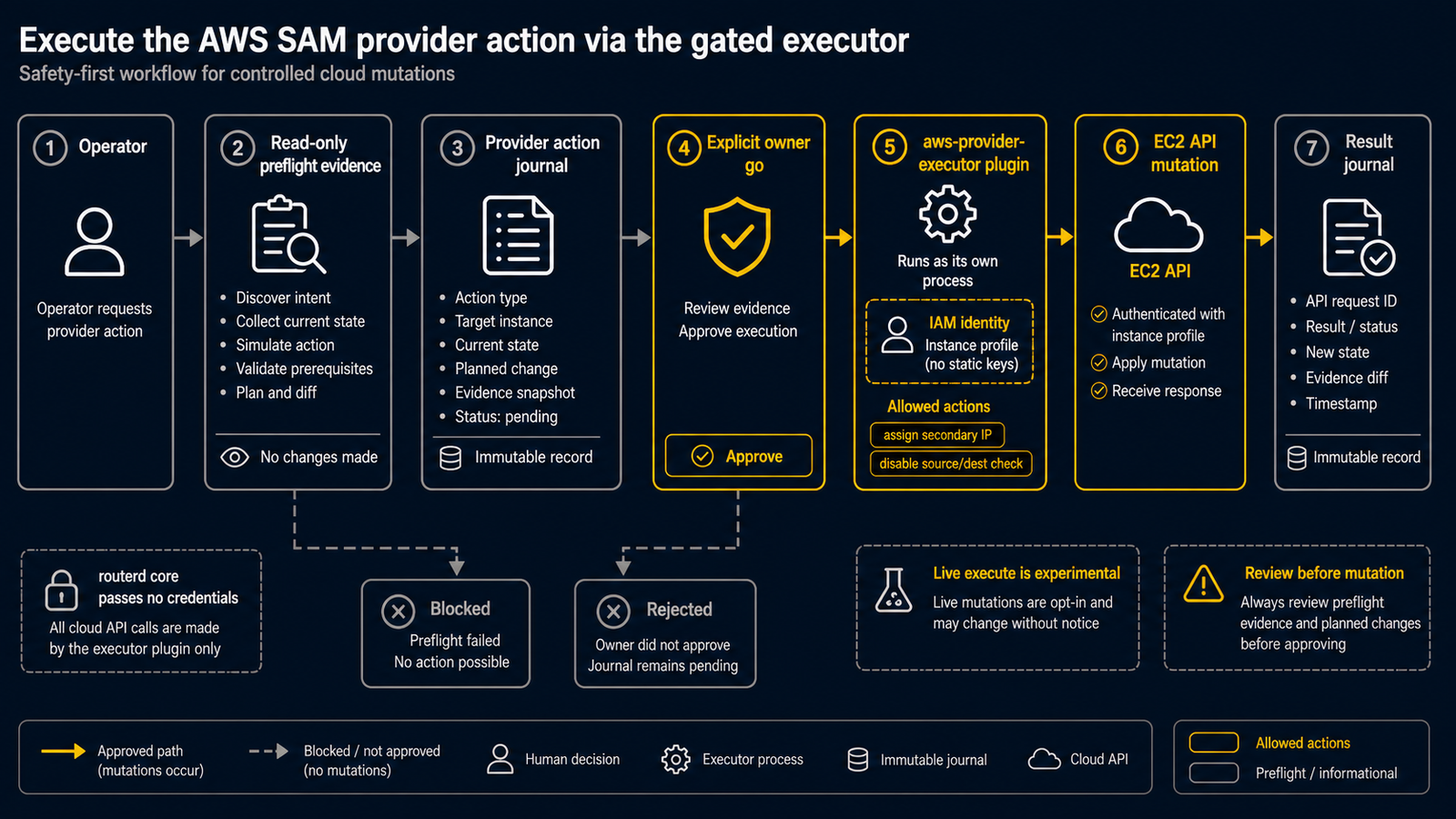
This is the gated live-mutation path for CloudEdge provider action execution. It is experimental and AWS-only. It builds on ADR 0007: Provider Action Execution and the Selective Address Mobility dataplane. Do not run the live execute step in production or against shared resources. Live execute happens only after explicit owner go following review of this runbook and the read-only preflight evidence.
The SAM dataplane is already real-cloud validated on AWS×PVE (an ENI secondary
private IP plus source/dest check disabled). Until now that attach/detach was a
manual operator step. This guide describes the aws-provider-executor plugin
that performs the same mutation through the gated, journaled execution path
(ADR 0007) instead of by hand.
1. Scope & boundaries
- AWS only. Exactly one provider. No Azure, no OCI in this runbook.
- Topology: 1
routerd-cloudnode + 1 cloud-client + 1 on-prem-client, with exactly one captured/32moving from on-prem to the cloud ENI. In lab address terms (per the SAM reference) the cloud-client is.7and the on-prem-client is.9. - Dedicated lab only. A throwaway VPC / subnet / instance created for this test. No production or shared resources. No EIPs, security groups, route tables, or instances that anything else depends on.
- Live execute only after explicit owner go. Everything up to and including the read-only preflight (Section 4) is runnable freely; the mutation in Section 7 is gated.
2. Executor design
The aws-provider-executor is a plugin advertising the capability
execute.providerAction (the Phase 5 enum value on PluginSpec.Capabilities).
It runs in its own process and authenticates with the EC2 instance IAM
role (instance profile) via the AWS CLI. routerd core passes it no
credentials — the executor uses cloud-native identity only, per the ADR 0007
hard invariant.
It reads one ExecuteActionRequest on stdin and writes one
ExecuteActionResult on stdout. The request spec carries Action, Provider,
ProviderRef, Target (the provider keys: for AWS nicRef = ENI id, address,
region), Parameters, Mode (dry-run | execute), IdempotencyKey, and the
allowlisted Context. The result carries Status (succeeded | failed |
skipped), Message, Observed (non-secret facts the journal records),
UndoAvailable, and Error.
dry-run mode performs NO mutation — describe / read-only calls only.
execute mode mutates.
assign-secondary-ip
Attach the captured /32 to the cloud ENI.
-
dry-run (read-only): describe the ENI to report current secondary IPs, then report
would assign <address> to <eni>.aws ec2 describe-network-interfaces \--network-interface-ids "<eni-id>" --region "<region>" -
execute (mutating):
aws ec2 assign-private-ip-addresses \--network-interface-id "<eni-id>" \--private-ip-addresses "<address>" --region "<region>"
ensure-forwarding-enabled
Disable the ENI source/dest check so the cloud node can forward for the captured address.
-
dry-run (read-only): describe the current
SourceDestCheck, reportwould set SourceDestCheck=false. -
execute (mutating): first describe the current
SourceDestCheckand capture the prior value intoObserved, then disable it.# 1. capture prior state (read-only) BEFORE mutatingaws ec2 describe-network-interfaces \--network-interface-ids "<eni-id>" --region "<region>" \--query 'NetworkInterfaces[0].SourceDestCheck'# 2. mutateaws ec2 modify-network-interface-attribute \--network-interface-id "<eni-id>" \--no-source-dest-check --region "<region>"The result's
ObservedMUST includepriorSourceDestCheck=<true|false>so the journal records the state that existed before this action ran. The undo step depends on it.
unassign-secondary-ip (undo of assign-secondary-ip)
aws ec2 unassign-private-ip-addresses \
--network-interface-id "<eni-id>" \
--private-ip-addresses "<address>" --region "<region>"
ensure-forwarding-disabled (undo of ensure-forwarding-enabled)
Restore the PRIOR state recorded in the journal's Observed.priorSourceDestCheck.
This is the load-bearing safety rule:
-
If
priorSourceDestCheck == true→ the check was on before we touched it → restore it:aws ec2 modify-network-interface-attribute \--network-interface-id "<eni-id>" \--source-dest-check --region "<region>" -
If
priorSourceDestCheck == false→ the check was already disabled before we ran (the ENI was already a forwarder) → NO-OP. ReturnStatus=skipped. Do not force the check back on.
NEVER hardcode undo = enable the check. A blind "undo re-enables source/dest-check" would break an appliance/ENI that was already a forwarder for its own reasons. The undo must read back what we observed and only revert what we actually changed.
3. IAM least-privilege
The instance profile attached to the executor's EC2 instance gets exactly these four EC2 actions and nothing more:
| Action | Used by |
|---|---|
ec2:DescribeNetworkInterfaces | dry-run + preflight + prior-state capture |
ec2:AssignPrivateIpAddresses | assign-secondary-ip execute |
ec2:UnassignPrivateIpAddresses | unassign-secondary-ip undo |
ec2:ModifyNetworkInterfaceAttribute | forwarding enable/disable execute |
Scope to the lab ENI / VPC via resource ARNs and conditions wherever the API
supports it (the mutating ENI actions are resource-scopable to the lab ENI ARN;
Describe* is not resource-scopable and is restricted by condition keys such as
ec2:Region / ec2:Vpc where applicable):
{
"Version": "2012-10-17",
"Statement": [
{
"Sid": "DescribeEnis",
"Effect": "Allow",
"Action": "ec2:DescribeNetworkInterfaces",
"Resource": "*",
"Condition": { "StringEquals": { "ec2:Region": "<region>" } }
},
{
"Sid": "MutateLabEni",
"Effect": "Allow",
"Action": [
"ec2:AssignPrivateIpAddresses",
"ec2:UnassignPrivateIpAddresses",
"ec2:ModifyNetworkInterfaceAttribute"
],
"Resource": "arn:aws:ec2:<region>:<account-id>:network-interface/<eni-id>"
}
]
}
No broader EC2 permissions. No IAM/STS write. No other AWS services. If a needed call is not on this list, the runbook stops rather than widening the role.
4. Read-only preflight
Run before any mutation, against the dedicated lab, to confirm the target. None of these mutate. lab-codex runs these and captures the output as the evidence the owner reviews before granting go.
# Target ENI + its current secondary private IPs + current SourceDestCheck
aws ec2 describe-network-interfaces \
--network-interface-ids "<eni-id>" --region "<region>" \
--query 'NetworkInterfaces[0].{Eni:NetworkInterfaceId,SrcDstCheck:SourceDestCheck,PrivateIps:PrivateIpAddresses[*].PrivateIpAddress}'
# The instance the ENI is attached to
aws ec2 describe-instances \
--filters "Name=network-interface.network-interface-id,Values=<eni-id>" \
--region "<region>"
# Subnet of the ENI
aws ec2 describe-subnets \
--subnet-ids "<subnet-id>" --region "<region>"
# Route table(s) for that subnet (confirm default gateway / no surprises)
aws ec2 describe-route-tables \
--filters "Name=association.subnet-id,Values=<subnet-id>" \
--region "<region>"
Then confirm:
- The IAM role has only the 4 permissions in Section 3 — inspect the instance profile's attached policy and verify no broader EC2, no IAM/STS write, no other services. (Read-only inspection of the policy document; do not modify it here.)
- The address is not already assigned — the
<address>must not already appear in the ENI'sPrivateIpAddressesfrom the first describe above. If it is already there, assign is a no-op / the lab is dirty — stop and investigate. SourceDestCheckcurrent value is recorded — this is the value the executor will capture aspriorSourceDestCheckduring execute.
5. Action journal fields the smoke relies on
The action_executions journal records, per action:
idempotencyKey— the dedupe key; a key that already succeeded is not run again.provider—aws.action— e.g.assign-secondary-ip,ensure-forwarding-enabled.target—eni,address,region.status—pending/approved/succeeded/failed/skipped/rolledBack.Observed.priorSourceDestCheck—true|false, captured before mutating; the undo ofensure-forwarding-enabledreads this.executedAt— timestamp.result/error— theExecuteActionResultmessage /Error.
The journal is the single source of truth for what ran and for the idempotency guard. Credentials are never journaled.
6. Undo / teardown plan
Reverse, in order, anything that was applied. Every step must be describable before the live run begins.
-
Undo forwarding —
ensure-forwarding-disabled, applying the restore-prior rule from Section 2: ifObserved.priorSourceDestCheckwastrue, run--source-dest-checkto re-enable it; if it wasfalse, NO-OP (skipped). Never blindly force the check on. -
Unassign the secondary IP —
unassign-secondary-ip:aws ec2 unassign-private-ip-addresses \--network-interface-id "<eni-id>" \--private-ip-addresses "<address>" --region "<region>" -
Stop / terminate lab instances and release cost-bearing resources — stop or terminate the
routerd-cloud, cloud-client, and on-prem-client lab instances; release any allocated EIP; delete any orphaned EBS volumes; tear down the dedicated VPC/subnet/SG if created only for this test.
Stop or delete every cost-bearing resource after evidence is captured. Do not leave lab instances running idle.
7. Live mutation smoke plan + acceptance
The smoke exercises the full gated path. Run only after the Section 9 gate is granted.
Sequence:
actionPlangenerated (planner, dry-run, as Phase 4.1).- Action imported into the journal as
pending(keyed byidempotencyKey). - Action approved (
routerctl action approve). - Action executed by the
aws-provider-executor(routerctl action execute --approved). - Journal shows
succeeded.
Acceptance (all must hold):
- actionPlan generated → imported → approved → executed → journal
succeeded. - The secondary IP exists on the ENI (
describe-network-interfacesshows<address>inPrivateIpAddresses). - Source/dest check disabled on the ENI (
SourceDestCheck=false), withObserved.priorSourceDestCheckrecorded in the journal. -
routerd-clouddoes NOT retain a BGP provider-secondary address as a local OS address, even while the provider secondary IP remains assigned on the ENI. Capture is provider ingress plus route/forwarding state, not a Linux local/32. -
MobilityPoolreports a healthy capture plan. -
routerctl doctorhybrid checks pass. - cloud-client
.7↔ on-prem-client.9— ping and ssh both ways succeed. - NAT absent on the captured path (routed/forwarded, not translated).
- Default gateway unchanged on every node.
- Teardown / undo succeeds (Section 6), including the source/dest-check restore-prior rule.
- Cost-bearing resources stopped / deleted after evidence capture.
8. Hard stops
Abort immediately (do not "work around") if any of the following is true:
- Credentials would pass through routerd core (they must not — executor uses its own instance profile only).
- The action would affect a non-lab resource.
- More than one provider is in play.
- Rollback / cleanup is not describable beforehand.
- The provider API returns an ambiguous / partial success.
- A cost-bearing resource would be left running without an active test.
- Waiting more than 10 minutes for a human decision while cloud resources are running → stop and deallocate (stop instances) to cut cost; resume after the decision.
- Any command implies a production or shared mutation.
9. Gate to run live
Live mutation runs only after explicit owner go, granted after the owner reviews this runbook and the read-only preflight evidence (Section 4). Until that go is given, only the read-only steps may run.