以声明式方式进行路由器主机的启动配置
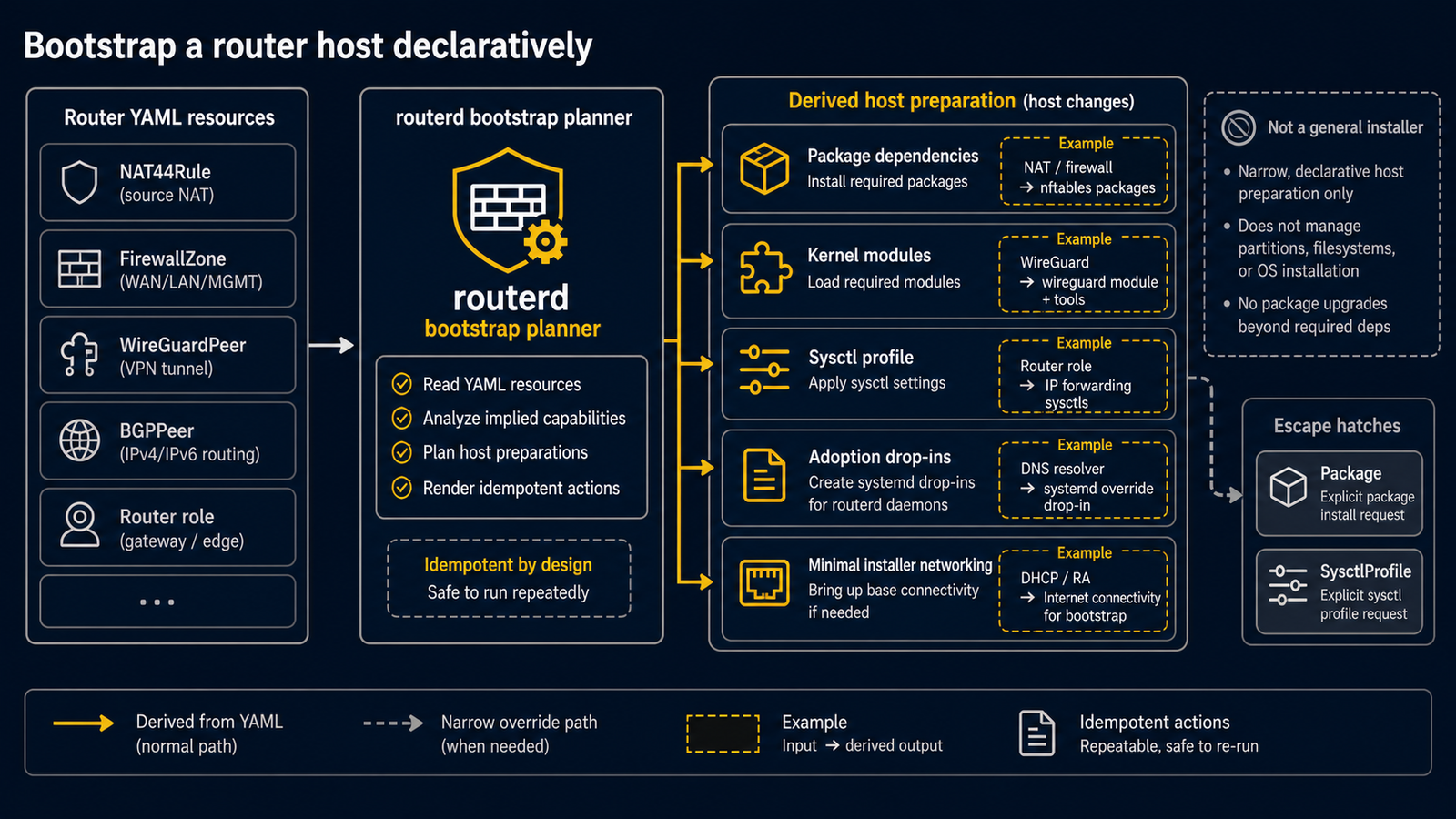
routerd 能将初次构建时容易变成手动操作的主机准备工作,整合至 YAML 管理。 这不是安装程序的替代方案,而是将路由器特有的差异以配置文件保留,而非散落在 shell 历史记录中的功能。
软件包
routerd 会从配置内的资源自动推导一般 OS 软件包依赖。
Package 作为窄范围的覆盖,仅用于补充尚无法自动推导的依赖软件包。
apiVersion: system.routerd.net/v1alpha1
kind: Package
metadata:
  name: router-service-dependencies
spec:
  packages:
    - os: ubuntu
      manager: apt
      names:
        - dnsmasq
        - nftables
        - conntrack
        - kmod
        - wireguard-tools
        - tailscale
    - os: freebsd
      manager: pkg
      names:
        - dnsmasq
        - wireguard-tools
        - mpd5
内核模块
Linux 的内核模块会从 NAT、防火墙记录、流量记录、WireGuard 等资源自动推导。
KernelModule 不是用户直接编写的配置 Kind。
Sysctl
routerd 会从路由器资源自动推导 forwarding、conntrack accounting、reverse path filter、redirect、TCP、RA 等 sysctl 设置。
通常不需要在配置中编写 SysctlProfile。
SysctlProfile 仅作为窄范围的逃生出口,用于补充 routerd 尚无法推导的平台特定内核设置。
请只在 overrides 中指定差异部分。
apiVersion: system.routerd.net/v1alpha1
kind: SysctlProfile
metadata:
  name: router-runtime
spec:
  profile: router-linux
  runtime: true
  persistent: true
  overrides:
    net.netfilter.nf_conntrack_udp_timeout: "60"
接管现有主机配置
systemd-networkd 与 systemd-resolved 的接管用 drop-in 会从 Interface、DHCP、DNS、RA 等资源自动推导。
DHCP、DNS、PPPoE、healthcheck、Tailscale 等 routerd 受管 unit 也从各自的资源 Kind 生成,
请勿重复定义。
在 Ubuntu 26.04 LTS 上,依 RA 状态不同,即使安装程序写入的 netplan 配置了 dhcp6: false,
systemd-networkd 仍可能在接口上开启 DHCPv6 客户端 socket。
对于 routerd 所管理的 WAN/LAN 链路,请在 OS 启动配置(bootstrap)阶段明确加入 accept-ra: false,
并在安装程序的 netplan 层中仅保留 IPv6 link-local。
这样可确保 routerd-dhcpv6-client 能使用 UDP port 546,
避免 OS 初始网络配置与 routerd 的 DHCPv6-PD 及 RA/DHCPv6 产生竞争。
管理用 DHCP 请保留在独立的管理接口上。
network:
  version: 2
  renderer: networkd
  ethernets:
    wan0:
      dhcp4: false
      dhcp6: false
      accept-ra: false
      link-local: [ipv6]
      optional: true
    lan0:
      dhcp4: false
      dhcp6: false
      accept-ra: false
      link-local: [ipv6]
      optional: true
    mgmt0:
      dhcp4: true
      dhcp6: false
      accept-ra: false
      link-local: [ipv6]
      optional: true
若需要 WAN 链路上来自 RA 的 IPv6 默认路由(例如用于解析 ISP DNS 或 AFTR), 请声明该 WAN 接口与 DHCPv6 / RA 的资源。 routerd 会推导所需的 systemd-networkd drop-in,并避免 systemd-networkd DHCP 客户端产生竞争。