跳到主要内容

Positioning

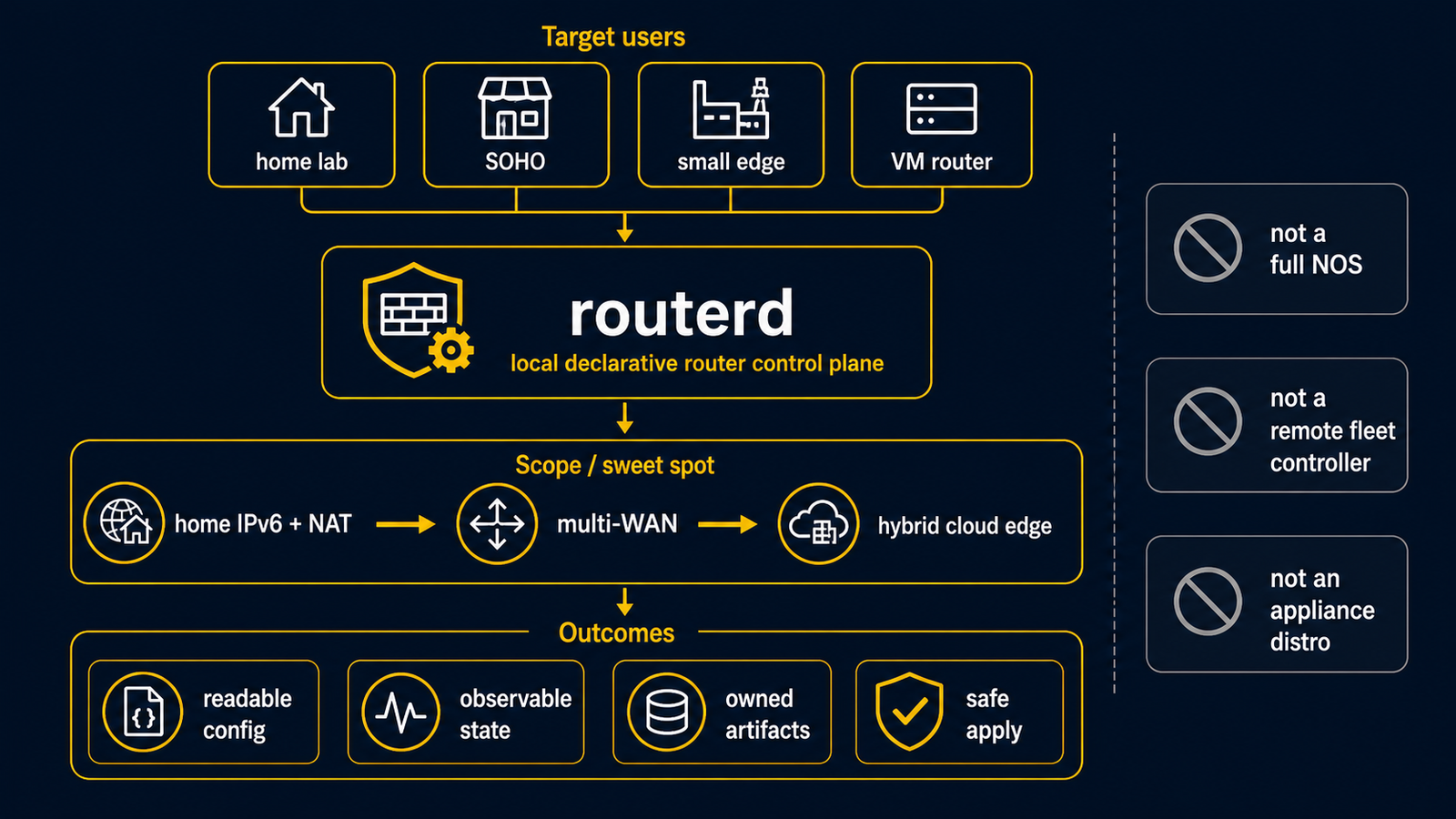
routerd is for people who want a router that is understandable from its configuration and observable from its runtime state.

It is not a replacement for a full network operating system. It is also not a cloud controller that owns many routers from the outside. routerd runs locally on one router host and turns typed YAML resources into host networking, services, routing, tunnels, firewall rules, logs, and status.

What routerd optimizes for

routerd optimizes for small and medium networks where the operator wants:

  • a declarative router configuration that can live in git
  • local operation without a hosted controller
  • explicit ownership of generated host artifacts
  • event-driven status instead of hidden daemon state
  • safe management-path checks before applying risky changes
  • observability that explains why a route, tunnel, or firewall decision exists

Typical users are home lab operators, small office operators, developers who run Proxmox VE or KVM, and people replacing hand-maintained Linux router scripts with something more repeatable.

Spectrum coverage

routerd intentionally covers a wide spectrum of router work:

AreaExamples
WAN accessDHCPv4, DHCPv6-PD, DHCPv6 information request, PPPoE
IPv4 transitionDS-Lite, NAT44, multi-stage WAN fallback
LAN serviceDHCPv4, DHCPv6, RA, DNS, NTP
Routingstatic routes, policy routes, EgressRoutePolicy, health checks
Securitythree-role firewall model, guest mode, denial logging
OverlayWireGuard, Tailscale integration, VXLAN groundwork, VRF
OperationsWeb Console, routerctl, OpenTelemetry, log stores
Bootstrappackages, sysctl profiles, systemd units, live ISO

The endpoints of that spectrum are deliberately far apart:

  • Virtual SDN/VNET routing: a router VM that connects Proxmox VE SDN segments, WireGuard overlays, VRFs, VXLAN experiments, and lab-only policy routes.
  • Diskless PC router: a small x86 mini PC that boots a live ISO, restores router.yaml from USB, buffers logs in RAM, and serves a physical LAN.

Few router projects treat both ends as the same configuration problem. routerd does. The difference is mostly the host artifacts being rendered, not the intent model.

The breadth matters because routers fail at the boundaries. A DNS choice may depend on a DHCPv6 information option. A DS-Lite tunnel may depend on an AFTR record that only resolves through a specific upstream. A route should not become primary until a health check has observed it. routerd keeps those relationships in one resource graph.

Compared with shell scripts

Shell scripts are easy to start and hard to audit later. They often answer "what command did we run?" but not "what state should exist now?"

routerd keeps the desired state in YAML, stores observed state, emits events, and exposes the result through an API, CLI, and Web Console. That makes it easier to inspect drift, compare generations, and debug real traffic.

Compared with appliance firmware

Appliance firmware is convenient when the use case fits its UI. It becomes harder when you need a precise mix of DS-Lite, PPPoE fallback, local DNS, custom firewall behavior, OpenTelemetry, or a lab overlay network.

routerd keeps those features as resources. The UI is for reading and debugging. Configuration changes remain CLI and YAML driven.

Compared with Kubernetes-style controllers

routerd borrows resource and controller ideas, but it does not require a cluster. The host is the boundary. The kernel, local daemons, and local files are the things being adjusted.

That keeps the operational model small enough for a home router while still allowing event-driven coordination between DHCP, DNS, tunnels, health checks, routes, firewall logs, and telemetry.

Non-goals

routerd does not currently aim to be:

  • a hosted SDN controller
  • a remote plugin marketplace
  • a general-purpose firewall language
  • a replacement for every enterprise router feature
  • a GUI-first configuration system

The project favors explicit YAML, local control, and high-quality operational feedback over a broad clickable management surface.