跳到主要内容

Install and upgrade

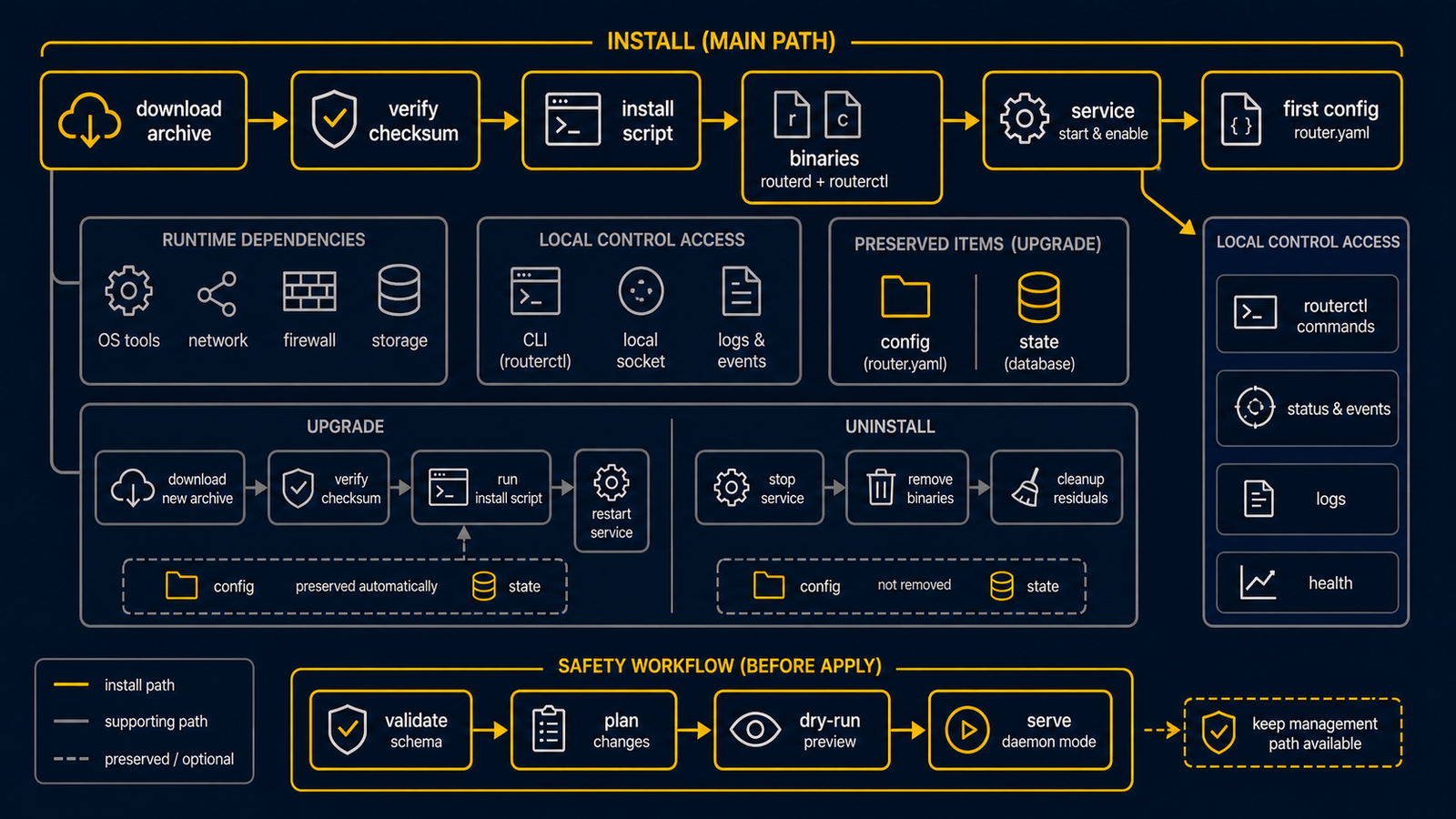
Use the release archive when you install routerd on a router host. The archive contains the binaries, service template, sample configuration, and the installer scripts. You do not need a Go toolchain or the Makefile on the router host.

Quick install

Download the archive for your OS and architecture from the GitHub Releases page.

Linux amd64:

curl -LO https://github.com/imksoo/routerd/releases/latest/download/routerd-linux-amd64.tar.gz
curl -LO https://github.com/imksoo/routerd/releases/latest/download/routerd-linux-amd64.tar.gz.sha256
sha256sum -c routerd-linux-amd64.tar.gz.sha256
tar -xzf routerd-linux-amd64.tar.gz
sudo ./install.sh

For Linux arm64, use the linux-arm64 archive.

FreeBSD amd64:

fetch https://github.com/imksoo/routerd/releases/latest/download/routerd-freebsd-amd64.tar.gz
fetch https://github.com/imksoo/routerd/releases/latest/download/routerd-freebsd-amd64.tar.gz.sha256
cat routerd-freebsd-amd64.tar.gz.sha256
sha256 routerd-freebsd-amd64.tar.gz
tar -xzf routerd-freebsd-amd64.tar.gz
sudo ./install.sh

For FreeBSD arm64, use the freebsd-arm64 archive. The latest release also includes versioned archives such as routerd-vYYYYMMDD.HHmm-linux-amd64.tar.gz. Use those when you need to pin a specific release.

Linux archives are built with CGO_ENABLED=0 and contain statically linked routerd binaries. They do not require the router host to have the same glibc version as the build machine. Runtime tools such as dnsmasq, nft, ip, conntrack, and tcpdump are still installed or checked by install.sh.

install.sh detects whether this is a fresh install or an upgrade. It installs the binaries under /usr/local/sbin, installs the service template, and writes /usr/local/etc/routerd/router.yaml.sample. It never overwrites an existing /usr/local/etc/routerd/router.yaml.

Try the live ISO

The release page also publishes a bootable Alpine-based live ISO:

curl -LO https://github.com/imksoo/routerd/releases/latest/download/routerd-live.iso
curl -LO https://github.com/imksoo/routerd/releases/latest/download/routerd-live.iso.sha256
sha256sum -c routerd-live.iso.sha256

Attach the ISO to a Proxmox VE test VM and boot it. The console prints routerd setup instructions and starts the same install.sh configure wizard after root login. Use the ISO for demos and short trials. For a persistent router, install routerd onto disk with the release archive.

The live ISO enables both the video console and a serial console. On Proxmox VE, add a serial socket and connect with qm terminal:

qm create 200 \
--name routerd-live-demo \
--memory 1536 \
--cores 2 \
--ostype l26 \
--serial0 socket \
--vga serial0 \
--boot order=ide2 \
--ide2 local:iso/routerd-live.iso,media=cdrom \
--net0 virtio,bridge=vmbr0 \
--net1 virtio,bridge=vmbr490
qm start 200
qm terminal 200

Use an isolated LAN bridge for net1 when you test DHCP or RA. The serial console runs at 115200 8N1 and uses plain text prompts, so the same wizard works from qm terminal, a framebuffer console, or a minimal terminal.

The live ISO can run in two modes:

  • Ephemeral demo mode: no USB storage is selected. Configuration and logs live in RAM and disappear at reboot.
  • Persistent router mode: select a USB partition in the wizard. The wizard saves router.yaml to the USB device. On the next boot, the ISO mounts the USB device, restores the config, and applies it automatically.

For persistent mode, label the USB partition ROUTERD or pass routerd.usb=/dev/sdX1 on the kernel command line when multiple removable devices are present. The helper detects ext4, vfat, and exfat with blkid and mounts them with async,noatime by default. Pass routerd.usb_mount=sync only when you explicitly want synchronous writes.

Logs are buffered under /run/routerd/logs on tmpfs. The wizard can enable a daily flush job that copies the config, state snapshot, and compressed log archive to the USB device. The default tmpfs log limit is 100 MiB. Older log files are removed when the buffer exceeds that limit.

For safe USB removal, run:

/usr/share/routerd/live-persistence.sh flush
/usr/share/routerd/live-persistence.sh umount

See Operations → USB persistence for the full layout, mount options, and Alpine lbu behavior.

Versioned ISO files are also published, for example routerd-live-vYYYYMMDD.HHmm.iso.

Runtime dependencies

By default, install.sh installs known OS packages before copying routerd. Use --list-deps to inspect the package list:

./install.sh --list-deps

Use --no-install-deps when dependencies are already managed by another tool:

sudo ./install.sh --no-install-deps

Use --deps-only when you only want to install dependencies:

sudo ./install.sh --deps-only

Tailscale is optional. Add it to the package list with --with-tailscale:

sudo ./install.sh --with-tailscale

Debian and Ubuntu

The installer uses apt-get and installs:

ca-certificates curl dnsmasq nftables wireguard-tools chrony bind9-dnsutils tcpdump cron jq ppp pppoe conntrack iproute2 iputils-ping iputils-tracepath net-tools kmod radvd strongswan-swanctl iptables

Fedora-like systems

The installer uses dnf and installs:

ca-certificates curl dnsmasq nftables wireguard-tools chrony bind-utils tcpdump cronie jq ppp rp-pppoe conntrack-tools iproute iputils traceroute kmod radvd strongswan iptables

Arch-like systems

The installer uses pacman and installs:

ca-certificates curl dnsmasq nftables wireguard-tools chrony bind tcpdump cronie jq ppp rp-pppoe conntrack-tools iproute2 iputils traceroute kmod radvd strongswan iptables

Alpine

The installer uses apk and installs:

alpine-conf ca-certificates curl dnsmasq nftables wireguard-tools chrony bind-tools tcpdump cronie jq ppp ppp-pppoe conntrack-tools iproute2 iputils iputils-tracepath kmod radvd strongswan iptables util-linux e2fsprogs dosfstools exfatprogs

alpine-conf provides lbu, which routerd uses on the live ISO to preserve the router configuration and selected local system state on USB media.

FreeBSD

The installer uses pkg and installs:

ca_root_nss curl dnsmasq wireguard-tools mpd5 bind-tools tcpdump jq chrony strongswan

FreeBSD pf, ifconfig, route, sysctl, service, sysrc, cron, netstat, sockstat, ping, and traceroute are base-system tools. The installer checks for the commands but does not install them as packages.

NixOS

NixOS should keep package state in the NixOS configuration. When install.sh detects NixOS-style tooling, it prints a warning instead of calling nix-env. Declare packages through the NixOS configuration or routerd Package resources.

Upgrade

Extract the new archive and run the same installer:

tar -xzf routerd-linux-amd64.tar.gz
sudo ./install.sh

When /usr/local/sbin/routerd already exists, the installer switches to upgrade mode. It prints the old and new routerd --version output. It replaces binaries and service templates, keeps configuration and state, and restarts the routerd service if it was already active. When /etc/systemd/system/routerd.service is already managed by routerd configuration, the installer preserves that unit instead of overwriting it with the archive template.

Every replaced file is copied to *.backup.YYYYMMDDHHMMSS before replacement. If the install fails partway through, the script restores files from the temporary rollback backup.

If routerd itself manages routerd.service as a SystemdUnit resource, a unit file change is applied carefully: routerd schedules a delayed self-restart through systemd-run instead of directly restarting itself in the middle of the apply pass.

Useful options:

sudo ./install.sh --no-restart
sudo ./install.sh --dry-run
sudo ./install.sh --verbose
sudo ./install.sh --no-config-update

Layout

The release installer uses these paths:

ItemLinuxFreeBSD
Configuration/usr/local/etc/routerd/router.yaml/usr/local/etc/routerd/router.yaml
Sample configuration/usr/local/etc/routerd/router.yaml.sample/usr/local/etc/routerd/router.yaml.sample
Binaries/usr/local/sbin/usr/local/sbin
Service template/etc/systemd/system/routerd.service/usr/local/etc/rc.d/routerd
Runtime sockets/run/routerd/var/run/routerd
Persistent state/var/lib/routerd/var/db/routerd

The installer never removes these state locations:

  • /usr/local/etc/routerd/router.yaml
  • /var/lib/routerd
  • /var/db/routerd
  • /run/routerd
  • /var/run/routerd
  • /var/log/otelcol

First configuration

For a first trial, run the built-in setup wizard:

sudo ./install.sh configure

The wizard asks for the WAN interface, LAN interface, LAN address, LAN services, management placement, and optional USB persistence. It writes a candidate file to /usr/local/etc/routerd/router.yaml.configure, shows a diff when an existing configuration is present, and installs it as /usr/local/etc/routerd/router.yaml only after confirmation. It then runs routerd validate, routerd plan, and routerd apply --once.

Automation can use environment variables and skip prompts:

sudo ROUTERD_WAN_INTERFACE=ens18 \
ROUTERD_LAN_INTERFACE=ens19 \
ROUTERD_LAN_ADDRESS=192.168.10.1/24 \
ROUTERD_LAN_CIDR=192.168.10.0/24 \
ROUTERD_MGMT_MODE=lan \
ROUTERD_ENABLE_USB_PERSISTENCE=no \
./install.sh configure --non-interactive --yes

For live ISO USB persistence, set:

sudo ROUTERD_ENABLE_USB_PERSISTENCE=yes \
ROUTERD_USB_DEVICE=/dev/sdb1 \
ROUTERD_USB_FLUSH=yes \
ROUTERD_LOG_TMPFS_LIMIT=100M \
./install.sh configure --non-interactive --yes

Use --no-apply when you want only the YAML file.

sudo ./install.sh configure --no-apply

Manual configuration is still available. Copy a sample configuration into place and edit it for your interfaces:

sudo install -d -m 0755 /usr/local/etc/routerd
sudo install -m 0600 /usr/local/etc/routerd/router.yaml.sample /usr/local/etc/routerd/router.yaml
sudo vi /usr/local/etc/routerd/router.yaml

Then validate and review the plan:

routerd validate --config /usr/local/etc/routerd/router.yaml
routerd plan --config /usr/local/etc/routerd/router.yaml
routerd apply --config /usr/local/etc/routerd/router.yaml --once --dry-run

Apply only after the management path is safe:

sudo routerd apply --config /usr/local/etc/routerd/router.yaml --once

Start the service when the one-shot apply is healthy:

sudo systemctl enable --now routerd.service

On FreeBSD:

sudo sysrc routerd_enable=YES
sudo service routerd start

Uninstall

The release archive also contains uninstall.sh. The default uninstall removes binaries, service templates, and runtime files. It keeps configuration and state.

sudo ./uninstall.sh --yes

Purge options are explicit:

sudo ./uninstall.sh --yes --purge-config
sudo ./uninstall.sh --yes --purge-state
sudo ./uninstall.sh --yes --all

Use --dry-run to preview removal.

Developer workflow

The Makefile is for development only. Use it to test, build, generate schemas, validate examples, build the website, and create release archives:

make test
make check-schema
make validate-example
make website-build
make dist ROUTERD_OS=linux GOARCH=amd64 VERSION="$(git describe --tags --abbrev=0)"

Do not use the Makefile as the user-facing install path. The release archive and install.sh are the supported deployment path.