资源 API v1alpha1
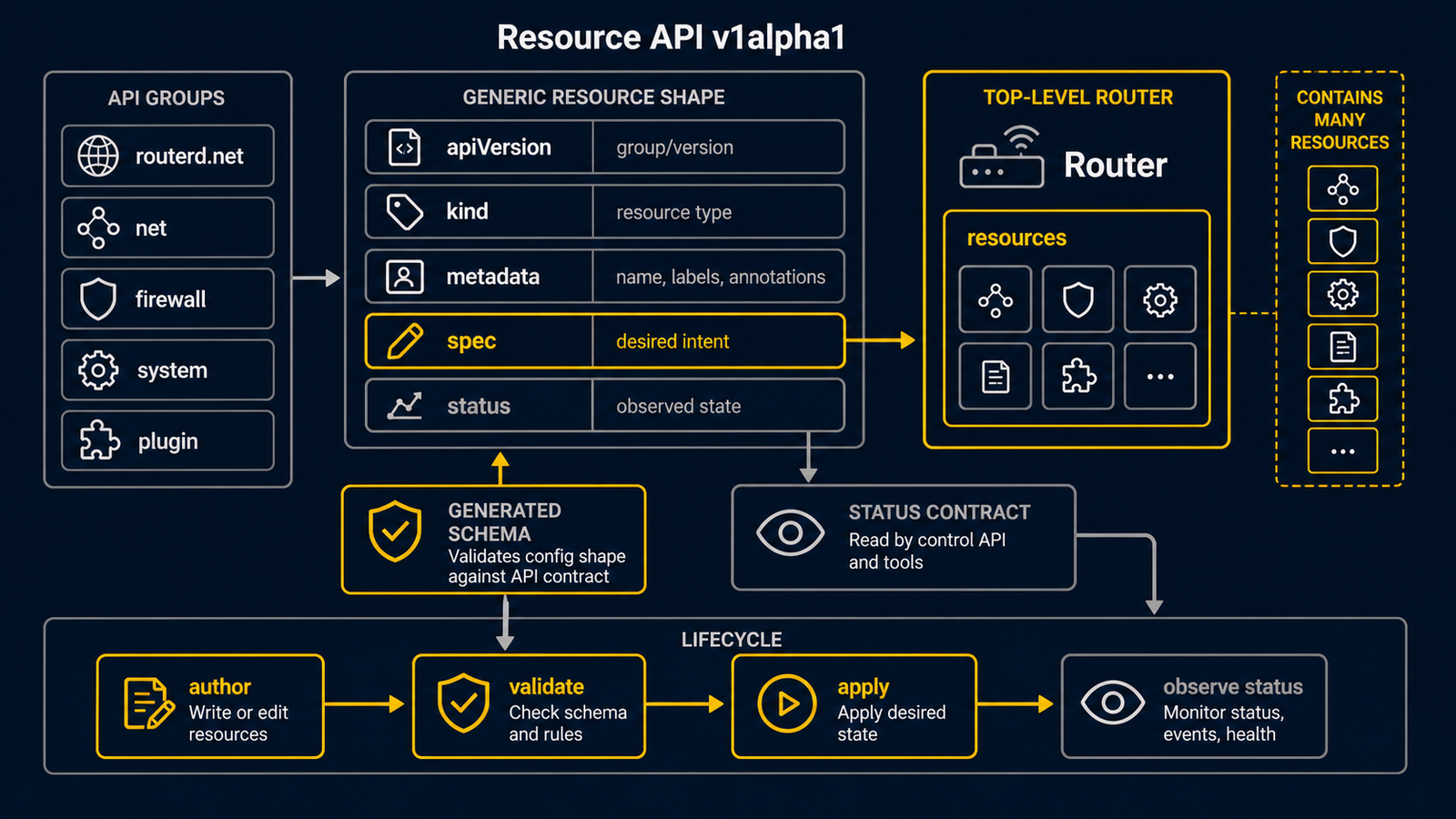
routerd 的配置由最顶层的 Router 以及类型化资源列表组成。
本页依照当前实现列出各资源。
Phase 1.6 起,DHCP 相关的 Kind 依 RFC 表记改为 DHCPv4* 与 DHCPv6*。
旧名称无兼容别名。
通用格式
apiVersion: net.routerd.net/v1alpha1
kind: Interface
metadata:
  name: wan
spec:
  ifname: ens18
  adminUp: true
| 字段 | 说明 |
|---|---|
apiVersion | API 组与版本。 |
kind | 资源种类。 |
metadata.name | 同种类内的名称。 |
spec | 用户声明的意图。 |
status | routerd 或专用守护进程观测到的状态。 |
API 组
| API 组 | 主要 Kind |
|---|---|
routerd.net/v1alpha1 | Router |
net.routerd.net/v1alpha1 | 接口、ManagementAccess、可复用的 IPAddressSet、DHCP、DNS、路由、隧道、VIP、BGP、事件、流量日志 |
mobility.routerd.net/v1alpha1 | MobilityPool、SAMNodeSet、SAMRRSet、SAMEnrollmentPolicy、SAMEnrollmentClaim、SAMEnrollmentClient、SAMTransportProfile |
firewall.routerd.net/v1alpha1 | FirewallZone, FirewallPolicy, FirewallRule, FirewallEventLog, ClientPolicy, PortForward, IngressService, LocalServiceRedirect |
system.routerd.net/v1alpha1 | Hostname, Sysctl, SysctlProfile, Package, NTPClient, NTPServer, LogSink, ObservabilityPipeline, RouterdCluster, LogRetention, WebConsole |
plugin.routerd.net/v1alpha1 | 插件列表 |
系统准备
| Kind | 用途 |
|---|---|
Package | 补充无法从其他资源导出的 OS 软件包,是限定范围的 override。一般的运行时依赖软件包会自动导出。 |
Sysctl | 补充当前尚无法从路由器资源导出的 sysctl 值,是限定范围的 escape hatch。可通过 compare: exact 与 compare: atLeast 选择回读的判断方式。 |
SysctlProfile | 补充路由器推荐的 sysctl 值,是限定范围的 escape hatch。一般的路由器 sysctl 会自动导出。 |
Hostname | 配置主机名称。 |
NTPClient | 启用 OS 的 NTP 客户端。从 DHCPv4 / DHCPv6 的状态导出时间服务器,若为空则回退至公共 NTP 服务器。 |
NTPServer | 运行面向 LAN 的本地 NTP 服务器。除静态的 allowCIDRs 外,也可通过 allowCIDRFrom 从 IPv6DelegatedAddress/<name>.address 或 DHCPv6PrefixDelegation/<name>.currentPrefix 等 status 字段导出允许范围。 |
LogSink | 将日志事件转发至 syslog、OTLP、webhook、file、journald。 |
ObservabilityPipeline | 配置 OTLP 的环境,以及将 routerd 事件转发至 stdout / syslog / Loki。 |
RouterdCluster | 通过 file 租约让 leader 负责变更主机配置,standby 则仅进行状态观测。 |
LogRetention | 管理事件、DNS、流量、防火墙事件日志的保存期限。 |
WebConsole | 在管理网络上提供只读的 Web 管理界面。 |
接口
| Kind | 用途 |
|---|---|
Interface | 将 routerd 使用的稳定名称与 OS 接口名称对应,并提供下游资源所需的 link/address status。 |
ManagementAccess | 声明管理用接口与 apply 前的 lockout 检查。声明后,若检测到管理接口缺失、被 firewall zone 阻断、或启用的 WebConsole 绑定到所有地址,则在未指定 --allow-mgmt-lockout 时中止 apply。 |
PPPoESession | 表示 PPPoE 的底层接口配置。 |
PPPoESession | 由 routerd-pppoe-client 管理的 PPPoE 会话。 |
WireGuardInterface | 表示 WireGuard 接口。 |
WireGuardPeer | 表示 WireGuard 对端。 |
TailscaleNode | 配置 Tailscale 节点。通过受管理的 systemd 单元管理 Exit node 与 subnet router 的广播。 |
IPsecConnection | 表示 strongSwan 的 cloud VPN 连接定义。 |
VRF | 表示 Linux VRF 设备与路由表。 |
VXLANTunnel | 表示 VXLAN 隧道。 |
将 PPPoESession.spec.enabled 设为 false,可在保留 PPPoE 定义的同时,停止并禁用受管理的 pppd 单元。
这样在正常运行时不使用 PPPoE 会话,仅在需要时手动用作备用路径。
TailscaleNode 可在首次注册时使用 authKey。
正式环境建议使用 authKeyEnv 或 authKeyFile,
以避免将密钥值写入 YAML 与 Git 历史记录。
两者均未指定时,tailscaled 视为已登录状态。
routerd 仅重新应用所广播的节点配置。
Tailscale 默认的 UDP/41641 视为保留用途。
WireGuard 的监听端口请使用其他号码。
详细配置步骤请参阅 Tailscale 配置指南。
WireGuardInterface 可接受 privateKeyFile,以便将私钥存放在路由器 YAML 之外。
WireGuardPeer 也可接受可选的 presharedKeyFile 作为 PSK。
内嵌的密钥字段主要用于示例与测试。
在 FreeBSD 上,routerd 会生成 rc.d 服务,
该服务负责创建 wg 接口、从文件读取私钥,
并应用所声明的 peer 与静态地址。
核心模块,以及 systemd-networkd/resolved 的 adoption drop-in 均从路由器资源自动导出。若已删除的 KernelModule、NetworkAdoption、Link 仍残留在配置中,routerd 不会静默忽略,而是返回错误。
WAN 地址与委派
| Kind | 用途 |
|---|---|
IPv4StaticAddress | 分配静态 IPv4 地址。 |
VirtualAddress | 声明 IPv4 /32 或 IPv6 /128 VIP。spec.family 为 ipv4 或 ipv6。mode: vrrp 在 Linux 使用 keepalived,在 FreeBSD 使用 CARP。 |
DHCPv4Client | 由 routerd-dhcpv4-client 管理 DHCPv4 租约、IPv4 地址及可选的默认路由。 |
DHCPv6Address | 表示 DHCPv6 IA_NA 的意图。 |
DHCPv6PrefixDelegation | 由 routerd-dhcpv6-client 管理的 DHCPv6-PD 租约。 |
DHCPv6Information | DHCPv6 信息请求的结果。观测 DNS、SNTP、域名搜索、AFTR 信息。 |
IPv6DelegatedAddress | 从委派前缀导出 LAN 侧地址。 |
IPv6RAAddress | 表示通过 RA/SLAAC 获取的 IPv6 地址。 |
DHCPv6PrefixDelegation 不具备旧式的 OS 客户端选择字段。
DHCPv6-PD 由 routerd-dhcpv6-client 负责。
LAN 侧服务
| Kind | 用途 |
|---|---|
DHCPv4Server | 提供 dnsmasq 的 DHCPv4 服务与可选的地址池。 |
DHCPv4Reservation | 表示依 MAC 地址的固定分配。 |
DHCPv4Relay | 表示 dnsmasq 的 DHCPv4 中继。 |
IPv6RouterAdvertisement | 生成 RA、PIO、RDNSS、DNSSL、M/O 标志、MTU、优先级、存活时间。 |
RogueRADetector | 自动导出的资源,以 status 显示在发出 RA 的接口上观测到的、非自身发出的 IPv6 Router Advertisement。 |
DHCPv6Server | dnsmasq 的 DHCPv6/RA 服务。支持 stateless、stateful、both、ra-only。 |
DNSZone | 表示本地权威区域。处理手动录入的记录与 DHCP 租约衍生的记录。 |
DNSResolver | 表示 routerd-dns-resolver 的守护进程实例、监听、缓存、metrics、查询日志。 |
DNSForwarder | 隶属于某个解析器的 DNS match 规则。可从 DNSZone 响应,或转发至指定的 DNSUpstream。 |
DNSUpstream | 表示一个上游端点,支持 udp、tcp、dot、doh。亦可指定状态衍生地址、bootstrap 解析器、TLS 名称及来源接口。 |
由于 Android 仅靠 DHCPv6 的 DNS 无法完成名称解析,在 IPv6 LAN 环境中需配置 IPv6RouterAdvertisement.spec.rdnss。
dnsmasq 仅负责 DHCPv4、DHCPv6、中继、RA。
DNS 的监听与响应由 DNSResolver 负责。
LAN 的 DNS suffix 可通过 DHCPv4Server.spec.domainFrom、
IPv6RouterAdvertisement.spec.dnsslFrom、DHCPv6Server.spec.domainSearchFrom
引用 DNSZone/<name>.zone,与本地区域保持一致。
DNSResolver.spec.listen[].sources 中列出该 listener 使用的 DNSForwarder 名称。
省略 listener 时,会使用引用该解析器的所有 DNSForwarder。
用户 YAML 的 DNSResolver.spec.sources 不予接受。请将旧式的内嵌 source
拆分为 DNSForwarder 与 DNSUpstream。
DNSForwarder.spec.match 可指定 home.example 或表示默认上游的 .。
spec.zoneRefs 从本地 DNSZone 响应,spec.upstreams 则转发至 DNSUpstream。
DNSSEC 验证写在 DNSForwarder.spec.dnssecValidate。
DNSUpstream.spec.protocol 为 udp、tcp、dot、doh 之一。
addressFrom 可从 DHCPv6Information/<name>.dnsServers 等来源导出 UDP 上游地址。
sourceInterface 在 Linux 上绑定发出接口,bootstrap 用于解析 DoH/DoT 端点名称的辅助解析器。
DS-Lite、路由、NAT
| Kind | 用途 |
|---|---|
DSLiteTunnel | 向 AFTR 建立 ip6tnl 隧道。AFTR 可直接指定 IPv6、FQDN 或从 DHCPv6 信息获取。 |
TunnelInterface | 为 hybrid overlay delivery 创建受信任的 Linux L3 underlay tunnel device。mode 支持 ipip、gre 以及 IPIP-over-UDP fou/gue。 |
OverlayPeer | 描述 on-prem 或 cloud overlay peer 以及用于到达它的本地 underlay。新 CloudEdge SAM transport 优先使用 SAMTransportProfile。 |
HybridRoute | 将非默认远端 IPv4 prefix 经由 OverlayPeer 降低为受管理的 IPv4Route resource。 |
MobilityPool | CloudEdge 的本地 address/capture intent。声明 pool prefix、federation group、BGP delivery、cloud capture profile、local value expansion、provider trap placement 与一个 local self overlay;共享 topology 只能通过 membersFrom 从 SAMNodeSet 导入。 |
SAMNodeSet | 共享 SAM fabric 的 identity/topology registry:node identity、site、role、placement、maintenance、Event Federation endpoint、SAM transport endpoint 与非秘密 WireGuard peer identity。它是 MobilityPool 唯一的 topology source。 |
SAMRRSet | 返回给已接纳 leaf 的仅运行时、以 policy 为作用域的 enrollment snapshot。它包含从 policy 的静态 SAMNodeSet 投影出的已选 RR node,不能在顶层 router YAML 中声明。 |
SAMEnrollmentPolicy | 仅 hub/RR 使用的 SAM transport enrollment claim 授权。它绑定 transport profile、输出 rrSetRef、必需的静态 RR topology rrNodeSetRef、join-token source、join audience、tunnel/endpoint prefix、可选 leaf ID pattern、TTL、显式 claim revoke、可选 WireGuard materialization,以及作为 RR 侧 admission authority 的 MobilityPool reference 或直接 mobilityPrefixes。directMesh.peerGroupRef 还能授权一个可选的 leaf 间直连组;RR 始终保留为回退。leaf 不声明副本。 |
SAMEnrollmentClaim | leaf 本地的远程 enrollment request:leaf identity、join nonce/timestamp/HMAC、远程 policy/RRSet reference、tunnel address、endpoint、可选且签名的 directMesh opt-in、可选 BGP identity、可选由 MobilityPool 拥有的 /32、可选 WireGuard credential、expiry 和 revocation state。 |
SAMEnrollmentClient | leaf 侧 bootstrap/refresh controller:向 bootstrap RR endpoint 提交本地远程请求的 SAMEnrollmentClaim,获取允许的 SAMRRSet 和符合条件的直连 peer group;仅在缺失、接近到期或 claim material 变化时将它们保存为 dynamic state。直连 peer 必须由所有 RR 对同一 client identity 和 topology 进行证明。如果所有 RR 已接受同一 claim、但 peer 列表暂时不同,则状态会显示 directTopologyPending: true:继续走 RR,不使用部分直连路径,并只用 GET 重新检查。配置 joinTokenFrom 时 identity 由 HMAC 认证;未配置时属于 trusted control-plane 输入。RR 仅丢失易失 admission state 时,只接受当前 RR 的 identity-aware 响应来自动重新提交;revoke、renewal 期间不同的 active identity、损坏响应、旧版/混合 RR 或任何不确定性都会保留 RR fallback。它不需要本地 policy 或 NodeSet。 |
SAMTransportProfile | 声明 router 稳定的 selfNodeRef、mode(ipip、gre、fou 或 gue)、encryption(none 或 wireguard)、inner tunnel prefix、underlay interface、BGP router 和 peer source。fou/gue 使用现有 TunnelInterface FOU/GUE 路径并要求 encapSport 与 encapDport。它通过 peersFrom 从 SAMNodeSet、运行时同步的 SAMPeerGroup、SAMEnrollmentPolicy 或已获取的 SAMRRSet 读取 topology 和 peer endpoint;SAMNodeSet 是 canonical identity/topology/endpoint source,nodeRefs 可选择相邻 peer。enrollment 返回的 SAMPeerGroup 标记为 direct: true 时,会增加一条可选的 leaf 间直连路径,并赋予较高的 BGP local preference;它必须使用 pair-stable 地址分配,并且必须排在一个非 optional SAMRRSet 回退 source 之后。direct profile 必须显式设置普通 RR 的 bgp.importPolicy.localPreference,bgp.directLocalPreference 必须更高。省略 bgp.timers、bgp.timersPreset 和 bgp.convergenceProfile 时,生成的 peer 会继承所引用 BGPRouter 的默认值;profile 中的设置优先。SAMPeerGroup 不能作为可 author 的顶层 resource。routerd 通过 replace-on-reconcile 的 DynamicConfigPart 为每个 peer 导出 TunnelInterface、endpoint /32 IPv4Route,以及(除非 spec.bgp.generatePeers: false)BGPPeer。 |
CloudProviderProfile | 描述 provider capabilities 与 external-command auth,用于 declarative address capture planning。 |
IPAddressSet | 从直接指定的地址或 FQDN 定义可复用的 IP 地址集。Linux nftables 的生成器将其输出为 named set,可从 redirect、NAT、policy routing 引用。 |
IPv4Route | 添加 IPv4 路由。也可用于 DS-Lite 的默认路由或明确的丢弃路由。 |
ClusterNetworkRoute | 将 Kubernetes 的 Pod / Service CIDR 展开为经由 worker next hop 的静态 IPv4 路由。 |
BGPRouter | 声明本地 BGP 路由器。当前的后端是长寿命的 routerd-bgp GoBGP 守护进程,导入策略默认为 deny。 |
BGPPeer | 声明隶属于 BGPRouter 的 GoBGP 管理 BGP peer。适用于 Kubernetes BGP speaker 等场景。 |
BFD | 声明 BFD session intent。在 Linux 上,routerd render FRR bfdd 配置并记录观测到的 BFD 状态;被引用的 GoBGP peer 不会因 BFD false-down 而被 deconfigure。 |
NAT44Rule | 在 nftables 的 routerd_nat 表中执行 IPv4 NAPT。 |
PortForward | 将 WAN 侧的 IPv4 TCP/UDP 端口 DNAT 至单一内部 IPv4 目的地。 |
IngressService | 公开 WAN 侧的 IPv4 TCP/UDP 服务。支持多个 backend、TCP/HTTP 健康检查,以及 failover / sourceHash / random 选择策略。 |
LocalServiceRedirect | 将 LAN 侧客户端向 IPAddressSet 发出的 IPv4/IPv6 流量重定向至路由器本地端口。适用于集中纯文本 DNS/NTP,不影响 DoH 或 DoT 端口。 |
EgressRoutePolicy | 表示默认路由选择、基于 mark 的 IPv4 policy routing,以及向多个 target 的 hash 分散。 |
CloudEdge Mobility 保持声明式的 operator-authored surface:MobilityPool 是高层
address/capture intent,SAMNodeSet 是 write-once node identity registry 和生成 peer 的
共享 membership source。SAMEnrollmentPolicy 通过必需的 rrNodeSetRef 选择静态 RR
identity/topology,并用 rrSetRef 命名获取的 runtime snapshot;它仅用于 hub/RR,
而 SAMEnrollmentClaim 是 leaf 的远程请求。SAMEnrollmentClient 是 leaf 的
bootstrap/refresh controller,它无需本地 policy 或 NodeSet 即可获取该 snapshot。
SAMTransportProfile 是高层 transport/BGP intent;federation event 是 observed fact,
BGP best path 是 mobility ownership/delivery view。mobility planner 生成 BGP /32
advertisement 与 provider trap action plan;operator 不应手写 per-address path 或 capture
procedure。
MobilityPool 一次性计划地址 ownership、capture 与 BGP delivery,并将类型化的本地
dataplane intent 与 FIB verdict 保存到 DynamicConfigPart。
每个 pool 通过 membersFrom 导入同一个 SAMNodeSet,并且只保留本节点的
nodeRef、capture、discovery、profileRef 与 static-owned-address overlay。
site、role、placement、maintenance 和 capacity 只能在 SAMNodeSet 声明。
SAMRRSet 只是在 enrollment fetch/dynamic-state 路径中供 transport 的 peersFrom
使用的运行时 RR snapshot;它不可作为顶层 YAML resource,也绝不替代
MobilityPool 从 SAMNodeSet 导入的 authoring 或 membership/topology source。
MobilityPool 始终使用 BGP delivery,不公开 delivery mode selector。Provider action
plan 是 review artifact,只有在导入 action journal 并通过 ProviderActionPolicy、approval、allowlist
与 executor plugin gate 后才可能执行。
EgressRoutePolicy 除 CIDR 指定外,还具有 destinationSetRefs 与
excludeDestinationSetRefs。这让以 FQDN 为后端的目的地集合无需在 policy
资源中展开地址,即可用于路由控制与排除条件。
mode: priority 用于默认路由故障转移,mode: mark 用于单一带 mark 的路由
表,mode: hash 或 candidates[].targets 用于向多个路由表进行
source/destination 的 hash 分散。
routerd 从路由器角色、隧道、防火墙区域、RA/DHCPv6 资源自动导出 reverse path filter sysctl、隧道 MTU、RA MTU、TCP MSS clamp。
配置中只需声明 LAN/WAN 与隧道的意图,无需编写 IPv4ReversePathFilter 或
PathMTUPolicy。
若外部管理的来源接口(如 tailscale0)具有较低的 MTU,可配置 Interface.spec.mtu。routerd 仅将其用于该来源路径,不会将较低的 MTU 应用至无关的 LAN 路径。
EgressRoutePolicy 具有 excludeDestinationCIDRs,可将 LAN 内部、管理网络、HGW LAN、RFC 1918 私有网络等排除在 policy routing 对象之外。
ClusterNetworkRoute 是面向 Kubernetes 节点的辅助资源。
在 spec.pods.cidrs 与 spec.services.cidrs 中列出 Pod / Service CIDR,
并在 spec.via[] 中指定 worker 或 VIP 的 next hop,routerd 即会生成
对应的 IPv4StaticRoute 意图。相同 weight 视为相同 metric,可用于多 next hop 的 ECMP;不同 weight 会转换为 metric 差值,表示优先路由与备用路由。
FirewallRule 除目的地 CIDR 外,还具有 destinationSetRefs 与
excludeDestinationSetRefs,让可复用的 FQDN 后端集合无需在各规则中展开地址,即可作为允许、拒绝、reject 的条件。
Stateful rule expression 亦支持 sourcePorts、destinationPorts、ICMP / ICMPv6 的
type matching、rateLimit、connLimit。port 作为单一目的地端口的简写仍可使用,但新示例建议改用 destinationPorts。
NAT44Rule 支持通过 outboundInterface、sourceCIDRs、translation 进行简单的
source NAT,以及通过 type、egressInterface 或 egressPolicyRef、sourceRanges
进行具有 policy 感知的 NAT。此外还具有 destinationCIDRs、destinationSetRefs、
excludeDestinationCIDRs、excludeDestinationSetRefs,可将仅互联网流量进行 masquerade,而有静态路由的私有目的地或可复用的地址集合则不进行 NAT。
PortForward 与 IngressService 在 Linux nftables 与 FreeBSD pf 上生成 DNAT。
指定 spec.hairpin.enabled: true 与 spec.hairpin.interfaces 后,也会生成让 LAN
客户端通过 WAN 地址连到同一服务的 hairpin NAT。
hairpin 需要 listen.address 或 listen.addressFrom,routerd 会生成 LAN 侧的
DNAT 与返回路径的 masquerade/NAT reflection。
listen.addressFrom 与 backend 的 addressFrom 可引用 IPv4StaticAddress/<name>.address
或 VirtualAddress/<name>.address 等可静态描述的地址资源。
IngressService 中,未指定 spec.hairpin.mode 视为 auto。
当 listen 地址与所选 backend 位于 listen 接口声明的同一前缀上时,routerd 会自动生成
LAN 客户端使用 VIP 所需的同一接口返回 SNAT。即使 YAML 未声明 listen 接口的前缀,
只要私有 IPv4 的 listen/backend 地址位于同一 /24,也会判断需要 hairpin。
这是为了涵盖如 Live ISO 等从启动环境继承接口地址的场景。
若要禁用,请使用 spec.hairpin.mode: off;明确指定时使用 manual 与 interfaces。
VirtualAddress.spec.vrrp.authentication 在 keepalived 中生成为 auth_pass,
在 FreeBSD CARP 中生成为 pass。正式环境不建议将共用密钥留在 routerd YAML 中,
请优先使用 VirtualAddress.spec.vrrp.authenticationFrom。
authenticationFrom.file 读取本地密钥文件,
authenticationFrom.env 读取环境变量,base64: true 可解码 base64 值。
已生成的 keepalived/CARP 配置与主机接口状态请视为机密。
VRRP authentication 在 VRRPv3(RFC 5798)中已 deprecated。routerd 以 L2 隔离为前提,
authentication 仅在周边网络有要求或作为简单的配置错误防护时使用。
IngressService 支持多个 backend、TCP health check、故障转移 policy。
runtime 控制器解析 backend 的 FQDN,DNS 暂时失败时以上次解析的 IPv4 作为 fallback。当健康的 backend 有多个时,Linux nftables 以 sourceHash 使用 jhash ip saddr、random 使用 numgen random 进行分配;健康的 backend 只剩一个时则降级为故障转移。
validator 会拒绝 IngressService、LocalServiceRedirect、routerd 管理的守护进程在同一接口/协议上发生冲突的监听端口配置。
IPAddressSet 在应用时将直接指定的 IPv4/IPv6 地址输出至 nftables 的 named set。
FQDN 的 A/AAAA 记录由 runtime 控制器解析,并在不重新加载整个防火墙、NAT、policy 表的情况下实时更新所引用的 set。下次更新以观测到的最小 DNS TTL 的一半为基准,最短不低于 60 秒。refreshInterval 可用作希望更积极更新时的上限。
IPAddressSet.spec.names 仅处理完全匹配的 DNS 名称。microsoft.com 仅表示
microsoft.com 本身的 A/AAAA 记录,不包含 www.microsoft.com、
login.microsoft.com、*.microsoft.com 及更深层的子域名。
通配符或以 suffix 形式判断服务的场景,需要能处理 DNS 查询观测或 provider 端点 feed 的其他资源,而非简单的 FQDN 解析。
BGPRouter 与 BGPPeer 使用长寿命的 routerd-bgp 守护进程。
routerd 通过本地 gRPC Unix socket 将资源 spec 直接映射为类型化的 GoBGP API 对象,
并以 ListPeer 与 ListPath 观测状态。不使用 FRR 的文本配置、
frr-reload.py、vtysh 解析、GoBGP 的文件配置。
apply 仅生成主机 artifact,
BGP 作为 routerd serve 的管理对象显示于 status。routerctl get BGPRouter 显示从存储的
GoBGP 观测数据中,路由器、peer、消息计数器、路由选择状态及最近的错误。
前缀 status 包含 best、valid、installed、stale、nextHop、
observed community。符合 spec.importPolicy.allowedPrefixes 的已学习 IPv4 best path,
以 routerd 拥有的 protocol/metric 写入内核 FIB。
默认情况下,GoBGP import policy 接受的 eBGP next-hop 会改写为学习来源的 peer 地址
(spec.importPolicy.nextHopRewrite: peer-address)。这与旧版 FRR 的
set ip next-hop peer-address 含义相同,即使广播的 next-hop 指向 downstream speaker,
也可以 peer 地址的 ECMP 形式写入。仅在希望将广播的 next-hop 原样写入内核时,才指定 nextHopRewrite: unchanged。
相同前缀的 equal best path 作为 ECMP 的 next-hop 写入。
BGPRouter.spec.convergenceProfile: fast 适用于 Kubernetes/edge 路由器,优先快速收敛而非 graceful restart 的 stale-path 保留。fast profile 缩短 peer timer,并在未明确配置 spec.gracefulRestart.enabled 时禁用 graceful restart。导入策略默认为 deny。请在 spec.importPolicy.allowedPrefixes 中列出希望接受的前缀,例如 Kubernetes LoadBalancer pool。
BGPPeer.spec.ebgpMultihop 适用于 loopback peering 或 lab 至正式路由器验证等非直连的 eBGP session。未指定、0、1 为直连 eBGP 的默认行为;指定 2 至 255 时,作为该 peer group 的 GoBGP multihop TTL。
router ID 不必与 TCP 的来源地址相同,但 peer 侧需配置主机实际使用的 BGP 来源地址。LAN 有多个地址时,在 Linux 可用 ip route get <peer-address> 确认来源地址,除非有明确理由,建议将 router ID 也与该运行中的来源地址对齐,以避免混乱。
BGPRouter 可广播 connected/static IPv4 路由,并附上各自的 allowedPrefixes。
仅在 BGPRouter.spec.exportPolicy.allowedPrefixes 或 redistribute 的 allow-list 中明确列出的前缀,才会作为 GoBGP 的本地路径添加。BGP community policy 可在路由器或
peer 上以 communities.send、communities.accept、communities.set.in/out 声明,
GoBGP 报告的 observed route community 存储于 status。watcher 默认每 15 秒轮询,前缀 status 上限为 4096 个条目。可通过 BGPRouter.spec.watcher 调整
pollInterval、maxPrefixes、peerStateChangeThrottle。验证会拒绝小于 3 秒的 interval 与 1,000,000 以上的前缀上限。GoBGP MVP 每个路由器支持一个 BGPRouter,spec.vrf 尚未支持。
multi-router、VRF、BFD 资源不会静默忽略,而是报告为 Pending。
spec.listen.address 与 spec.listen.port 用于绑定 routerd-bgp 的 GoBGP listener。
VirtualAddress 的 mode: vrrp 在 Linux 使用 keepalived,在 FreeBSD 使用 CARP。
spec.family: ipv4 需要 IPv4 /32,spec.family: ipv6 需要 IPv6 /128。
IPv6 VIP 在 keepalived 中生成为 VRRPv3 的 family inet6,在 FreeBSD 中成为 inet6 的 CARP alias。
Linux VRRP 使用明确的 unicast peer,默认为 nopreempt。
FreeBSD CARP 使用父接口上的 multicast advertisement,因此 spec.vrrp.peers 在 FreeBSD 上会被忽略。preempt: true 仅在需要自动 failback 时使用。advertisement 与
failback 的低级 timing 不通过各资源字段,而是通过 routerd 的 profile 默认值处理。可通过 track 根据 BGPRouter、BGPPeer、IngressService 等的状态降低优先级。默认在连续 3 次 unhealthy 时应用惩罚,连续 2 次 healthy 时解除。spec.hostname 可让 DNSResolver 自动将 VIP 发布至对应的 DNSZone。IPv4 VIP 成为 A 记录,IPv6 VIP 成为 AAAA
记录。若由外部 AD DNS 等管理名称,请配置 spec.externalDNS: true。routerd 仅验证 hostname 语法,不发出 DNSZone coverage 警告也不自动发布。routerctl get VirtualAddress 显示角色、
优先级、peer,以及自上次切换以来的经过时间。
VRRP 正式环境调整
仅在需要自动 failback 的控制平面 VIP 等场景下使用 preempt: true。
家庭 LAN 或 DS-Lite 周边的 VIP,稳定性优先于回复至优先 owner,建议使用默认的非抢占行为。backup 取得 VIP 后,在该节点停机或明确移动之前会持续持有。完整的资源片段请参阅
examples/vrrp-tuning-presets.yaml。
BGPPeer.spec.password 作为 GoBGP peer 的 TCP MD5 authentication 密码传递。
正式环境不建议将共用密钥留在 routerd YAML 中,请优先使用 BGPPeer.spec.passwordFrom。
passwordFrom.file 读取本地 root 拥有的密钥文件,
passwordFrom.env 读取环境变量,base64: true 可解码 base64 值。
IngressService 支持多个 backend、TCP health check、故障转移 policy。
runtime 控制器解析 backend 的 FQDN,DNS 失败时以上次解析的 IPv4 作为 fallback。Linux nftables 在下次 NAT 调和(reconcile)时以 status 中的 active backend 作为转发目的地。不清除现有的 conntrack,因此现有流量保留在旧 backend,新流量则导向所选的 backend。spec.hostname 可自动反映至 DNSResolver 作为 listen 地址的 A 记录。若由外部 DNS 管理名称,请配置 spec.externalDNS: true。
routerctl get IngressService 显示 active backend 及各 backend 的健康状态。
同时显示 hairpinMode、是否需要 hairpin,以及预期的 nftables SNAT 规则是 present 还是 missing。调试 live dataplane 时,请直接检查主机的 ip、nft 和 conntrack state。从 Ingress、NAT 系、DS-Lite、IPv6 PD/RA、路由资源导出转发、redirect 抑制、reverse path filter 例外、各接口的 RA 接收等所需的 runtime sysctl。routerctl apply 会 plan / render 衍生配置,但主机变更仅限于明确的 Sysctl / SysctlProfile escape hatch。
衍生 runtime 配置的应用由 routerd serve 的控制器调和(reconcile)负责。
维护期间可用 routerctl ingress drain ingress/<service> backend=<name> --duration 10m 将 backend 设为 drain 状态。控制器在 duration 结束或执行 routerctl ingress undrain ingress/<service> backend=<name> 解除前,将该 backend 视为以 Drained 为原因的 unhealthy。
LocalServiceRedirect 在 Linux nftables 的 prerouting 生成 redirect 规则。
仅针对从指定接口进入的数据包,以及指向 IPAddressSet 目的地的流量。
路由器自身发出的通信与健康检查不经过此 hook。
示例:
apiVersion: firewall.routerd.net/v1alpha1
kind: PortForward
metadata:
  name: web-admin
spec:
  listen:
    interface: wan
    addressFrom:
      resource: IPv4StaticAddress/wan-ip
      field: address
    protocol: tcp
    port: 8443
  target:
    address: 172.18.1.88
    port: 443
  hairpin:
    enabled: true
    mode: manual
    interfaces:
      - lan
DS-Lite、IPv4 默认路由、NAT44 均已在实际 lab 中验证。
状态联动
| Kind | 用途 |
|---|---|
HealthCheck | 从 target、protocol、cadence、threshold 声明连接探测的意图。被 EgressRoutePolicy 的 candidate/target 引用时,routerd 自动导出 health-check 守护进程、来源绑定及 socket mark。 |
EgressRoutePolicy | 从准备就绪的候选中选出 weight 最高的 egress 路由。具有 destinationCIDRs 以及 candidate 的 gatewaySource、gateway。 |
EventRule | 对事件序列评估 all_of、any_of、sequence、window、absence、throttle、debounce、count。 |
DerivedEvent | 从多个资源状态发出虚拟事件。 |
SelfAddressPolicy | 表示自身主机地址的选择策略。 |
将 HealthCheck.spec.enabled 设为 false 时,守护进程单元仍会生成,但会停止并禁用。
EgressRoutePolicy 的候选也可指定 enabled: false。
禁用的候选即使最后观测状态为 Healthy,也不会被选中。
mode: priority 中,candidate 的 weight 仍是选择的第一排序键,priority 用于平局决胜与 policy 规则的优先级。删除候选时,ledger 拥有的 policy-route 规则/路由表也会一并删除。
spec.when
具有 spec.when 的资源,只在对 routerd 本地状态存储的 predicate 相符时才生效。传统的单一 predicate 语法仍可使用。
when:
  state:
    wan.ipv6.mode:
      equals: pd-ready
AND 以 all、OR 以 any 表示,可任意深度嵌套。
when:
  any:
    - all:
        - state:
            dslite.a.health:
              status: set
        - state:
            wan.ipv6.mode:
              in: [pd-ready, address-only]
    - state:
        pppoe.health:
          equals: healthy
每个 when 节点只能包含 state、all、any 之一。
state 以状态变量名称为键,通过 exists、equals、in、contains、
status、for 进行匹配。只有一个元素的 all 等同于单一 predicate 语法。
不公开专门用于状态管理的资源 Kind。条件式 activation 直接写在相依资源的 spec.when 中。
HealthCheck.spec.sourceInterface 在执行时解析为 OS 的接口名称。
Linux 使用 SO_BINDTODEVICE。若指定 fwmark,也会配置 SO_MARK。HealthCheck 被 EgressRoutePolicy 的 candidate 或 target 引用时,routerd 自动从该路由 target 的 mark 导出 SO_MARK。
直接指定 fwmark 适用于不与路由 target 绑定的低级探测。
FreeBSD 因没有与 Linux 相同的 socket option,改从指定接口选择来源地址。
系统
| Kind | 用途 |
|---|---|
Hostname | 管理主机名称。 |
Sysctl | 管理 sysctl 值。 |
NTPClient | 管理 NTP 客户端配置。可通过 serverFrom 引用 DHCPv4Client.status.ntpServers 或 DHCPv6Information.status.sntpServers。 |
LogSink | 表示日志的发送目的地。 |
WebConsole | 显示状态、事件、IPv4/IPv6 连接观测的只读界面。 |
Telemetry 是将 routerd 自身及受管理守护进程的 metrics / traces / logs 送至
OpenTelemetry 端点的资源。LogSink 表示运行事件与观测日志的转发路径。若要将日志转发至 OTLP,请勿重复填写 collector 端点,而是通过 LogSink.spec.otlp.telemetryRef 引用 Telemetry。
WebConsole.spec.listenAddressFrom 从其他资源的状态导出 HTTP 的监听地址。
例如可引用 Interface/mgmt.status.ipv4Addresses。
若管理地址由 DHCP、IPAM 或其他声明资源提供,请使用此方式而非固定的 listenAddress。
Status Provides Contract
addressFrom、gatewayFrom、dnsServerFrom、dependsOn[].field
等引用字段,只能引用来源 Kind 在此 contract 中声明的字段。引用不存在的资源,或 provides 中未声明的字段,验证器会返回错误。
| Kind | Provides |
|---|---|
BFD | peer (string), phase (string) |
BGPPeer | acceptedPrefixes (int), address (string), observedAt (timestamp), phase (string), state (string) |
BGPRouter | acceptedPrefixes (int), establishedPeers (int), observedAt (timestamp), peers (objectList), phase (string), prefixes (int) |
Bridge | ifname (string), members (stringList), phase (string) |
ClientPolicy | phase (string) |
ClusterNetworkRoute | phase (string), pods (stringList), services (stringList) |
DHCPv4Client | currentAddress (string), defaultGateway (string), device (string), dnsServers (stringList), domain (string), expiresAt (timestamp), gateway (string), interface (string), leaseTime (int), ntpServers (stringList), phase (string), rebindAt (timestamp), renewAt (timestamp) |
DHCPv4Relay | phase (string) |
DHCPv4Reservation | address (string), hostname (string), phase (string) |
DHCPv4Server | configPath (string), dnsServers (stringList), domain (string), dryRun (bool), interface (string), ntpServers (stringList), phase (string) |
DHCPv6Address | address (string), interface (string), phase (string) |
DHCPv6Information | aftrName (string), dnsServers (stringList), domainSearch (stringList), phase (string), sntpServers (stringList), source (string) |
DHCPv6PrefixDelegation | aftrName (string), currentPrefix (string), dnsServers (stringList), domainSearch (stringList), interface (string), phase (string), sntpServers (stringList) |
DHCPv6Server | configPath (string), dnsServers (stringList), dryRun (bool), interface (string), phase (string), sntpServers (stringList) |
DNSForwarder | phase (string), resolver (string), upstreams (stringList) |
DNSResolver | listenAddresses (stringList), listeners (int), phase (string), sources (int), updatedAt (timestamp) |
DNSUpstream | address (string), phase (string), url (string) |
DNSZone | pendingRecords (objectList), phase (string), records (int), updatedAt (timestamp), zone (string) |
DSLiteTunnel | aftrIPv6 (string), aftrName (string), device (string), dryRun (bool), innerLocalIPv4 (string), innerRemoteIPv4 (string), interface (string), localIPv6 (string), localInterface (string), mtu (int), phase (string), tunnelName (string) |
DerivedEvent | phase (string), topic (string) |
EgressRoutePolicy | advisory (bool), candidates (objectList), dryRun (bool), family (string), lastTransitionAt (timestamp), phase (string), role (string), selectedCandidate (string), selectedDevice (string), selectedGateway (string), selectedGatewaySource (string), selectedInterface (string), selectedMetric (int), selectedRouteTable (int), selectedSource (string), selectedTargets (int), selectedWeight (int), updatedAt (timestamp) |
EventRule | phase (string), topic (string) |
FirewallEventLog | path (string), phase (string), sinks (stringList) |
FirewallPolicy | phase (string) |
FirewallRule | action (string), phase (string) |
FirewallZone | interfaces (stringList), phase (string) |
HealthCheck | consecutiveFailed (int), lastCheckedAt (timestamp), phase (string), protocol (string), role (string), sourceAddress (string), sourceInterface (string), target (string) |
Hostname | hostname (string), phase (string) |
IPAddressSet | addresses (stringList), ipv4Addresses (stringList), ipv6Addresses (stringList), phase (string), updatedAt (timestamp) |
IPsecConnection | phase (string) |
IPv4Route | destination (string), device (string), dryRun (bool), gateway (string), metric (int), phase (string), type (string) |
IPv4StaticAddress | address (string), dryRun (bool), ifname (string), interface (string), phase (string) |
IPv4StaticRoute | destination (string), gateway (string), interface (string), phase (string) |
IPv6DelegatedAddress | address (string), dryRun (bool), interface (string), phase (string), prefixSource (string) |
IPv6RAAddress | address (string), interface (string), phase (string) |
IPv6RouterAdvertisement | configPath (string), dryRun (bool), interface (string), phase (string), prefix (string), rdnss (stringList) |
RogueRADetector | interface (string), observedRouters (string), packetsSeen (string), phase (string), rogueCount (string), selfMAC (string) |
IPv6StaticRoute | destination (string), gateway (string), interface (string), phase (string) |
IngressService | activeBackend (object), activeBackends (objectList), backends (objectList), dryRun (bool), healthyBackends (int), hostname (string), listenAddress (string), observedAt (timestamp), phase (string), totalBackends (int) |
Interface | addresses (stringList), ifname (string), ipv4Addresses (stringList), ipv6Addresses (stringList), macAddress (string), phase (string) |
Inventory | host (object), phase (string) |
LocalServiceRedirect | phase (string) |
LogRetention | phase (string), targets (objectList), updatedAt (timestamp) |
LogSink | phase (string), type (string) |
ManagementAccess | interfaces (stringList), phase (string) |
NAT44Rule | dryRun (bool), egressInterface (string), phase (string), snatAddress (string) |
NTPClient | phase (string), servers (stringList), source (string), updatedAt (timestamp) |
NTPServer | allowCIDRs (stringList), listenAddresses (stringList), phase (string), servers (stringList), source (string), updatedAt (timestamp) |
ObservabilityPipeline | phase (string), signals (stringList) |
PPPoESession | connectedAt (timestamp), currentAddress (string), device (string), dnsServers (stringList), dryRun (bool), gateway (string), interface (string), peerAddress (string), phase (string) |
Package | dryRun (bool), packages (stringList), phase (string) |
PortForward | dryRun (bool), listenAddress (string), phase (string), target (object) |
RouterdCluster | leader (string), leaseExpiresAt (timestamp), phase (string) |
SelfAddressPolicy | address (string), phase (string), source (string) |
Sysctl | dryRun (bool), key (string), phase (string), value (string) |
SysctlProfile | dryRun (bool), phase (string), profile (string) |
TailscaleNode | advertiseRoutes (stringList), peerCount (int), phase (string), tailnetName (string) |
Telemetry | phase (string), signals (stringList) |
TrafficFlowLog | path (string), phase (string), sinks (stringList) |
VRF | ifname (string), members (stringList), phase (string), routeTable (int) |
VXLANSegment | ifname (string), phase (string), vni (int) |
VXLANTunnel | ifname (string), phase (string), vni (int) |
VirtualAddress | address (string), dryRun (bool), hostname (string), ifname (string), phase (string), priority (int), role (string), virtualRouterID (int) |
WebConsole | listenAddress (string), phase (string), port (int) |
WireGuardInterface | fwmark (int), listenPort (int), peerCount (int), phase (string), publicKey (string) |
WireGuardPeer | handshakeAgeSeconds (int), latestEndpoint (string), latestHandshake (timestamp), phase (string), transferRxBytes (int), transferTxBytes (int) |
防火墙
| Kind | 用途 |
|---|---|
FirewallZone | 将接口分配至区域,配置 untrust、trust、mgmt 角色。 |
FirewallPolicy | 表示拒绝日志等全局配置。 |
FirewallRule | 表示无法以角色组合表达的例外。可通过来源 CIDR、目的地 CIDR、IPAddressSet 目的地引用缩小范围。 |
ClientPolicy | 依 MAC 地址分类客户端,通过 Linux nftables 实现访客隔离。 |
PortForward | 添加单一目的地的 ingress DNAT 规则。routerd 同时管理防火墙表时,也会生成内部的 forward accept。可选的 hairpin 模式下,也会生成 LAN 侧的 DNAT 与返回路径的 SNAT。 |
IngressService | 添加与 PortForward 相同的 ingress DNAT。接受多个 backend、选择策略及健康检查的意图,runtime 的故障转移状态由控制器路径处理。可选的 hairpin 模式与 PortForward 相同。 |
LocalServiceRedirect | 将明确指向 IPAddressSet 的通信重定向至本地服务。防火墙的生成器也会生成从来源区域到对应本地输入端口的开口。 |
有状态的过滤规则生成于 nftables 的 inet routerd_filter 表。
已建立的通信、loopback、必要的 ICMPv6 始终允许。
DHCP、DNS、DS-Lite 等所需的开口由 routerd 内部生成。
ClientPolicy 在 mode: include 下的行为是「将列表中的 MAC 地址视为访客」。
mode: exclude 下的行为是「将列表中的 MAC 地址视为 trusted,对象接口上的其余设备视为访客」。
spec.macs 是简写形式。classification[] 是结构化形式,每个条目具有
mode: trusted|guest|isolated 以及 match.macs、match.ouiPrefixes、
match.hostnamePatterns、match.dhcpFingerprints 选择器。
match 字段以 OR 评估。ipv4Reservation 亦可用于在无法直接匹配 Ethernet 来源地址的平台上,稳定以地址为基础的生成。
spec.isolation 可表达典型访客的意图,例如允许互联网、拒绝 LAN/mgmt、拒绝 mDNS/SSDP/NetBIOS discovery。
FreeBSD pf 在 routed filter path 上不具备相同的 MAC 匹配模型,因此此资源在 FreeBSD 上视为不支持。
管理面(Management plane)
ManagementAccess 声明 routerd 必须保持可达的管理接口与管理来源 CIDR,
避免非 dry-run 的 apply 把运维人员自己锁出。当存在至少一个 ManagementAccess 时,
apply 前 preflight 会执行以下检查,未指定 --allow-mgmt-lockout 时会中止 apply。
validate / plan / show 不受影响,dry-run apply 仅显示 findings 不中止。
apiVersion: net.routerd.net/v1alpha1
kind: ManagementAccess
metadata:
  name: home-mgmt
spec:
  interfaces: [mgmt0]
  allowSourceCIDRs:
    - 192.168.100.0/24
    - fd00:100::/64
  requireWebConsoleBound: true  # 默认
Preflight 检查内容:
| 检查 | 失败条件 |
|---|---|
| 接口存在 | interfaces[] 中声明的 IF 在 Interface 资源中不存在(管理接口被删除或改名)。 |
| firewall self-access | 存在至少一个 FirewallZone(firewall 启用),但声明的管理 IF 未归属于 role mgmt / trust 的 FirewallZone — input 链的 policy drop 会切断对路由器自身的 SSH。 |
| WebConsole 绑定 | WebConsole 启用且绑定到 0.0.0.0 / ::。requireWebConsoleBound: true(默认)为 fail,false 为 warn。 |
相同检查也可在 routerctl doctor mgmt 中执行(不会 apply)。
spec.allowSourceCIDRs 当前是信息性字段(用于 status 与 doctor 显示),尚未由 firewall guard 强制执行。
--allow-mgmt-lockout 是紧急覆盖旗标。例如将管理接口迁移到新 VLAN,需要在准备好 PVE console 等恢复路径的情况下,故意应用会被阻止的配置时使用。日常运维不需要它。
名称变更要点
Phase 1.6 中进行了以下名称整理:
| 旧名称 | 现在的名称 |
|---|---|
IPv4DHCPServer | DHCPv4Server |
IPv4DHCPReservation | DHCPv4Reservation |
IPv4DHCPScope | DHCPv4Server |
IPv6DHCPAddress | DHCPv6Address |
IPv6PrefixDelegation | DHCPv6PrefixDelegation |
IPv6DHCPServer / IPv6DHCPv6Server | DHCPv6Server |
IPv6DHCPScope | DHCPv6Server |
DHCPRelay | DHCPv4Relay |
二进制文件名称也已更新为 routerd-dhcpv4-client、routerd-dhcpv6-client。