Host inventory
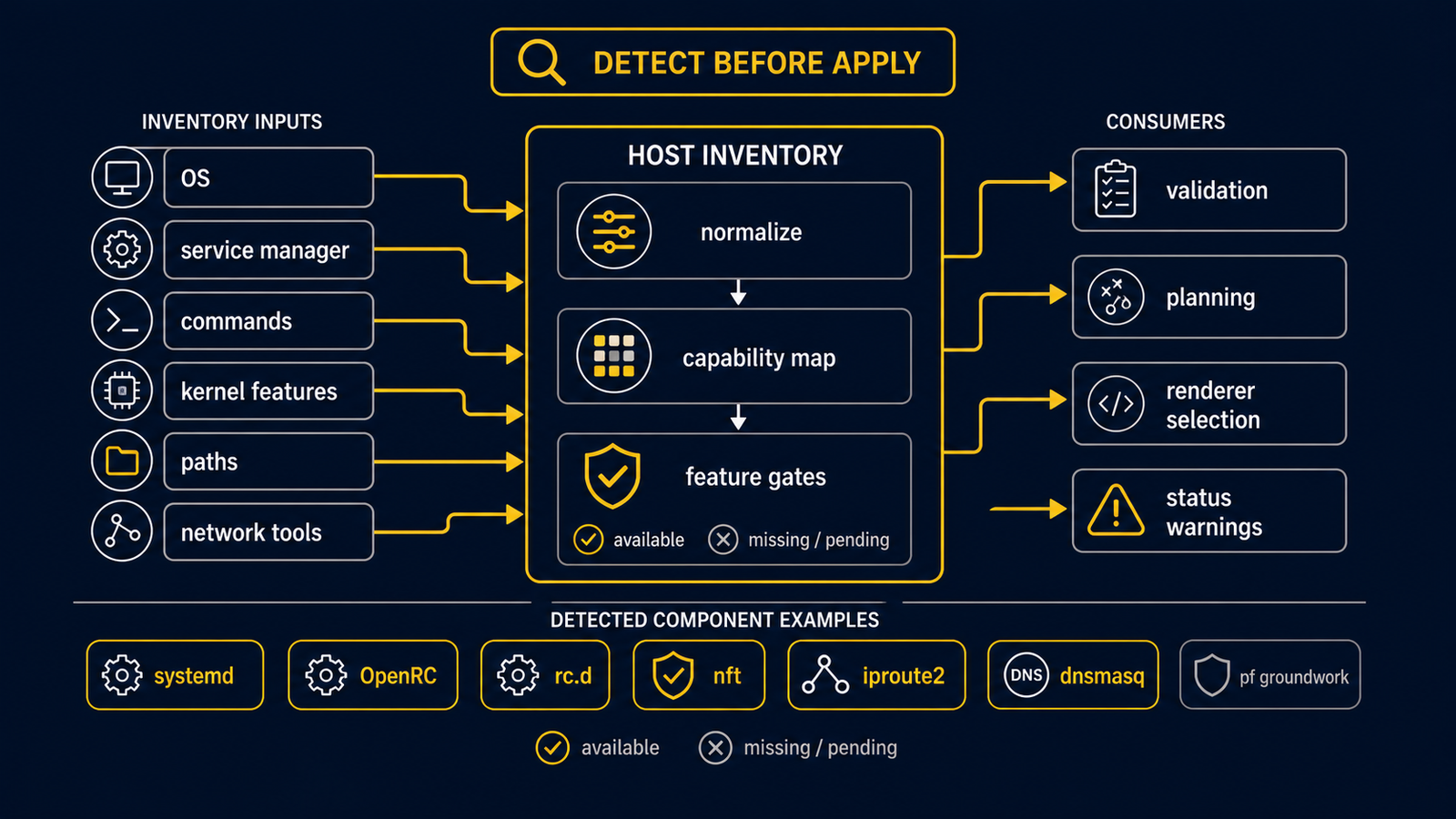
routerd inspects the host's operating system, available commands, and network features. This inventory is used by the renderers and the apply path to make OS-specific decisions explicit instead of failing at runtime.
What routerctl plans
- Operating system and release
- Service-management scheme (systemd, rc.d, NixOS modules)
- Available commands (iproute2, nftables, conntrack, dnsmasq, radvd, pppd, WireGuard, strongSwan, etc.)
- Kernel features (IPv6, VRF, VXLAN, WireGuard)
- Whether
/run/routerdand/var/lib/routerdare usable
How it informs behaviour
- On Ubuntu, routerd targets systemd and the Linux networking stack.
- On NixOS, declarative generation takes priority over runtime mutation.
- On FreeBSD, routerd uses
daemon(8)and rc.d for service control.
If a configuration depends on a feature the host does not provide, routerd reports the gap during validation or planning rather than failing halfway through apply.
Common commands routerd looks for
| Command | Purpose |
|---|---|
ip, bridge | Addresses, routes, DS-Lite, VRF, VXLAN |
nft | NAT, firewall, route marks |
dnsmasq | DHCPv4, DHCPv6, RA |
conntrack | IPv4/IPv6 connection observation |
pppd, ppp | PPPoE |
wg | WireGuard |
tailscale | Tailscale exit-node and subnet-router advertisement |
swanctl | IPsec |
radvd | Optional radvd RA path |
sysctl | Kernel settings |
systemctl, resolvectl, networkctl, journalctl | systemd environment management |
service, sysrc, pfctl | FreeBSD environment management |
dig, ping, ping6, tcpdump, tracepath, traceroute, netstat, sockstat | Diagnostics |