CloudEdge Selective Address Mobility Phase G — detailed implementation guide
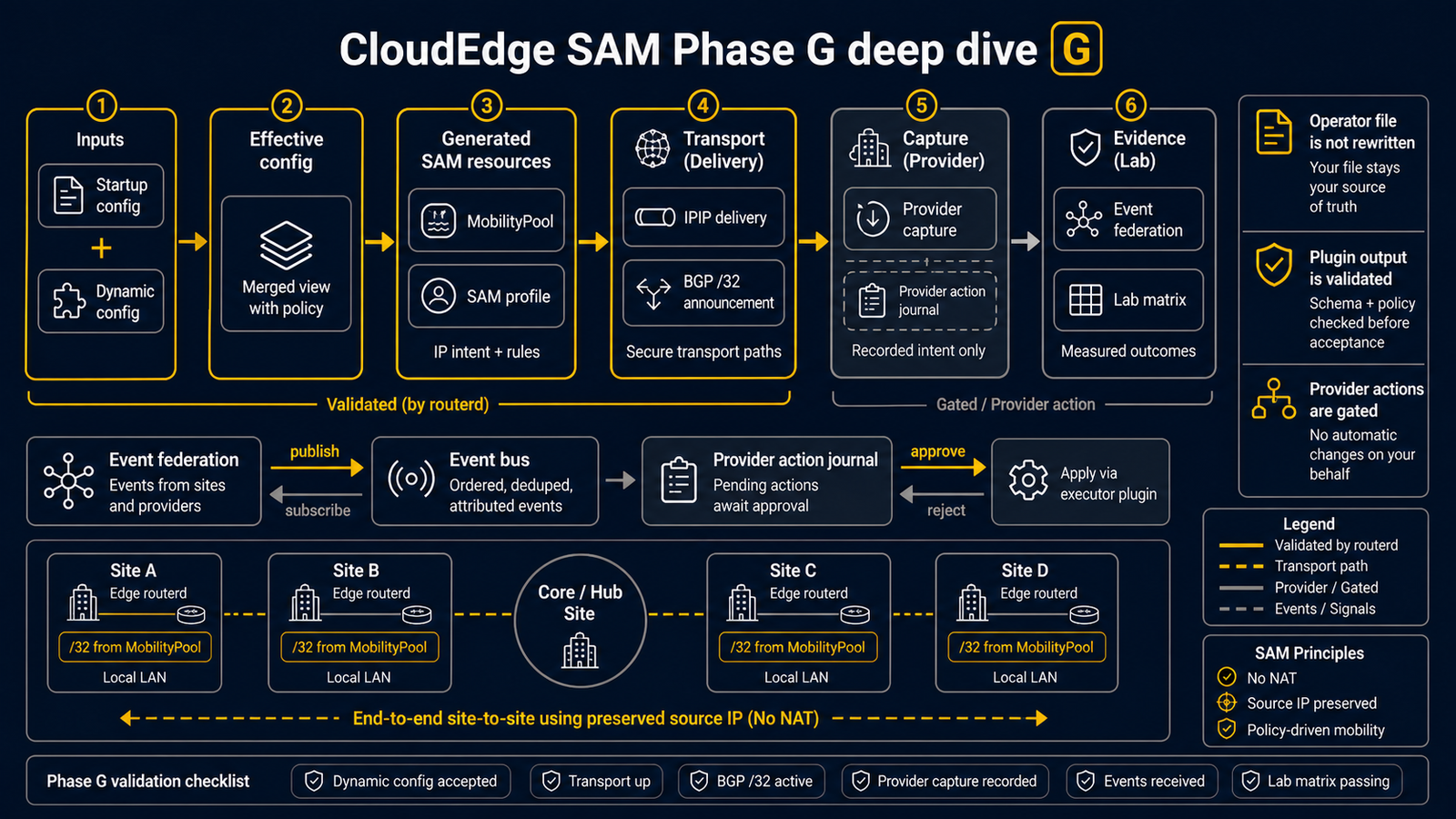
This guide complements the short Phase G overview with the lower-level pieces that operators usually need when explaining or troubleshooting CloudEdge SAM:
- underlay / transport / overlay terminology;
- WireGuard or
TunnelInterfaceencapsulation and the actual inner/outer packet view; - iBGP peers, Route Reflector behavior, BGP
/32ownership, and liveness markers; - RIB-driven traps and provider/on-prem capture realization;
- AWS / Azure / OCI / on-prem implementation differences;
- normal data-plane flow, failover, and endpoint add/remove behavior.
The current Phase G design is clean Option B: BGP is the mobility source of
truth. Older mobility-specific AddressLease, ownershipEpoch, captureEpoch,
heartbeat, and route-lowering planner state were removed from the mainline. They
may still appear in historical ADRs or pre-Phase-G discussions, but they are not
the primary explanation path for current CloudEdge SAM.
1. Layer vocabulary
CloudEdge documents sometimes use “underlay” as shorthand for the transport below the SAM/BGP mobility overlay. In operator conversations it is useful to separate three layers:
| Layer | Meaning | Examples in CloudEdge SAM |
|---|---|---|
| Physical/provider network | The network that actually carries outer packets. | AWS VPC, Azure VNet, OCI VCN, on-prem WAN, Internet, DirectConnect, ExpressRoute, FastConnect. |
| Overlay transport / underlay | The tunnel or transport used by routerd nodes to carry BGP and workload packets over the physical/provider network. | WireGuard by default; TunnelInterface modes ipip, gre, fou, gue over trusted underlays. |
| SAM/BGP mobility overlay | The logical /32 reachability plane. | BGP best-path ownership, liveness marker routes, RIB trap, background provider capture. |
| Workload packet | The actual client/service traffic inside the transport. | src=10.77.60.11, dst=10.77.60.12, protocol TCP/UDP/NFS/RPC/etc. |
When we say “WireGuard underlay” in CloudEdge docs, read it as “the default transport below the SAM/BGP mobility overlay,” not as the physical provider network itself.
2. Overall topology
The validated Phase G demo uses a 4-site topology:
- on-prem acts as the iBGP Route Reflector hub;
- AWS, Azure, and OCI cloud edge routers peer to the on-prem RR over the transport network;
- each site has active/standby routers for local failover;
- selected addresses within the logical pool, for example
10.77.60.10/32through10.77.60.13/32, are advertised and learned as BGP/32paths.
3. BGP ownership plane
The owner of a mobile /32 is the current BGP best path for that prefix.
Operators do not hand-author leases, per-address ownership records, or provider
actions.
routerd projects MobilityPool intent into BGP advertisements and observes the
RIB to decide what to realize locally.
Key points:
- owned service/client addresses are plain IPv4 unicast
/32advertisements; - marker routes identify node liveness and are separate from the owned
/32; - route policy and communities express preference and identity;
- BGP RIB/FIB state is the owner view used by the data plane;
- provider capture actions are fenced by the current BGP mobility path signature.
4. Encapsulation: actual packet view
When one site sends traffic to a remote owner /32, the client packet is not NATed.
It becomes the inner packet carried by the transport.
Example: AWS client .11 talks to Azure owner .12.
Inner workload packet:
  src = 10.77.60.11
  dst = 10.77.60.12
  proto = TCP/22, NFS, RPC, FTP, bulk TCP, etc.

Transport encapsulation:
  WireGuard / GRE / IPIP / FOU / GUE wraps the inner packet.

Outer transport packet:
  src = AWS CER transport/underlay IP
  dst = Azure CER transport/underlay IP
  proto = UDP/51820 for WireGuard, GRE, IPIP, UDP-encap, ...

Provider/physical network:
  AWS VPC / WAN / Azure VNet carries the outer packet.
At the receiving CER:
- The transport packet is decapsulated.
- The inner packet still has
src=10.77.60.11anddst=10.77.60.12. - The destination site delivers it locally through the captured
/32path. - Reply traffic follows the same overlay/BGP decision path in reverse.
5. Capture realization by environment
BGP decides reachability. Provider or on-prem capture makes the selected /32
physically or locally reachable at the correct edge.
| Environment | Capture method | Control/API | Failover movement | Notes |
|---|---|---|---|---|
| AWS | ENI secondary private IP | assign-private-ip-addresses with allow-reassignment behavior | Standby seizes the secondary IP when active marker/path disappears. | Keep ENI permissions and source/dest check behavior consistent. Route-table rejected for same-subnet /32 (#516). |
| Azure | NIC secondary IP via ipConfig or UDR route-table | secondary-ip: delete old holder ipConfig, create new; route-table: UDR NextHopType=VirtualAppliance | Two-step remove/add; retry must handle partial failure. | UDR capture works for same-subnet /32 (limit 1000, #516). Use route-table when secondary-IP count approaches NIC limits. |
| OCI | VNIC secondary private IP | assign-private-ip --unassign-if-already-assigned | Standby reassigns the private IP to its VNIC. | Validate VNIC/private-IP state, forwarding, and local firewall. VCN route-rule rejected for intra-subnet /32 (#516). |
| On-prem | proxy ARP + GARP | OS networking gated by VRRP/CARP-like mastership, or capture.activeWhen.type: single-router for one-site/one-router/one-owner labs | HA pairs use the VRRP master gate; a single-router site can choose always-active capture without VRRP. | Prevent duplicate ARP response; split-brain doctor must fail loudly. |
Provider secondary IP reconciliation is a background fabric-ingress realization. It is important for cloud-native entry paths, but it must not become the source of truth for overlay reachability.
6. Normal communication sequence
Invariants to prove in packet captures:
- client default gateway did not change;
- server sees the original source
/32; - no NAT translation signature appears;
- only selected
/32destinations are absorbed by CloudEdge SAM; - bulk/protocol tests do not blackhole due to MTU/PMTU.
7. Cloud failover sequence
Provider-specific behavior:
- AWS: reassign secondary private IP to standby ENI.
- Azure: remove old ipConfig, create new ipConfig on standby NIC.
- OCI: reassign private IP to standby VNIC with
--unassign-if-already-assigned. - On-prem: VRRP master transition enables proxy ARP/GARP on the new master only.
8. On-prem LAN capture and split-brain safety
BGP can decide the remote overlay path, but it does not by itself protect local L2 ARP authority. On-prem capture therefore remains gated locally.
Rules:
- only master answers proxy ARP for captured
/32addresses; - backup stays fail-closed even if it has the same declarative intent;
- GARP is emitted on master transition to refresh LAN caches;
- in a one-site/one-router/one-owner deployment,
capture.activeWhen.type: single-routeris an explicit always-active proxy-ARP capture mode with no VRRP gate; - duplicate proxy ARP holders are a hard diagnostic failure.
9. Endpoint add/remove and route propagation
The important message propagation is BGP advertise/withdraw, not mobility-specific lease/heartbeat propagation.
New or restored /32
- Local owner becomes eligible and advertises the owned
/32and marker. - The RR reflects the route to cloud/on-prem peers.
- Peers import the best path into their local FIB.
- RIB trap triggers provider/on-prem capture reconciliation if needed.
- Data plane starts forwarding to the new owner path.
Removed or moved /32
- Old owner withdraws the
/32or marker disappears. - BGP best path changes or disappears.
- Stale provider actions are skipped by path-signature fencing.
- New holder advertises and realizes capture.
- All peers converge to the new FIB route or release state.
10. PMTU and protocol transparency
Encapsulation adds overhead. CloudEdge therefore treats PMTU/MSS as a data-plane invariant, not a nice-to-have diagnostic.
EstimateMTUfollows WireGuard orTunnelInterfaceoverhead.routerd_mssclamps TCP MSS to avoid blackholes.- IPv4 force-fragment is available for trusted paths where DF blackhole mitigation is more important than preserving DF semantics.
- Protocol transparency acceptance should include more than ping: FTP active/passive, NFS, RPC/rpcbind, large TCP bulk, and DF/no-DF PMTU probes.
11. Operational checklist
When explaining or debugging CloudEdge SAM, walk this list:
- Which
/32is the BGP best path owner right now? - Which transport carries the iBGP session and workload packets?
- Can we observe inner and outer packets separately?
- Did the non-owner CER import the
/32best path into the FIB? - Did provider/on-prem capture run under the right authority?
- Are stale provider actions fenced by the current BGP path signature?
- Is on-prem backup fail-closed and split-brain doctor clean?
- Do packet captures prove source preservation and no NAT?
- Do MSS/PMTU probes and bulk protocols pass?
12. Short explanation for humans
CloudEdge SAM is BGP best-path driven /32 mobility. routerd connects sites with a
transport underlay such as WireGuard, learns and advertises selected /32 owners
through iBGP, traps RIB changes, realizes ingress through provider secondary IP or
on-prem proxy ARP/GARP, and carries workload packets without NAT so source IP and
client default gateway behavior stay unchanged.