Provider Action Execution (experimental)
Experimental. This feature is gated, default-off, and under active development. See ADR 0007 for the design and safety rationale.
routerd can drive an approved cloud provider mutation (for example, attaching a secondary IP for Selective Address Mobility) through an executor plugin — without ever holding cloud credentials.
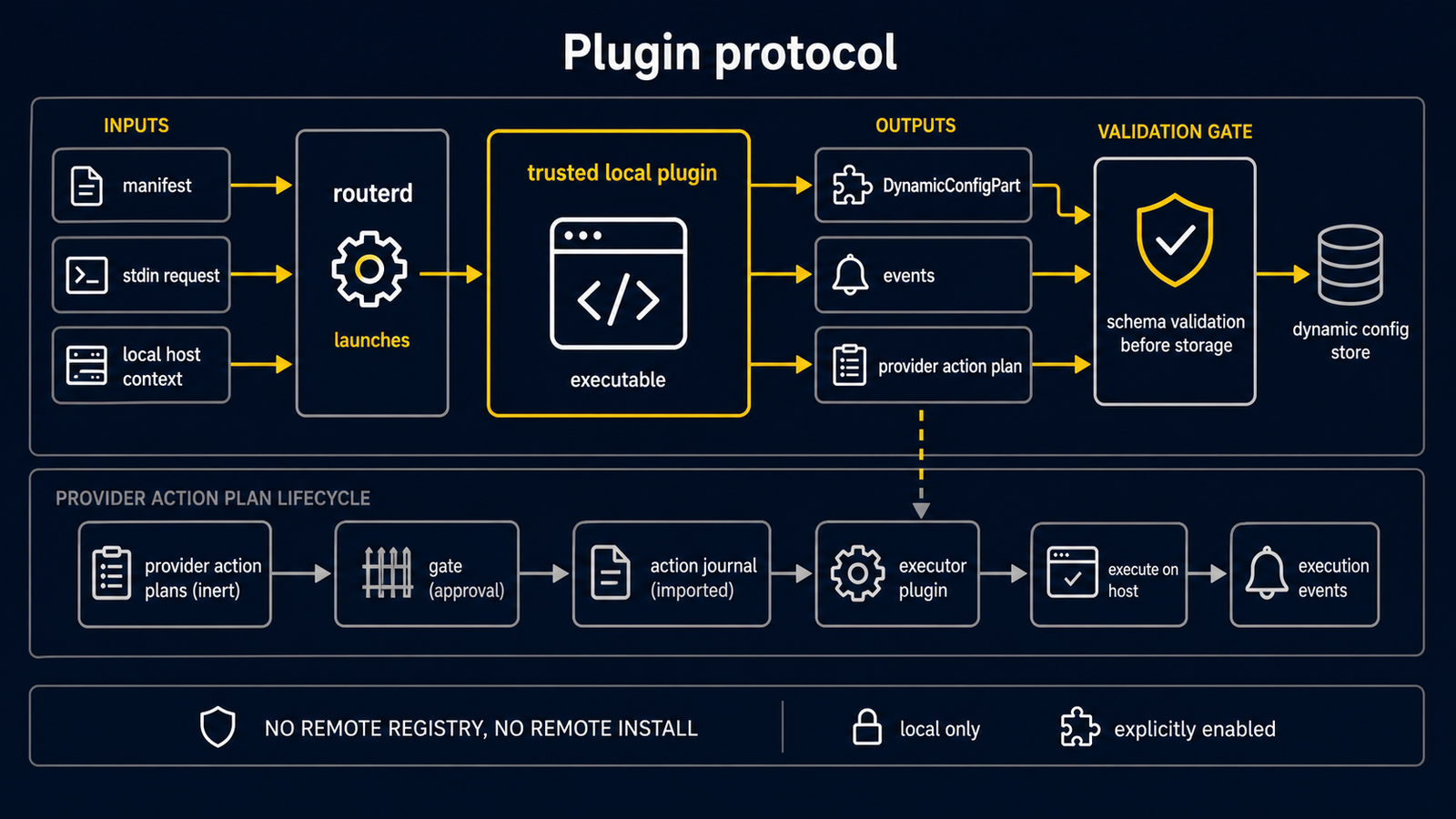
Credential model
- The executor plugin holds the credentials, not routerd. An executor
(capability
execute.providerAction) runs in its own process and authenticates with cloud-native identity (AWS instance profile, Azure managed identity, OCI instance principal) or its own environment. - routerd core never holds, reads, or passes provider credentials. routerd hands the executor only the approved action plan (no secrets) plus the allowlisted, redacted plugin context.
- The
action_executionsjournal records the plan and its outcome only — never any secret.
ProviderActionPolicy
apiVersion: hybrid.routerd.net/v1alpha1, kind: ProviderActionPolicy. The zero
value is the safe locked-down state: execution disabled, dry-run only, approval
required, nothing allowlisted.
| Field | Type | Default | Meaning |
|---|---|---|---|
enabled | bool | false | Execution is disabled unless true. |
dryRunOnly | bool (pointer) | true when omitted | Only dry-run permitted; live mutation rejected. |
requireApproval | bool (pointer) | true when omitted | Operator approval required before execution. |
allowedProviders | list | empty = none | Providers permitted: aws, azure, oci, gcp. |
allowedProviderRefs | list | empty = no restriction | Restrict to named CloudProviderProfile refs. |
allowedActions | list | empty = none | Canonical verbs: assign-secondary-ip, unassign-secondary-ip, assign-route-table-route, unassign-route-table-route, ensure-forwarding-enabled, ensure-forwarding-disabled. |
allowedCIDRs | list | empty = no restriction | Action target address must fall within one CIDR. |
maxActionsPerRun | int | 0 = no actions | Cap on actions per run; set a positive bound to permit any. |
allowUndo | bool | false | Permit best-effort rollback. |
executionWindow | string | empty = no window | Optional time window; validated leniently. |
Example (still locked down except for a single allowlisted action):
apiVersion: hybrid.routerd.net/v1alpha1
kind: ProviderActionPolicy
metadata:
  name: sam-execution
spec:
  enabled: true
  dryRunOnly: false
  requireApproval: true
  allowedProviders: [aws]
  allowedActions: [assign-secondary-ip, unassign-secondary-ip]
  allowedCIDRs: [10.88.60.0/24]
  maxActionsPerRun: 4
  allowUndo: true
Action lifecycle
An action plan proposed by a planner plugin is imported into the journal and moves through these states:
pending  ->  approved  ->  succeeded
                       ->  failed
                       ->  skipped
                            (succeeded) -> rolledBack
- pending — imported from an
actionPlan, keyed byidempotencyKey, awaiting approval. - approved — approved by an operator, or auto-approved by policy
(
requireApproval: falsewithenabledand notdryRunOnly). - succeeded / failed / skipped — the executor's reported outcome.
skippedcovers a duplicateidempotencyKeythat already succeeded, or a policy-declined action. - rolledBack — a best-effort undo was applied to a previously succeeded
action (only when
allowUndois true).
Import is idempotent: re-importing the same idempotencyKey never creates a
second row, so an action that already succeeded is never executed twice.
routerctl action commands
The current operator surface is intentionally journal-oriented: import or approve actions first, then execute only the approved entries that pass policy.
| Command | Purpose |
|---|---|
routerctl action list | List journal entries (filter by status/provider). |
routerctl action show ID | Show one journal entry. |
routerctl action approve ID | Operator approval: pending to approved. |
routerctl action execute --dry-run | Validate and preview; no mutation. |
routerctl action execute --approved | Execute approved actions permitted by policy. |
routerctl action journal | Print the execution journal / audit trail. |
routerctl action rollback ID --dry-run | Preview a best-effort undo (no mutation). |
Dry-run versus execute
- Dry-run is the default and the only path permitted while
dryRunOnlyis true (orenabledis false). It validates the plan, checks the policy, and previews the effect, but makes no provider mutation. - Execute performs the real mutation through the executor, and only when all
hard safety stops are satisfied:
enabled, notdryRunOnly, approved (or policy auto-approve), allowlist match, and withinmaxActionsPerRun.
See ADR 0007 for the full list of hard safety stops.