Cloud Edge SAM transport layering
Cloud Edge SAM should keep address mobility routes out of WireGuard
AllowedIPs.
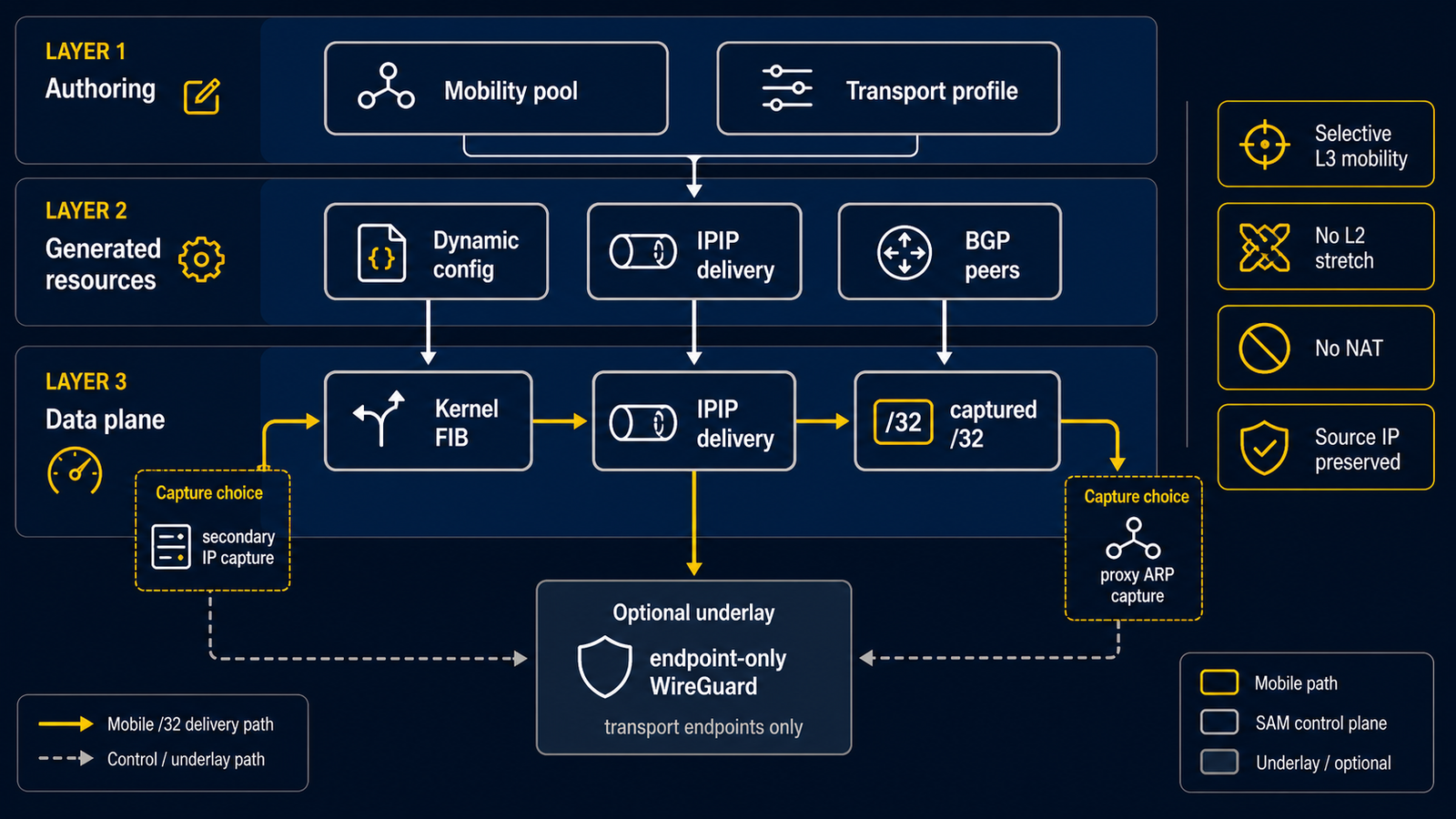
WireGuard treats AllowedIPs as cryptokey routing state. Outbound packets use
the inner destination address to select a peer, and inbound packets are accepted
only when the decrypted inner source address is allowed for that peer. This is
the right behavior for WireGuard, but it conflicts with SAM mobility when BGP,
route reflectors, or ECMP can move a /32 between peers.
Recommended layers
Trusted on-prem or home underlay can use direct IPIP or GRE:
physical underlay
  IPIP or GRE tunnel
    SAM overlay packets
Encrypted transport should keep WireGuard as an endpoint-only layer and put IPIP or GRE above it:
physical underlay
  WireGuard endpoint transport
    IPIP or GRE tunnel
      SAM overlay packets
In that model, WireGuard peers should only contain router-to-router endpoint
prefixes such as 10.252.0.2/32. SAM prefixes such as
192.168.123.10/32 remain in BGP, the kernel FIB, and SAM resources.
Protocol choice
Use IPIP first when SAM carries IPv4 mobility prefixes. It is the default
delivery plane for current SAMTransportProfile examples because it adds the
least tunnel overhead while preserving the separation between WireGuard
cryptokey routing and SAM route mobility. When encryption is required, run IPIP
over a WireGuard interface whose AllowedIPs contain only transport endpoint
addresses.
Use GRE when the deployment needs protocol identification beyond IPv4, a GRE key, or stronger FreeBSD interoperability.
Avoid VXLAN, Geneve, or GRETAP unless L2 semantics are explicitly required. SAM is selective L3 address mobility, so L2 overlay headers are usually unnecessary.
FOU and GUE can help when UDP encapsulation is useful on the physical underlay, but using them inside WireGuard usually adds overhead without improving physical underlay load balancing, because the physical network only sees WireGuard UDP.
Configuration ergonomics
Low-level resources must still support DHCP/IPAM-safe endpoints. A
TunnelInterface should be able to derive local or remote from resource
status so operators do not duplicate DHCP-managed addresses in static config.
When the underlay address is managed outside routerd, such as a live image
DHCP client, use the adopted interface status:
apiVersion: hybrid.routerd.net/v1alpha1
kind: TunnelInterface
metadata:
  name: tun-k8s-rt02
spec:
  mode: ipip
  localFrom:
    resource: Interface/mgmt
    field: primaryIPv4
  remote: 192.168.1.53
  trustedUnderlay: true
primaryIPv4 may include a prefix length, for example 192.168.1.32/24; the
tunnel controller resolves it to the address form required by ip tunnel.
When using an Interface/... status source, the link controller must publish the
interface status into the same state database. Normal routerd serve runs this
controller, but isolated tunnel tests should include both link and tunnel.
Common SAM topologies can use SAMTransportProfile to generate the low-level
TunnelInterface, endpoint /32 route, and BGPPeer resources while preserving
these invariants:
- WireGuard
AllowedIPscontains only transport endpoint prefixes. - SAM mobility
/32s are never injected into WireGuard peers. - IPIP/GRE endpoint addresses can come from DHCP/IPAM-derived status fields.
- MTU and MSS behavior is explicit for each transport mode.
spec.selfNodeRef is required on every router. It is the stable identity used
for deterministic /31 inner address derivation; routerd does not infer it from
hostname or BGP router ID.
addressingMode: edge-index(default) uses the sharedSAMNodeSetnamed byspec.peersFrom. routerd sorts that node set, ranks unordered node pairs, and allocates ranked/31edges frominnerPrefix.addressingMode: pair-stablederives/31slots from a stable hash of each node pair, so an adjacency selector can choose only actual peers (for example RR nodes) without changing the shared node set.
For production fabrics, size innerPrefix with collision probability in mind.
/24 has only 128 /31 slots; with hash+mod allocation this can collide at
modest edge counts. Use /20 or larger where feasible.
SAMNodeSet remains the shared mobility placement and transport topology.
MobilityPool.spec.members contains only the local ownership/capture overlay;
it is not the SAM transport BGP peer topology.
apiVersion: mobility.routerd.net/v1alpha1
kind: SAMNodeSet
metadata:
  name: lab-nodes
spec:
  nodes:
    - nodeRef: pve-rt
      site: pve
      role: onprem
      routeReflector: true
      samEndpoint: 10.99.0.1
    - nodeRef: k8s-rt
      site: k8s
      role: cloud
      samEndpoint: 10.99.0.2
---
apiVersion: mobility.routerd.net/v1alpha1
kind: SAMTransportProfile
metadata:
  name: lab-sam-transport
spec:
  selfNodeRef: pve-rt
  mode: ipip
  innerPrefix: 10.255.1.0/24
  addressingMode: pair-stable
  underlayInterface: wg-hybrid
  localEndpointFrom:
    resource: Interface/wg-hybrid
    field: primaryIPv4
  bgp:
    routerRef: BGPRouter/mobility
    peerASN: 64512
    timersPreset: fast
    # Set these only on route-reflector core routers.
    routeReflectorClient: true
    routeReflectorClusterID: 192.168.1.38
    # A transit RR without a local MobilityPool must state its mobility /32
    # boundary here; generic BGPRouter import policy is not transit authority.
    importPolicy:
      allowedPrefixes: [192.168.123.0/24]
      allowedPrefixLengthMin: 32
      allowedPrefixLengthMax: 32
  peersFrom:
    - resource: SAMNodeSet/lab-nodes
      nodeRefs: [k8s-rt]
SAMTransportProfile has no direct peer or topology list. Keep the full shared
identity and endpoint registry in SAMNodeSet; use nodeRefs only to select
which non-self nodes become transport peers. Omitting nodeRefs selects every
non-self node with a samEndpoint.
A static RR that does not run MobilityPool planning still needs a narrow FIB
authority for leaf-owned routes. The generated RR-client BGPPeer derives that
authority from this profile's explicit /32 import policy plus peer identity;
it does not fall back to the global BGP policy, and validation rejects this RR
role if that explicit policy is absent. Do not create a no-capture
placeholder pool for this role. Use one shared full SAMNodeSet on RR and leaf
profiles with nodeRefs to select hub-spoke adjacency, or use pair-stable
and verify the derived /31 peer addresses before cutover.
The controller writes one DynamicConfigPart per profile and self node. Peer
removal replaces that part with the new generated resource set. Profile deletion
replaces the old part with an empty active part, causing the effective config to
drop generated tunnels, BGP peers, and endpoint routes.
Cleanup then uses the normal lifecycle GC path. The desired set is the effective
view after dynamic SAM generation, so generated transport resources are retained
while the profile exists and become GC candidates only after the profile output
removes them. The generated TunnelInterface, BGPPeer, and IPv4Route
resources keep their own owner/status records and teardown through the generic
GC planner plus resource-specific teardown contracts.
Related issues:
- #194: decouple SAM mobility prefixes from WireGuard
AllowedIPs. - #196: allow
TunnelInterfaceendpoints to come from resource status. - #197: add compact SAM underlay transport profiles.
References:
- WireGuard conceptual overview and cryptokey routing: https://www.wireguard.com/
- Linux tunnel link types: https://man7.org/linux/man-pages/man8/ip-link.8.html
- FreeBSD GRE: https://man.freebsd.org/gre/4